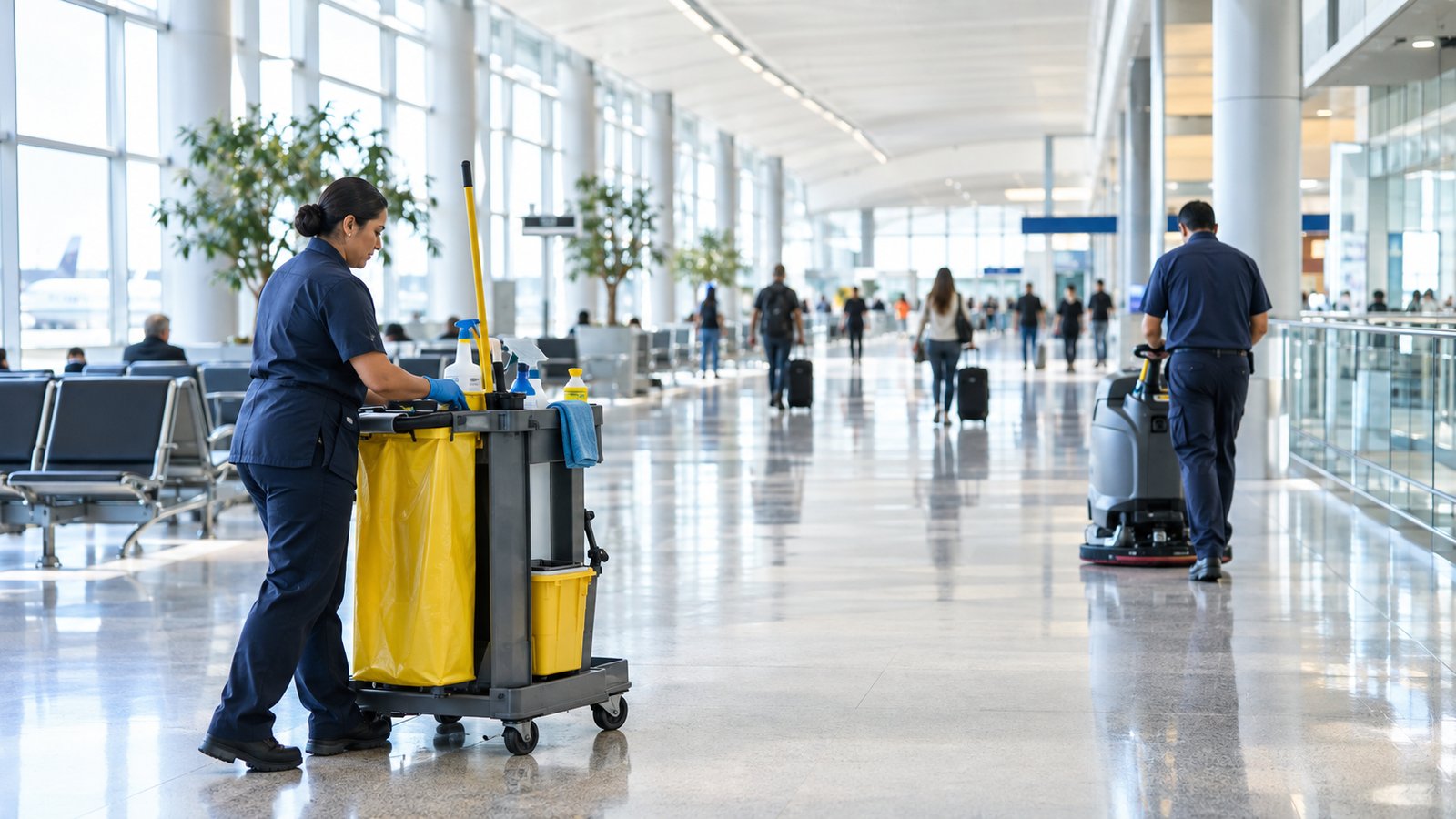
Airport terminals operate continuously, and cleaning quality is visible to travelers at the same time that access, safety, and flight schedules constrain the work. A strong airport janitorial contract defines coverage by terminal zone and time of day, explains how workers are admitted and supervised, and sets clear response targets for spills, restrooms, and passenger surges. GreenPoint Maintenance Services Corp provides commercial cleaning across New York, New Jersey, Connecticut, Pennsylvania, and Florida. Airport work must be coordinated with the airport authority, tenant, security office, and any applicable badging or escort program.
Build the service map around passenger flow
Inventory the public lobby, ticketing and check-in areas, security queues, gates, seating, restrooms, elevators, escalators, moving walkways, food courts, family rooms, nursing rooms, baggage claim, curbside entrances, and staff spaces. For each zone, record access status, peak periods, flight-bank patterns, footfall estimates if available, floor surfaces, waste stations, and the nearest storage point. An arrivals hall next to baggage claim may need a different response plan than a quiet gate corridor. A map makes it possible to assign crews without leaving blind spots between tenant and authority responsibilities.
Define the boundary between common areas, airline-controlled lounges, concessions, restrooms, and airline or airport operations rooms. The contract should name who cleans each boundary and how a complaint is routed when ownership is unclear. GreenPoint Maintenance Services recommends a responsibility matrix that identifies the party for routine service, spill response, deep cleaning, and repairs. It prevents duplicated effort in one zone while another is missed. If a cleaning team cannot enter a secured area, the record should show the restriction and notify the designated airport contact rather than silently marking the task complete.
A map should label passenger-facing doors, checkpoints, service corridors, storage closets, and approved waste routes. Airport authority and tenant maps may not use the same room names, so confirm local identifiers during the walkthrough. Assign a site supervisor to reconcile new construction barriers or temporary gate closures each shift, then communicate the revised assignment before the cleaning team leaves its staging area.
Match staffing to flight banks and service-level targets
A terminal often experiences short periods of intense activity rather than a smooth hourly pattern. Staffing plans should account for early departures, midday arrivals, evening peaks, weather disruption, holiday travel, and overnight construction windows. Restrooms may require scheduled service plus demand-based checks; gate seating and food areas may need rapid spot cleaning after departures. State the number of staff assigned by zone, supervisor coverage, break relief, response time, and the backup plan for absences or irregular operations. Do not rely on a single end-of-shift clean when the public area is in constant use.
The service specification should distinguish routine tasks from surge and event response. For example, it can define who requests additional crews during a diversion, a terminal closure, or a major weather event and how additional scope is authorized. GreenPoint offers fixed pricing for a documented baseline, with changes approved in writing to avoid hidden hourly billing. The buyer can compare staffing assumptions using the [cleaning staffing ratios and square-footage guide](/blog/cleaning-staffing-ratios-square-footage/), then validate them through an on-site walkthrough that observes actual passenger movement.
Ask bidders to show a sample roster that covers meal breaks, sick calls, training, and supervisor relief without leaving a restroom or gate zone unattended. Identify which leader can reassign a worker during irregular operations and which airport representative approves expanded coverage. A short tabletop exercise for a delayed flight bank can reveal whether the communications chain and staffing assumptions are realistic.
Document security, badging, and restricted-area procedures
Airport access is controlled by the airport authority and applicable security program, not by the janitorial vendor alone. The solicitation should state badge eligibility, background checks, training, escort rules, approved entrances, equipment screening, vehicle access, key control, and what workers must do if a badge is lost or a door is found unsecured. Requirements differ by airport and work area, so bidders should not promise a universal credential. GreenPoint coordinates employee onboarding with the customer’s security contact and keeps access instructions specific to the awarded site.
Also identify where carts, chemicals, vacuums, and waste can be staged. Equipment must not obstruct egress, fire equipment, passenger queues, or accessible routes. Chemical storage and transport should follow the airport’s rules, product labels, and employer safety procedures. Review the [commercial cleaning contract key terms](/blog/commercial-cleaning-contract-key-terms/) to structure access responsibilities, incident reporting, and scope changes. GreenPoint can document task completion in JaniTrack, but system records do not replace airport security logs or the authority’s incident-reporting process.
Document the approved entry point, equipment inspection requirements, and who is contacted when an escort is late or a badge does not work. Tell workers not to follow another person through a controlled door or leave a secured entry propped open. Airport-specific training and authorization should be completed before deployment, with refresher steps when a project moves from one terminal or work area to another.
Manage restrooms, spills, waste, and accessibility
Restroom service is one of the most visible and time-sensitive functions. Specify scheduled cleaning, supply checks, fixture inspections, odor and leak escalation, and a process for keeping accessible stalls available when possible. Wet-floor signage and barricades should guide passengers without narrowing routes beyond what the airport permits. Spill response should define who receives calls, how the area is isolated, how contaminated material is handled, and when the surface is reopened. For the ordinary task detail, see [restroom cleaning best practices for high-traffic facilities](/blog/restroom-cleaning-best-practices-high-traffic/).
Waste and recycling need a route that avoids food-service contamination and passenger congestion. Clarify container liner standards, pickup frequency, recycling stream rules, compactor access, and the airport’s approved disposal locations. Accessible paths, tactile surfaces, elevators, and boarding areas should remain passable throughout the shift. New York-area terminals at JFK, LaGuardia, and Newark Liberty serve passengers arriving by AirTrain, subway, bus, taxi, and roadway, so curbside soil and queue patterns vary by terminal. A walkthrough should examine each approach rather than assume a single airport-wide traffic profile.
Coordinate with airport operations on what happens when a restroom is temporarily closed or a spill requires a barrier near a passenger queue. The vendor should know how to request a safe alternate route and how to notify the terminal contact when the area is reopened. Review the procedure for unattended items or suspicious materials with airport security; cleaners should report them through the authorized channel, not move or inspect them.
Measure quality without interfering with airport operations
Define what the airport will inspect: visible litter, restroom condition, floor hazards, supply levels, task logs, response time, and corrective-action closure. A supervisor can use a rotating sample of zones and record the time, location, condition, and re-clean. JaniTrack supports GreenPoint’s service verification with timestamped GPS-tagged photos and a live dashboard where site rules permit. Photography must follow airport privacy and security policies; no image should expose restricted information or capture passengers without authorization.
ATP testing can supplement hygiene monitoring on selected, appropriate surfaces when the customer defines a sampling plan and response thresholds. It does not test for a specific pathogen or prove an area is sterile. The [digital cleaning verification systems guide](/blog/digital-cleaning-verification-systems/) outlines useful reporting questions for buyers. GreenPoint Maintenance Services Corp reports 98% client retention and provides documented service review, but airport buyers should evaluate references, security onboarding, safety documentation, supervisor presence, and the vendor’s ability to cover overnight and irregular operations.
Choose a reporting cadence that fits the airport’s operating rhythm: shift handoff for open hazards, daily summaries for missed tasks, and a monthly review for trends and contractual performance. Each corrective item should show a location, accountable owner, due time, and closure evidence. GreenPoint can make this information available through the JaniTrack dashboard where the airport approves the workflow and the data fields.
Write a bid scope that airport buyers can compare
The RFP should include terminal maps, square footage, zone boundaries, operating hours, flight-bank or occupancy data where available, staffing hours, equipment requirements, consumables, access steps, badging assumptions, required response targets, insurance, and contract term. Separate routine service from periodic floor care, high-level cleaning, construction cleanup, and extraordinary-event work. State who supplies paper goods and liners, where the crew stores equipment, and what happens if an area is closed or a flight delay changes the work window. Use a common pricing workbook so all bidders quote the same assumptions.
Ask for an implementation plan, named account leadership, training and backup coverage, safety records, a sample quality report, and airport or transportation references. GreenPoint Maintenance Services can schedule a walkthrough, document the terminal’s access conditions, and provide a fixed-price proposal with no hourly billing or hidden fees for the agreed scope. Call 347-332-9348 or email info@greenpointms.com to discuss New York, New Jersey, Connecticut, Pennsylvania, or Florida airport facilities. The buyer should confirm all badging and security eligibility directly with the airport authority before award.
The implementation schedule should include contract transition, badge processing, site orientation, equipment approval, test shifts, reporting setup, and a joint acceptance review. Airport procurement should identify which milestones depend on authority approval and avoid promising a service start before access is granted. A phased start by terminal or zone can reduce disruption while the airport verifies that assigned staff understand local procedures.
Frequently asked questions
Q: Does a janitorial contractor provide airport security clearance? A: No. The airport authority controls access, badging, and any required vetting. The contractor can support onboarding and training but must follow the airport’s current process.
Q: How often should airport restrooms be cleaned? A: Specify a baseline schedule based on fixture count and traffic, plus demand checks and a response process for spills or supply shortages. The airport should review performance against actual peak periods.
Q: Can JaniTrack replace airport inspection records? A: No. It can support the contractor’s task and quality documentation, subject to site rules, but it does not replace airport security, safety, or operational reporting systems.
Q: What should be evaluated in an airport cleaning bid? A: Compare staffing by zone and shift, badging assumptions, restroom and spill response, backup coverage, insurance, safety training, service evidence, and clearly priced extra work. Call GreenPoint at 347-332-9348 to schedule a walkthrough.
Seeking an airport terminal cleaning contractor for JFK, LaGuardia, Newark Liberty, or another tri-state facility? Call GreenPoint Maintenance at 347-332-9348 or email info@greenpointms.com to schedule a walkthrough. GreenPoint provides fixed-scope pricing, MBE/MWBE credentials, and JaniTrack service verification, subject to airport access and documentation rules.