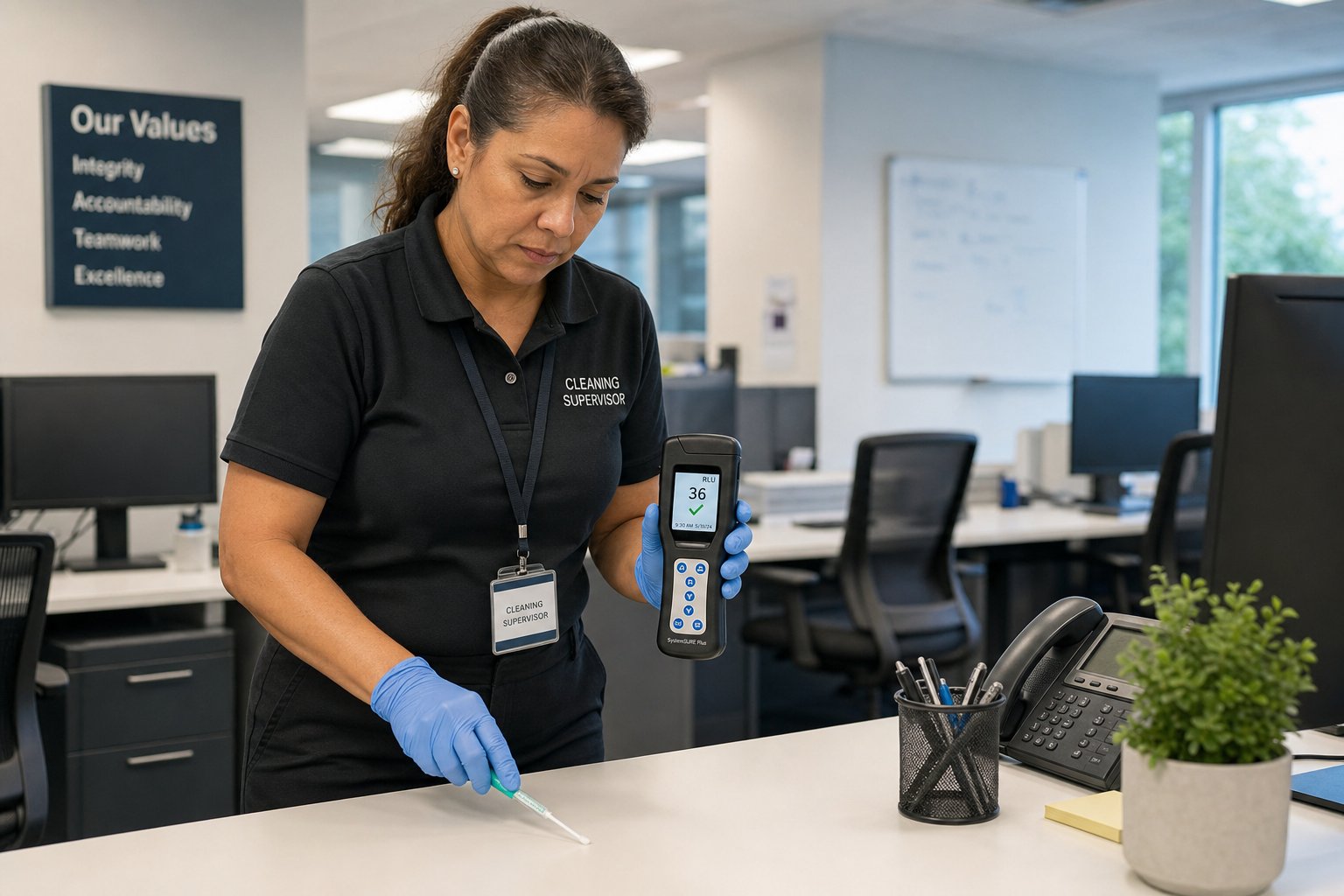
Facility managers are under pressure to prove cleanliness—not just claim it. ATP bioluminescence testing is one of the fastest ways to measure whether a surface was effectively cleaned by detecting organic residue and converting it into a numeric reading (often in RLUs: relative light units). ATP isn’t a direct germ count, but it’s a practical verification tool for high-touch areas, restrooms, breakrooms, and healthcare-adjacent spaces. GreenPoint Maintenance Services uses ATP testing as part of a broader QA program alongside JaniTrack verification (timestamped GPS-tagged photos and live reporting). If you want an ATP-based cleaning verification plan for your NYC, NJ, or CT facility, call 347-332-9348 to schedule a walkthrough.
1) What ATP testing actually measures (and what it does not)
ATP testing detects adenosine triphosphate—a molecule found in living cells and organic residue. The meter measures light output from a chemical reaction and reports a number. Lower readings typically indicate less organic residue. However, ATP does not identify specific pathogens and does not replace targeted microbiological testing. In practice, ATP is best used as a process control tool: did our cleaning method consistently remove residue from defined surfaces? GreenPoint uses it to validate technique and train teams, not to create false certainty.
2) Where ATP adds the most value in commercial buildings
ATP is most useful on high-touch, high-soil surfaces where visual inspection is unreliable: restroom fixtures, breakroom counters, door handles, elevator buttons, shared equipment, and touchscreens. It also adds value in environments where stakeholders demand objective evidence: schools, medical offices, and high-traffic offices. If you’re developing a verification program beyond ATP, this overview can help: [Digital cleaning verification systems](/blog/digital-cleaning-verification-systems/). GreenPoint combines ATP with JaniTrack photo documentation so you can see both the numeric trend and the work completed.
3) Sampling strategy: why 10 random swabs are less useful than 10 consistent swabs
ATP works best when you sample the same surfaces the same way over time. Choose 8–12 "sentinel" surfaces per site (e.g., one sink faucet, one toilet flush handle, one breakroom counter section, one elevator call button panel, one conference table edge). Swab the same area size each time and test at consistent times (e.g., immediately after cleaning). GreenPoint builds a sampling map so results are comparable and defensible when questions arise.
4) RLU thresholds: set targets based on baseline, surface type, and risk
A common mistake is adopting a generic "pass number" without context. Different meters and swabs have different scales, and porous or textured surfaces can read differently than smooth stainless. A practical approach is: baseline the site, set improvement targets, then tighten thresholds as the program stabilizes. In higher-risk areas (restrooms, breakrooms, medical-adjacent spaces), use stricter internal targets and more frequent sampling. GreenPoint can help define thresholds that are realistic and that drive better technique rather than gaming the metric.
5) How often should you test? (and how to avoid creating noise)
During onboarding or after service changes, test weekly for 4–6 weeks to stabilize technique. Once performance is consistent, monthly sampling is often enough to maintain control, with additional tests after complaints or events (illness spikes, high-traffic events). If you want a broader QA cadence, pair ATP with structured inspections: [Cleaning audit checklist for facility managers](/blog/cleaning-audit-checklist-facility-managers/). GreenPoint uses ATP as a targeted audit tool, not as a daily burden.
6) Cost planning: what ATP testing typically costs in a commercial program
ATP programs have three cost components: equipment (meter), consumables (swabs), and labor (sampling and reporting). For many facilities, the ongoing cost is dominated by swabs and labor, so the smartest design uses a small, consistent sample set rather than large random batches. A well-run ATP program is inexpensive compared to the cost of rework, complaints, and reputational damage. GreenPoint can bundle ATP sampling into a fixed-price QA plan so it’s predictable. Call 347-332-9348 for a walkthrough and a testing plan quote.
7) ATP and disinfection: cleaning first, then disinfecting (in the right situations)
ATP results usually improve most when cleaning technique improves—especially pre-cleaning. Disinfection is not a substitute for removing residue. If your facility requires scheduled disinfection (healthcare-adjacent, outbreak response, or specific policy), align the process with EPA label directions and contact time. For a practical explanation of cleaning versus disinfection, see: [Scheduled disinfection vs routine cleaning](/blog/scheduled-disinfection-vs-cleaning-difference/). GreenPoint designs workflows that prevent "spray and pray" and instead focus on correct sequencing.
8) How to use ATP results to train teams without blame
ATP is most effective as a coaching tool. When a surface fails a threshold, treat it as a process problem: was the right chemical used, was dwell time respected, was the wipe technique correct, was the cloth clean, was the surface textured? Build micro-training based on the most common failure points. GreenPoint’s retention-focused management style prioritizes training and consistent processes, which is part of why our client retention is high.
How ATP differs from visual inspection and microbial culturing
Visual inspection answers 'does it look clean?' Microbial culturing answers 'is this pathogen present?' ATP bioluminescence answers a different question: 'how much organic residue is on this surface right now?' That residue—from food, body fluids, dust, biofilm—is what microbes feed on, so high ATP readings are a leading indicator of contamination risk even when no specific pathogen is present. The three tools are complementary: visual inspection for everyday QC, ATP for ongoing process verification, and microbial culturing for outbreak investigation or compliance in healthcare/food-service settings. GreenPoint Maintenance Services uses ATP as the standard verification layer on every healthcare, education, and food-handling account. For background on appearance standards specifically, see [ISSA clean standards: appearance levels](/blog/issa-clean-standards-appearance-levels/).
RLU thresholds: what numbers actually matter on real surfaces
ATP is reported in Relative Light Units (RLU), and thresholds depend on both the manufacturer’s scale and the surface type. Industry-standard pass/fail thresholds GreenPoint uses across tri-state facilities: high-touch surfaces in healthcare (door handles, bed rails, IV poles, switches) <100 RLU; classroom desks and high-touch surfaces in K-12 <250 RLU; restroom fixtures and stall hardware <500 RLU; kitchen prep surfaces <30 RLU (food-handling has the strictest threshold by far). Anything above 1,000 RLU is a clear fail regardless of surface type and indicates either missed cleaning or ineffective product/process. These thresholds align with CDC and AHE guidance on environmental hygiene monitoring.
Where to swab, when to swab, and how often
Random ATP sampling produces unreliable trends. The right approach is structured: define 8-12 'sentinel' surfaces per facility (high-touch, high-consequence) and test them on a fixed rotating schedule—usually monthly. Within each visit, swab using consistent technique: a 10cm x 10cm area, swabbed in two perpendicular directions, immediately after the surface is supposed to be clean (not before, not hours later). Document the surface, time, swabber, and result in a single log so trends can be analyzed over months. GreenPoint Maintenance Services delivers ATP results in the JaniTrack dashboard alongside the photo log for the cleaning visit that should have addressed the surface—so a high RLU is immediately tied to a specific cleaning event for accountability.
When an ATP test fails: troubleshooting in the right order
A failed ATP reading isn’t automatically a sign of bad cleaning—there are five possible causes and they should be checked in order: (1) Sampling error—swab held too briefly, surface still wet, contaminated swab; re-test; (2) Surface incompatibility—some materials (porous wood, certain plastics) give artificially high readings even when clean; (3) Product mismatch—the wrong chemical for the soil type (e.g. quat against heavy organic soil); (4) Process error—missed the surface, insufficient dwell time, single-pass instead of two-pass; (5) Frequency miss—the surface needs to be cleaned more often than the schedule provides. About 60% of ATP failures in our data trace to process or frequency issues, not chemical or staffing—which is good news because both are fixable without spending more money. For chemical selection guidance, see [OSHA cleaning chemical safety: GHS/SDS](/blog/osha-cleaning-chemical-safety-ghs-sds/) and [EPA disinfectant registration guide](/blog/epa-disinfectant-registration-guide/).
Cost and tooling: what a real ATP program costs
An ATP luminometer (the reader) costs roughly $1,200-$2,500; individual test swabs run $2-$5 each. For a typical commercial facility doing 10 surfaces monthly, the annual consumable cost is $240-$600—negligible relative to the cleaning contract. GreenPoint Maintenance Services includes ATP testing and reporting in standard tri-state healthcare, education, and food-handling contracts at no additional charge. For office and standard commercial contracts, we include ATP testing on request, typically at $75-$150 per visit depending on scope. For the broader case on digital verification, see [digital cleaning verification systems](/blog/digital-cleaning-verification-systems/).
Common ATP mistakes that produce misleading data
Three mistakes invalidate roughly half the ATP programs we audit when taking over a new account: (1) Swabbing wet surfaces—residual water dilutes the sample and gives falsely low RLU; wait until surface is dry; (2) Inconsistent swabber—different people apply different pressure and area; one trained tester per facility; (3) Sample timing—swabbing 4 hours after cleaning measures re-soiling, not cleaning effectiveness; sample within 30-60 minutes of the cleaning event. Fix these three and the data becomes a reliable basis for SLA enforcement and continuous improvement. To set up a verification program at your facility, call GreenPoint Maintenance Services at 347-332-9348.
FAQ: ATP bioluminescence testing
Q: Does ATP prove a surface is disinfected? A: No. ATP indicates organic residue level, not specific pathogen kill. It’s best used to verify cleaning effectiveness. Q: What surfaces should we swab? A: Choose consistent, high-touch sentinel surfaces: restroom fixtures, breakroom counters, elevator buttons, door hardware, and shared equipment. Q: How many swabs do we need? A: Often 8–12 per site per audit cycle is enough if they’re consistent and tied to a training/QA plan. Q: Will ATP reduce complaints? A: It can, because it makes quality measurable and helps teams correct technique before problems become visible or smelly. Q: Can GreenPoint provide ATP testing as part of our service? A: Yes. We can include ATP sampling and reporting in a fixed-price QA program with JaniTrack documentation.
Want measurable cleaning verification? GreenPoint Maintenance Services can implement ATP testing with a smart sampling plan, clear thresholds, and reporting through our QA process—paired with JaniTrack timestamped photo verification. Call 347-332-9348 or email info@greenpointms.com to schedule a walkthrough.