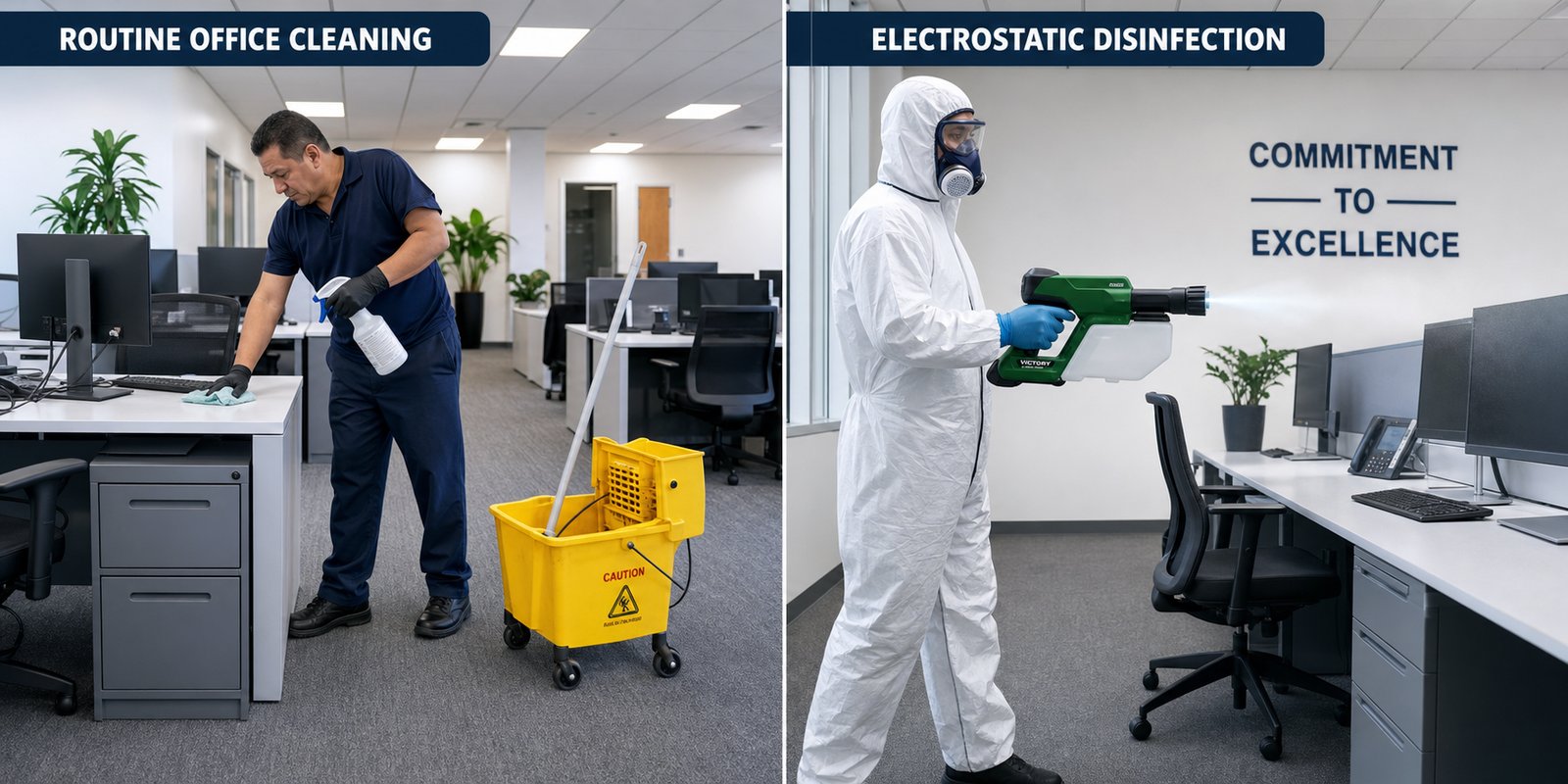
If you’re searching for "disinfection service NYC" or asking your vendor about "cleaning vs disinfection," you’re already ahead of most facility teams: the two are not interchangeable. Routine cleaning is about removing soil (dust, oils, debris) so your space looks and feels maintained; scheduled disinfection is about reducing pathogens on high-touch surfaces and specific risk zones using products with verified kill claims and the correct contact time. GreenPoint Maintenance Services builds both into a single, proof-driven program—so you can show stakeholders what was done, when, and with what result. For a walkthrough and fixed-price quote, call 347-332-9348.
Routine cleaning vs scheduled disinfection: plain-English definitions
Routine cleaning focuses on appearance and soil removal: vacuuming, mopping, trash removal, restroom detailing, and wipe-down of typical touchpoints. Disinfection is a targeted process that uses an EPA-registered disinfectant on specific surfaces for a specified wet dwell time (contact time) to inactivate germs. In practice, disinfection fails when a surface is dirty (soil blocks chemistry) or when the disinfectant dries too quickly to meet its label contact time. GreenPoint separates these steps intentionally: clean first, then disinfect the priority surfaces on a schedule tied to real risk and traffic patterns.
What ‘contact time’ means (and why it’s where most programs break)
Disinfectants don’t work by being sprayed and immediately wiped off. Each product has a label-defined contact time—often 1 to 10 minutes—during which the surface must stay visibly wet. That’s why "spray-and-wipe" routines often deliver a false sense of protection. A high-quality program trains techs to apply enough product to keep surfaces wet, avoid incompatible materials (some finishes and electronics need special handling), and document the method. GreenPoint’s approach pairs high-touch mapping with verification so you can demonstrate compliance in audits and tenant communications. Call 347-332-9348 to discuss a schedule that fits your building’s occupancy and risk profile.
When routine cleaning is enough (and when it isn’t)
For many low-traffic professional offices, consistent routine cleaning plus daily high-touch wipe-downs can be sufficient most of the year—especially when sick-season absence rates are low and your HVAC/filtration is strong. But "enough" changes quickly when you have shared conference rooms, high visitor volume, breakrooms, open pantries, coworking-style hot desking, or public-facing reception areas near transit hubs. In Midtown and Downtown Manhattan, for example, buildings adjacent to Penn Station, Port Authority, Grand Central, Fulton Center, or major ferry terminals often see higher hand-contact load on door hardware and elevator call buttons—exactly where scheduled disinfection adds measurable value. GreenPoint Maintenance Services recommends baselining your program with a walkthrough and then adding disinfection where it actually moves the risk.
What a ‘scheduled disinfection’ plan looks like in tri-state facilities
A practical disinfection plan is not "everything, every night." It is a set of defined zones, surfaces, products, and cadences. Common patterns we deploy across NYC, North Jersey, and Connecticut include: (1) daily disinfection of restrooms and pantry touchpoints; (2) 2–3x/week disinfection of elevator cabs, lobby touchpoints, and shared meeting rooms; and (3) a weekly "reset" disinfection pass aligned to your busiest days. For multi-tenant buildings near high-traffic corridors (e.g., Flatiron, Hudson Yards, Long Island City, Downtown Brooklyn, and Jersey City waterfront), we often add a mid-day high-touch refresh to reduce peak-hour accumulation. To price this fairly, GreenPoint uses fixed pricing—no hourly billing and no hidden fees—based on square footage, surface count, and occupancy patterns.
High-touch mapping: the surfaces that drive outcomes
The best ROI comes from disinfecting surfaces people touch constantly, not the ones that merely look large. Typical "high-touch" lists include: elevator buttons and handrails; door push plates, pull handles, and panic bars; reception counters; shared printers and copy rooms; breakroom appliance handles; faucet handles; soap dispensers; stall latches; and conference room table edges. In healthcare-adjacent facilities (urgent care, dental, PT/OT), that list expands to waiting room armrests and patient-contact surfaces. If you’re building a program, cross-reference your cleaning scope with verification methods described in [digital cleaning verification systems](/blog/digital-cleaning-verification-systems/) and measurement tools like [what is ATP bioluminescence testing](/blog/what-is-atp-bioluminescence-testing-cleaning/). GreenPoint uses that same evidence-first mindset for disinfection so results are not "trust us"—they’re documented.
How GreenPoint proves it: JaniTrack verification + optional ATP testing
Disinfection is only valuable if it actually happened, to spec, on the correct surfaces. GreenPoint’s JaniTrack system provides timestamped, GPS-tagged photos and a live dashboard so property managers and facility directors can verify critical tasks—especially in multi-shift buildings or after-hours environments. For higher-risk accounts, we can layer ATP testing (a fast surface cleanliness indicator) to confirm whether cleaning steps are removing organic residue before disinfection. The combination reduces missed touchpoints and supports 98% client retention because expectations are clear and performance is visible. If your current vendor can’t show proof, schedule a walkthrough with GreenPoint Maintenance Services at 347-332-9348.
Costs and cadence benchmarks facility teams can use (without hourly billing)
Budgeting is easier when you translate "disinfection" into measurable workload: number of touchpoints, number of restrooms, and occupancy cycles. As a starting benchmark for many office environments, routine nightly cleaning often aligns to staffing ratios discussed in [cleaning staffing ratios and square footage](/blog/cleaning-staffing-ratios-square-footage/), while disinfection is best treated as a defined add-on scope with a clear touchpoint list and cadence. The cost driver is not chemical—it's labor time to keep surfaces wet for the required contact time and to avoid recontamination during wipe-off. GreenPoint’s fixed-price proposal breaks out routine cleaning and scheduled disinfection as separate line items so you can dial frequency up in flu season and down when occupancy drops—without surprise invoices. Call 347-332-9348 to get a facility-specific range.
Cleaning, sanitizing, and disinfecting: the three terms most facility managers conflate
Cleaning, sanitizing, and disinfecting are not synonyms—each describes a different process, with different products, dwell times, and verification. Cleaning physically removes soil, dust, and organic residue with detergent and friction. Sanitizing reduces microbial load to a level considered safe by public-health standards (typically a 99.9% reduction on food-contact surfaces). Disinfecting kills a defined list of pathogens at the percentage stated on the EPA registration (typically 99.999% or 'six-log' kill for hospital-grade products). Skipping the cleaning step renders disinfecting nearly useless because organic soil shields microbes from the chemical. This is the single most common process error in commercial facilities—and one of the easiest to fix once a written SOP is in place. GreenPoint Maintenance Services structures every account around a three-stage protocol: clean first, sanitize where required, disinfect where required. For deeper background on registered products, see [EPA disinfectant registration guide](/blog/epa-disinfectant-registration-guide/).
How to decide what your facility actually needs by surface and zone
Not every surface in a facility needs disinfection every day. A reasonable, evidence-aligned framework: (1) High-touch shared surfaces in healthcare, K-12, daycare, and food handling—disinfect daily with EPA List N products; (2) High-touch surfaces in general office and retail—disinfect 2-3x weekly during normal seasons, daily during respiratory virus surges or active outbreak; (3) Common-area floors, walls, ceilings—clean and sanitize; disinfect only after contamination events; (4) Private offices and low-touch desks—clean and sanitize on the regular schedule. Layering this way controls cost, reduces chemical exposure for occupants, and focuses disinfection where it actually changes infection risk. GreenPoint Maintenance Services builds this zoning into every commercial scope at no extra charge—it is just the right way to run the program. Call 347-332-9348 to request a free zoning walkthrough for your facility.
Dwell time, contact time, and why a quick wipe doesn’t disinfect
Every EPA-registered disinfectant has a contact time printed on the label—usually 1, 3, 5, or 10 minutes. That is how long the product must remain visibly wet on the surface to deliver the kill claim. Wiping immediately after applying is the most common in-the-field failure, and it converts a disinfectant into a glorified surface cleaner. Three practical rules GreenPoint Maintenance Services trains every crew on: (1) apply product first, do something else for the dwell time, then wipe; (2) use enough product that the surface stays wet through the full dwell time—particularly on porous textured surfaces; (3) never mix disinfectants with detergents or other disinfectants, which can neutralize the active ingredient. These three rules alone close the gap between 'we disinfected' and 'the EPA kill claim actually applied.' For more on chemical safety, see [OSHA cleaning chemical safety: GHS/SDS](/blog/osha-cleaning-chemical-safety-ghs-sds/).
When electrostatic disinfection makes sense (and when it’s overkill)
Electrostatic spray application charges disinfectant droplets so they wrap around surfaces and adhere to undersides and back edges that manual wiping misses. It is genuinely useful in three scenarios: post-outbreak terminal disinfection, fitness facilities and locker rooms with high surface complexity, and large open spaces like cafeterias and waiting rooms where surface counts are high. It is overcooked—and a waste of money—when applied as a daily process in standard office space, or when the underlying cleaning step is being skipped. GreenPoint Maintenance Services offers electrostatic application as a scheduled add-on (typically weekly or monthly for hospitality, healthcare, and education) and as a one-time response for outbreak situations. For an honest breakdown of the technology, see [electrostatic disinfection explained](/blog/electrostatic-disinfection-explained/).
Verification: how to know the disinfection actually worked
A facility that disinfects but doesn’t verify has no idea whether the program is working. The two practical verification tools: ATP bioluminescence testing for organic residue (validates that cleaning preceded disinfection), and visual inspection plus photo log for process compliance. Healthcare and food-handling settings often add periodic microbial culturing on sentinel surfaces. GreenPoint Maintenance Services includes JaniTrack photo verification on every account and ATP testing in healthcare, education, and food-service contracts as standard practice. Without verification, you are paying for a process you can’t confirm. For the full picture on ATP, see [what is ATP bioluminescence testing in cleaning](/blog/what-is-atp-bioluminescence-testing-cleaning/).
Cost comparison: cleaning, sanitizing, disinfecting per 1,000 sq ft
Approximate tri-state cost benchmarks per 1,000 sq ft per service: routine cleaning $30-$70, sanitizing add-on (food-contact zones) $10-$25, hospital-grade disinfection of high-touch surfaces $35-$80, electrostatic full-room disinfection $40-$120. These layer—you do not pay for all four separately on every visit. A typical Class A office in Manhattan running daily cleaning plus 3x weekly high-touch disinfection runs $0.10-$0.16 per square foot per month all-in. GreenPoint Maintenance Services quotes fixed monthly pricing with no hourly billing—budget certainty is part of the model. Schedule a walkthrough at 347-332-9348.
FAQ: cleaning vs disinfection for commercial buildings
Q: Is ‘sanitizing’ the same as disinfecting? A: Not exactly. Sanitizing reduces germs to a public health standard, while disinfecting is intended to inactivate a broader range of pathogens per the product label; the right choice depends on your facility type and risk. Q: Can you disinfect without cleaning first? A: It’s risky. Soil and organic residue can block disinfectant chemistry, which is why GreenPoint sequences clean-then-disinfect for high-touch surfaces. Q: Do I need scheduled disinfection if my building has good HVAC? A: Better ventilation helps, but high-touch surfaces are still a transmission pathway; a targeted plan focuses on the most-touched areas rather than over-treating the entire space. Q: How often should elevator buttons be disinfected? A: In high-traffic buildings, daily is common, with additional mid-day refreshes when tenant traffic spikes (commute peaks, lunch periods, event days). Q: How do we prove it to tenants or executives? A: Use documented checklists and verification—GreenPoint provides JaniTrack proof (timestamped photos and dashboard), and ATP testing can be added for objective spot checks. Q: What should I ask a disinfection vendor before signing? A: Ask about EPA registration, label contact time, surface compatibility, training, scope definition (touchpoint list), and verification; you can also use the vetting framework in [how to choose a commercial cleaning company](/blog/how-to-choose-commercial-cleaning-company/).
Want a cleaning + scheduled disinfection program you can actually prove? GreenPoint Maintenance Services delivers fixed-price scopes, JaniTrack verification (timestamped, GPS-tagged photos), and optional ATP testing to validate results. Call 347-332-9348 or email info@greenpointms.com to schedule a walkthrough and get a quote within 24–48 hours.