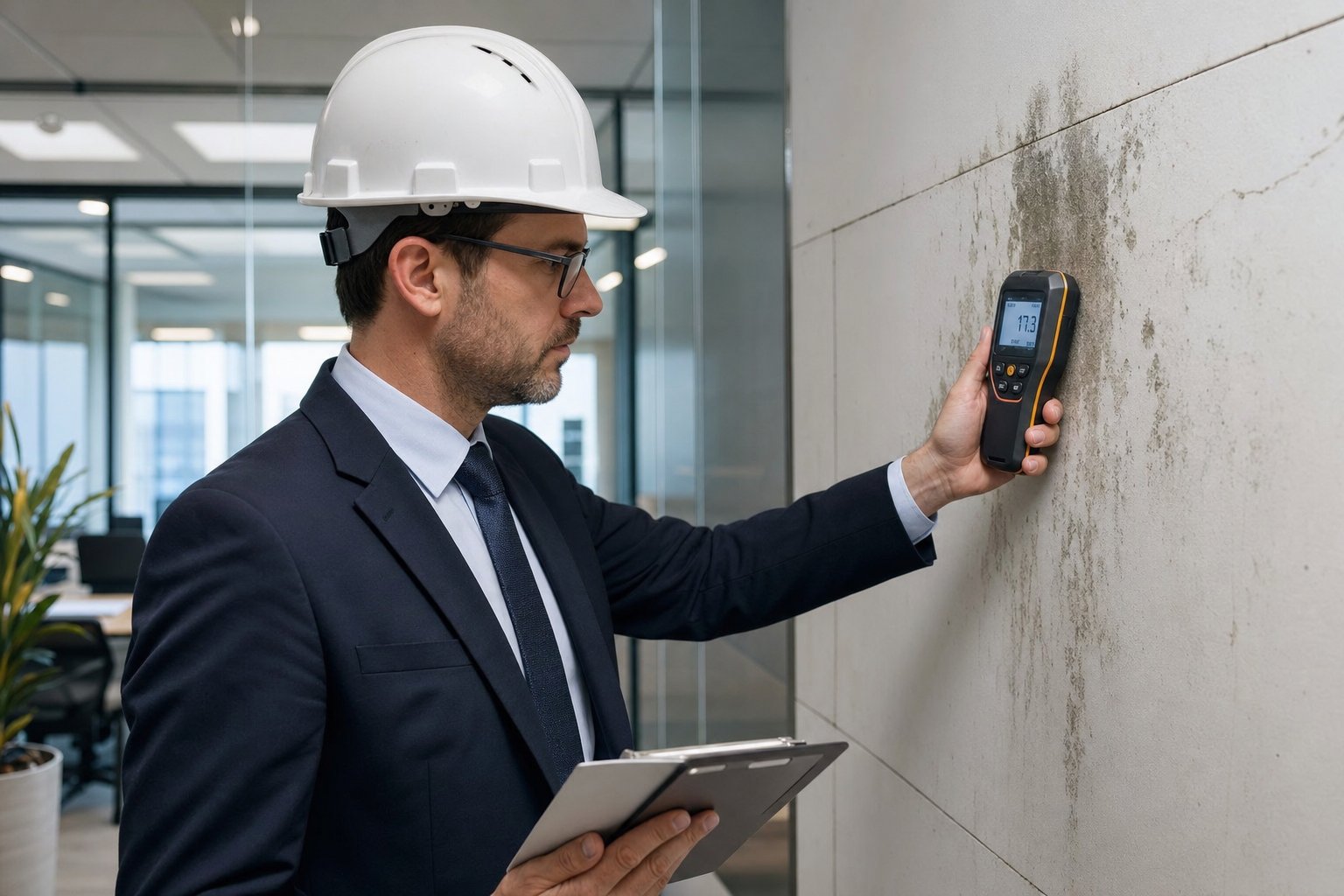
If you’re typing "mold remediation vs cleaning" into Google, you’re likely looking at visible growth, musty odors, or recurring stains near HVAC vents, window sills, or a prior leak. The hard truth: many ‘mold cleaning’ responses are well-intentioned but create liability by spreading spores, disturbing contaminated materials, or ignoring the moisture source. GreenPoint Maintenance Services is a commercial cleaning partner—we can support safe cleaning where appropriate and help facilities coordinate with qualified remediation when the situation crosses the line. The key is knowing where that line is and documenting the decision. For a walkthrough and vendor guidance, call 347-332-9348.
The key difference: cleaning removes soil; remediation controls a contaminated environment
Cleaning is typically a surface process: wipe, scrub, remove residue, and restore appearance on non-porous surfaces. Remediation is an environmental control process: contain the work area, protect occupants, prevent spore spread, remove or treat affected materials, and address the moisture condition that allowed growth. In commercial buildings, the consequences of getting this wrong include tenant complaints, employee health concerns, and building-owner disputes. GreenPoint’s role is to keep your facility maintained with documentation and to help you escalate to remediation when the scope requires specialized containment and material handling.
The ‘10 square feet’ rule of thumb—and why size isn’t the only factor
A common benchmark in industry guidance is that small areas (often cited around 10 square feet) may be manageable with careful cleaning practices, while larger areas generally require more formal containment and remediation procedures. But size alone is not the whole story. A small patch on drywall can signal a hidden moisture problem behind the wall; a small growth area in a mechanical room can be tied to recurring condensation and HVAC issues. The decision should consider: material type (porous vs non-porous), location (occupied space vs back-of-house), whether HVAC is involved, and whether the source of moisture is controlled. GreenPoint recommends a walkthrough to assess these variables before any aggressive cleaning is attempted.
When routine cleaning can be appropriate (and safe)
Routine cleaning may be appropriate when the suspected growth is on a non-porous surface (e.g., tile, sealed metal, glass) and the moisture source is resolved. Examples include: light mildew on restroom tile grout due to ventilation issues that were fixed, or surface spotting on sealed window frames after a one-time leak that has been repaired. Even then, the cleaning method matters: use proper PPE, avoid dry brushing that aerosolizes particles, and manage runoff so you don’t spread contamination. GreenPoint can integrate these tasks into a quality-assurance program with verification similar to what we outline in [quality assurance commercial cleaning program](/blog/quality-assurance-commercial-cleaning-program/).
Red flags that mean you should call a remediator, not a cleaner
Escalate to a qualified remediation contractor when you see any of the following: (1) growth on porous materials (drywall, ceiling tiles, insulation, carpet pad); (2) recurring growth after ‘cleaning’; (3) evidence of water intrusion that is not fully repaired; (4) HVAC involvement (growth in diffusers, insulation, or inside air-handling components); or (5) occupant complaints that suggest exposure concerns. In tri-state commercial real estate, these scenarios often arise after façade leaks, cooling-coil condensation, or roof/pipe failures—especially in older NYC building stock and along coastal humidity zones on Long Island and New Jersey. GreenPoint can help you stabilize the space, increase HEPA filtration cleaning protocols, and coordinate a safe handoff to remediation rather than risking a "wipe-and-pray" approach.
Documentation: how to protect your facility team and ownership
Facilities get into trouble when decisions aren’t documented. A defensible approach includes: dated photos of the area; notes on size and material type; confirmation that the moisture source was investigated; and a clear plan for follow-up inspection. GreenPoint’s JaniTrack system can support timestamped, GPS-tagged photos for maintenance tasks, which is valuable when coordinating multiple vendors and proving what actions were taken. If you need help building a documentation workflow, the principles in [digital cleaning verification systems](/blog/digital-cleaning-verification-systems/) translate well to moisture and cleanliness events. Call 347-332-9348 to discuss.
How cleaning vendors should communicate scope limits (and why it matters)
A professional cleaning vendor should be explicit about what is and isn’t included—especially when mold is mentioned. Overpromising creates risk for everyone. GreenPoint Maintenance Services is proof-driven and scope-specific: we will explain when a task is a cleaning activity versus a remediation activity, and we’ll align the work to safety procedures and surface compatibility. This is the same transparency we apply to contract structure, fixed pricing, and avoiding hidden fees; see [commercial cleaning contract key terms](/blog/commercial-cleaning-contract-key-terms/) for how scope clarity prevents disputes.
Preventing recurrence: moisture control + cleaning standards
Even after remediation, recurrence can happen if humidity and condensation are not controlled. Facility teams can reduce risk by monitoring humidity (many aim for roughly 40–60% RH in occupied spaces), addressing leaks quickly, maintaining HVAC drain pans, and cleaning cooling coils and diffusers appropriately. For the cleaning side, HEPA filtration and controlled dusting matter because they reduce particulate load that can hold moisture and support growth in damp areas; start with [HEPA filtration commercial cleaning](/blog/hepa-filtration-commercial-cleaning/) and align frequencies with [cleaning frequency standards by facility type](/blog/cleaning-frequency-standards-by-facility-type/). GreenPoint builds preventive cleaning into a program so you’re not reacting to the same corner every quarter.
The dividing line: when cleaning is appropriate and when remediation is required
The EPA and most state guidance use a roughly 10 square foot threshold to separate routine cleaning from formal mold remediation. Below 10 sq ft of visible mold on a non-porous surface, with no underlying moisture source, can typically be handled by a qualified cleaning crew using appropriate PPE and EPA-registered antimicrobials. Above 10 sq ft, or any mold on porous materials (drywall, ceiling tile, insulation, carpet), or any active moisture intrusion, requires a licensed mold remediation contractor following IICRC S520 standards. The reason isn’t bureaucratic—it’s about effectiveness and liability. Cleaning visible mold without addressing the moisture source or the contaminated porous substrate guarantees regrowth within weeks. GreenPoint Maintenance Services is explicit with every client about this line; we handle the cleaning side and refer the remediation side to credentialed partners. Call 347-332-9348 to request a free assessment.
How to tell the difference during a site walkthrough
Six on-site signals that the situation requires remediation rather than cleaning: (1) visible mold larger than 10 sq ft contiguous or 100 sq ft cumulative; (2) any mold on drywall, ceiling tile, or other porous building material; (3) active moisture readings above 16-18% on a wood-based substrate or above 1% on drywall, measured with a calibrated moisture meter; (4) visible water staining or efflorescence indicating ongoing intrusion; (5) musty odor disproportionate to visible mold (suggesting hidden growth); (6) any occupant health complaints (asthma exacerbation, persistent headaches) plausibly linked to the affected space. Any one of these triggers a remediation referral. For background on broader indoor air quality, see [indoor air quality commercial cleaning](/blog/indoor-air-quality-commercial-cleaning/).
What GreenPoint does on the cleaning side of a mold case
For situations clearly on the cleaning side of the line, GreenPoint Maintenance Services follows a structured protocol: PPE (N95 minimum, gloves, eye protection) for crew; isolation of the affected zone with poly sheeting if appropriate; HEPA vacuum of dust and spore residue; cleaning with EPA-registered antimicrobials specifically labeled for mold on non-porous surfaces; thorough drying; final HEPA vacuum and ATP/visual verification. Any porous materials are replaced rather than cleaned. We document the work with timestamped JaniTrack photos and provide a written summary for the building file. This is sufficient documentation for routine maintenance records but is not a substitute for a remediation post-verification report when remediation is required.
Liability and insurance: why miscategorizing matters
Mold-related claims are among the most expensive in commercial property insurance, and the standard property policy often excludes or sublimits mold coverage. If a building owner directs a cleaning vendor to handle what should have been a remediation project, three risks emerge: (1) the cleaning vendor’s insurance likely will not respond to a subsequent mold claim because the work wasn’t within their professional scope; (2) the building’s own policy may deny coverage if remediation wasn’t performed to recognized standards; (3) future tenants or buyers conducting due diligence will flag the absence of a remediation post-verification report. GreenPoint Maintenance Services explicitly will not accept work that crosses into formal remediation territory—not because we can’t do the cleaning piece, but because the liability structure has to be right for the building. For broader insurance context, see [cleaning company insurance requirements](/blog/cleaning-company-insurance-requirements/).
Cost: cleaning vs remediation in tri-state commercial buildings
Approximate tri-state benchmarks: a focused mold cleaning project (under 10 sq ft on non-porous surfaces, moisture source already controlled) typically runs $400-$1,500 including PPE, antimicrobials, HEPA work, and documentation. Formal mold remediation through a licensed contractor following IICRC S520 typically starts at $3,500-$8,000 for a contained zone and scales up rapidly with affected square footage, with most commercial cases falling in the $10,000-$50,000 range. The cost differential is precisely why building owners need to make this call correctly the first time—paying twice (once for cleaning, then again for remediation when regrowth happens) is the common failure mode.
Preventing mold problems with the recurring cleaning program
A well-designed recurring cleaning program reduces mold risk substantially even though it doesn’t address the building envelope. Three program elements that matter most: (1) HEPA vacuuming reduces airborne spore counts and surface settled dust where mold can establish; (2) restroom protocols that fully dry surfaces between cleanings prevent the persistent damp environments where mold takes hold; (3) routine inspection by trained crew members surfaces small water intrusions (window seals, HVAC condensate, plumbing) before they become remediation jobs. GreenPoint Maintenance Services trains every supervisor on these inspection points. Schedule a walkthrough at 347-332-9348.
FAQ: mold remediation vs cleaning in commercial buildings
Q: Can my janitorial vendor remove mold? A: Sometimes small amounts on non-porous surfaces can be cleaned safely, but porous materials, HVAC involvement, or recurring issues generally require remediation procedures and containment. Q: If it’s only a small spot, can we just paint over it? A: Painting without addressing moisture is a common reason problems return; document the source investigation and fix first. Q: Does bleach solve mold on drywall? A: Bleach may lighten staining, but porous drywall often needs removal when contaminated; remediation contractors handle material decisions and containment. Q: How should we handle employee complaints? A: Treat them seriously, document observations, and bring in qualified assessment/remediation when appropriate; clear documentation reduces conflict. Q: What proof should we keep for owners or tenants? A: Photos, dates, scope notes, moisture source actions, and vendor documentation; GreenPoint can provide task verification via JaniTrack for cleaning/maintenance items.
Not sure if you need cleaning or remediation? GreenPoint Maintenance Services will walk the site, identify the practical scope boundary, and provide documentation and next steps—without hidden fees or hourly surprises. Call 347-332-9348 or email info@greenpointms.com to schedule a walkthrough.