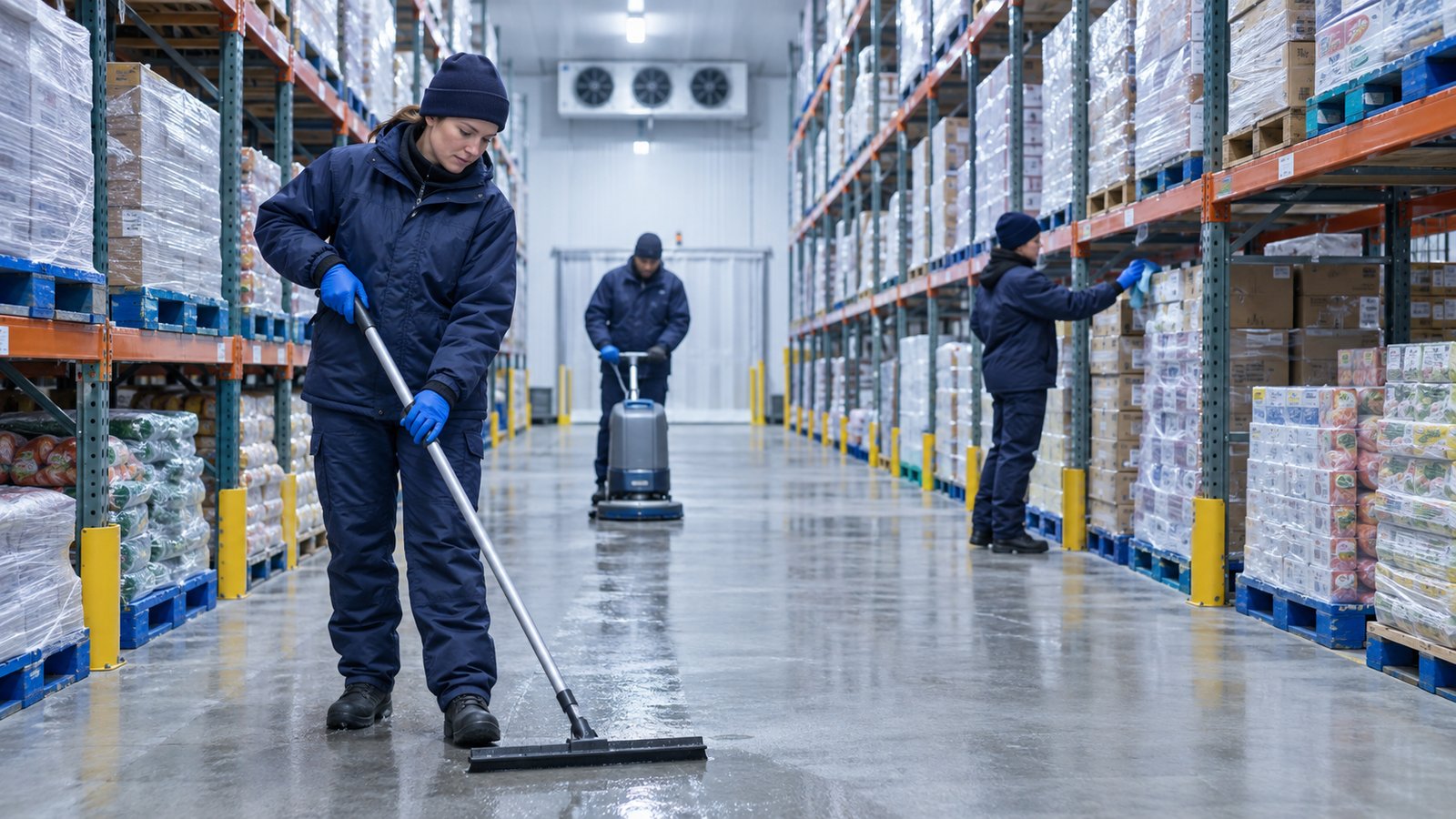
Cold-storage cleaning is a coordinated operations task, not ordinary office janitorial work performed in a coat. Temperature transitions, condensation, forklift traffic, food exposure, and production schedules all affect the safe work window. Facility managers searching for a refrigerated warehouse cleaning company should require a written zone plan, product-protection rules, approved chemicals, staff training, and documented release criteria. GreenPoint Maintenance Services Corp provides commercial cleaning across New York, New Jersey, Connecticut, Pennsylvania, and Florida; any food-safety program must still be approved by the facility’s food-safety lead and matched to its products and hazard analysis.
Map cold zones, product exposure, and operating windows
Start with a floor plan that identifies chilled rooms, frozen rooms, ante-rooms, docks, battery-charging areas, packing lines, drains, employee welfare spaces, and spaces where exposed food or packaging is present. For each zone, record the operating temperature range, permitted chemicals, required protective clothing, door and alarm procedures, and which employee releases the area for cleaning. The facility’s food-safety plan controls what is acceptable. GreenPoint asks the customer to define product hold rules, allergen boundaries, and whether a room may be cleaned only after inventory is moved or protected.
Include a change-control step for a new product line, temporary storage layout, or revised allergen profile. The customer should notify the contractor before the change takes effect, update room instructions, and confirm whether the routine schedule still fits. GreenPoint can record the approved revision and brief assigned staff so that the written scope stays aligned with production reality.
The schedule should identify whether work occurs during shutdown, between shifts, or in short blocks while the warehouse remains active. Cleaning in an operating aisle requires separation from picking and forklift movements, a clear lockout or access-control procedure where applicable, and a way to prevent wet floors from becoming a slip hazard. A contractor should never improvise around refrigeration equipment or open product. GreenPoint Maintenance Services separates routine janitorial tasks from specialized sanitation, refrigeration maintenance, pest control, and food-contact equipment cleaning unless those responsibilities are expressly assigned and validated by the facility.
Control condensation, frost, and slip hazards
Temperature differences can cause moisture to form when warm, humid air enters a cold space. That moisture can freeze, collect around doors, or create a slippery transition at thresholds. A practical service plan calls out door seals, air curtains, drains, floor transitions, and condensate lines as observation points, while making clear that the cleaning team reports defects rather than repairs refrigeration systems. Use only the floor method approved for the surface and temperature. The facility should set a safe drying and re-entry standard based on the product label, surface, and its own safety procedures.
In cold rooms, equipment and floors can behave differently than they do at ambient temperature. A liquid detergent or disinfectant may not perform as expected if the surface is too cold, and excess water can create refreezing risk. Product labels and the facility’s sanitation program must govern dilution, temperature limits, and contact time. GreenPoint’s supervisors can document observed water accumulation, damaged seals, or recurring ice at an entry point in the service log so the operator can assign follow-up. Do not treat a cleaning crew as a substitute for a qualified refrigeration technician or building engineer.
Ask the site engineer to identify floor drains, approved squeegee routes, and rooms where water-based cleaning is prohibited. Record who can isolate an affected aisle and the re-opening criteria. A written threshold is especially useful when condensation is seasonal or a door is frequently opened during loading, because repeated wet-floor events can signal an operational issue rather than a cleaning omission.
Specify food-safe chemical and tool controls
The facility’s food-safety lead should approve every cleaning product, tool, and method before use. The scope should name product labels, dilution instructions, contact time, rinsing requirements, storage location, and where each tool is used. Color-coded microfiber or other dedicated equipment can reduce transfer between restrooms, break areas, docks, and controlled production zones, but the code must be trained and audited. Never use a product simply because it is described as green or food safe; verify its label and suitability for the specific surface and use case.
OSHA hazard-communication procedures require workers to understand chemical hazards and have access to safety information. Secondary bottles must be labeled according to the employer’s applicable hazard-communication program, and incompatible products must not be mixed. The [cleaning chemical safety and GHS/SDS guide](/blog/osha-cleaning-chemical-safety-ghs-sds/) and [EPA disinfectant registration guide](/blog/epa-disinfectant-registration-guide/) can help procurement teams frame product questions. GreenPoint uses Green Seal certified products where appropriate, but the warehouse must authorize products for its food-safety controls before deployment.
Create a signed product matrix showing the facility approver, approved use, dilution method, storage location, and review date for each item. Keep labels visible on working containers and remove unapproved bottles from the area. This simple control helps the warehouse, sanitation lead, and vendor supervisor resolve questions quickly during audits or shift handoffs.
Protect people during cold-room work
Cold exposure requires a customer-specific work plan. Confirm appropriate insulated clothing, gloves, footwear, break and warming arrangements, communication devices, buddy or check-in procedures, emergency egress, and exposure limits set by the employer’s safety program. A contractor should train staff on door release mechanisms, alarm response, and who to contact if a door or refrigeration system behaves unexpectedly. Facility policy and applicable OSHA requirements guide the employer’s controls; a generic vendor statement is not a substitute for the site’s hazard assessment.
Also account for material-handling traffic. The crew needs a route that avoids active forklift lanes, blind corners, pallet staging, and charging stations, with cones or barriers placed so they do not create a new obstruction. Schedule cleaning of high-traffic crossings for a closed or controlled window whenever possible. GreenPoint Maintenance can coordinate access with site supervisors and record start, finish, and exception notes in JaniTrack. Call 347-332-9348 to schedule a walkthrough before pricing so the team can understand the temperature zones, work windows, and access constraints.
The kickoff should include a site orientation and practical check: workers should point out the nearest exit, alarm or call point, warming area, first-aid contact, and route for reporting a spill. A supervisor should verify that the team knows how to pause work if a door alarm sounds or product is exposed. Keep attendance and refresher records with approved vendor documentation.
Build a measurable sanitation and verification record
Define acceptance by room and task: visible soil removed, designated drains and thresholds addressed, waste removed, tools returned to their marked storage points, and surfaces dry or released according to the customer’s procedure. Records should show the scheduled task, responsible worker or supervisor, completion time, exceptions, and corrective actions. JaniTrack supports GreenPoint’s service verification with timestamped, GPS-tagged photos and a live dashboard. Photographs should avoid capturing proprietary product information or personnel unless the customer has approved that documentation method.
ATP testing may be used as a supplemental hygiene check when the facility has a defined sampling plan and baseline. A result is affected by the sampled location, collection technique, instrument, and local threshold; ATP does not establish that a specific pathogen is present or absent. For food-contact areas, follow the facility’s validated sanitation and verification protocol rather than substituting a general janitorial audit. GreenPoint Maintenance Services can include scheduled inspection and documented re-cleaning steps in a fixed-price scope, with no hourly billing or hidden fees for the agreed routine.
A useful exception record identifies the exact aisle or room, what prevented the task, who was notified, what temporary control was applied, and whether a follow-up visit is needed. Do not close an exception simply because the crew left the site. The customer’s supervisor should decide when the affected zone is ready for normal traffic and whether a maintenance ticket or quality review remains open.
Plan a vendor scope for tri-state cold-chain sites
Cold-chain properties around Hunts Point in the Bronx, Port Newark and Elizabeth, the New Jersey Turnpike logistics corridor, Long Island City, Maspeth, and industrial sections of Queens may operate around the clock with strict delivery windows. Upstate and Long Island distribution centers may have longer travel routes and different shift patterns. A quote should list each building, cleanable area, temperature zone, visit frequency, planned crew size, access requirement, product and equipment responsibility, and exclusions. For pricing context, see [commercial cleaning cost per square foot](/blog/commercial-cleaning-cost-per-square-foot/), but cold-room work should be priced from the actual labor, safety, and task assumptions.
Before award, request insurance documentation, staff training records, references for temperature-controlled or food-related operations, a product approval workflow, emergency contacts, and a sample service report. Confirm whether the vendor provides only environmental cleaning or is expected to perform validated food-contact sanitation. GreenPoint Maintenance Services Corp can walk the facility with operations, safety, and food-safety representatives to document the boundary between those scopes. Phone 347-332-9348 or email info@greenpointms.com to request a walkthrough and a written proposal for a New York, New Jersey, Connecticut, Pennsylvania, or Florida site.
For multi-site operators, use one master scope with a site appendix for each building. The appendix can capture temperature ranges, restricted zones, local access contacts, site-specific products, and emergency numbers without creating contradictory corporate standards. Review it after a renovation, new customer contract, or change in operating hours, and schedule a periodic walkthrough to confirm that documented assumptions still match the floor.
Frequently asked questions
Q: Can a cleaning contractor sanitize food-contact surfaces in a cold room? A: Only if the facility has specifically assigned that work, approved the product and method, and defined the required verification. Confirm the contractor’s training and the customer’s validated sanitation procedure before work begins.
Q: How often should a refrigerated warehouse be cleaned? A: Frequency depends on traffic, product risk, spill history, operating hours, and the facility’s food-safety plan. Set routine tasks by zone and add documented response procedures for spills and abnormal moisture.
Q: Does ATP testing prove a cold room is pathogen-free? A: No. ATP is a general hygiene indicator for a sampled surface and is not a pathogen-specific test. Use it only as one element of an approved verification program.
Q: What should a cold-storage cleaning bid include? A: Require zone-specific tasks, work windows, product approval, cold-exposure controls, access steps, verification records, exclusions, and fixed pricing assumptions. Call GreenPoint at 347-332-9348 to schedule a walkthrough.
For refrigerated warehouse cleaning in New York, New Jersey, Connecticut, Pennsylvania, or Florida, call GreenPoint Maintenance at 347-332-9348 or email info@greenpointms.com to schedule a site walkthrough. GreenPoint provides fixed-scope pricing and JaniTrack documentation with timestamped, GPS-tagged service evidence; food-safety methods remain subject to facility approval.