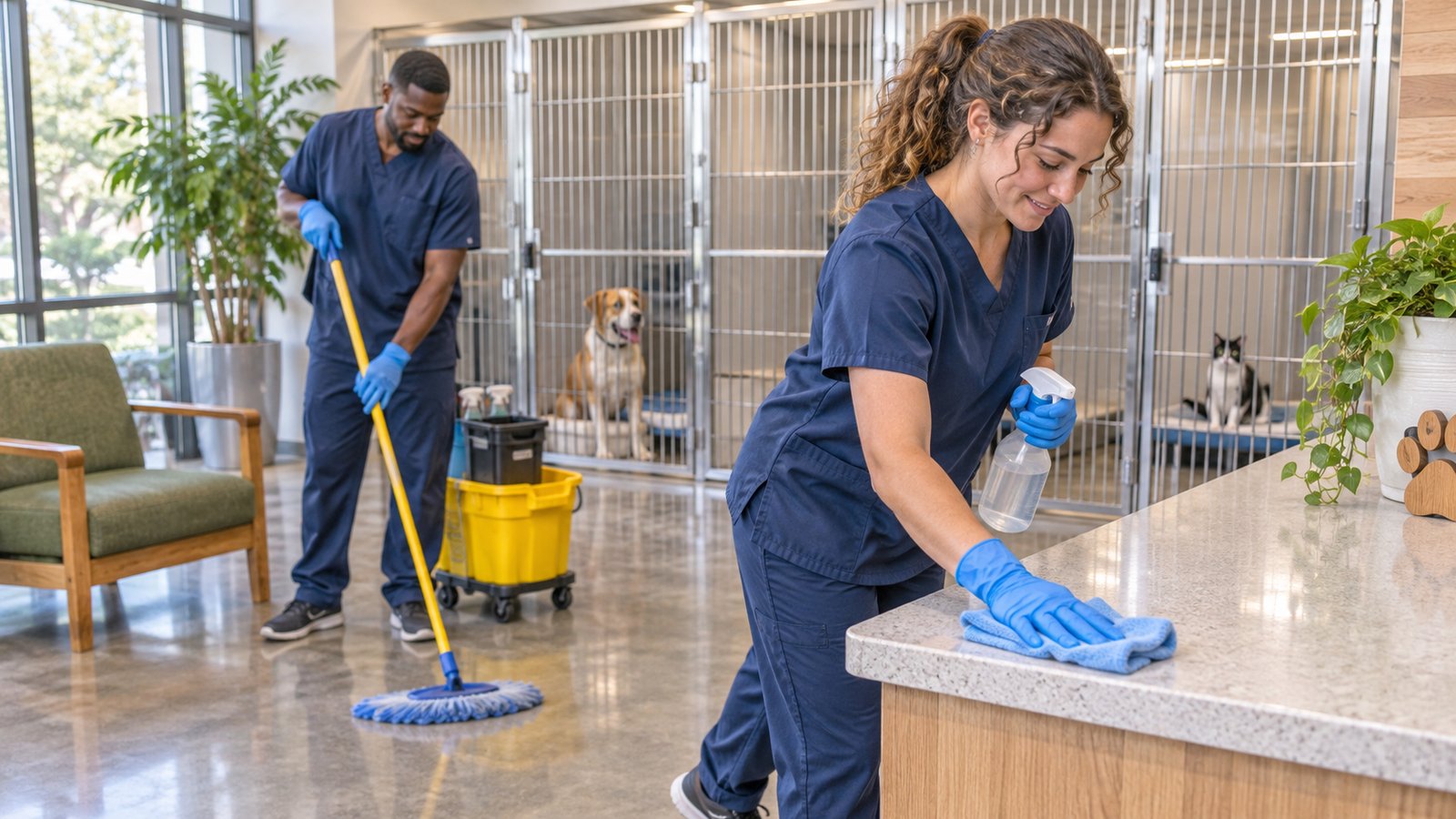
Animal shelter cleaning is a health-sensitive facility service, not a standard office route with kennels added to the checklist. Adoption lobbies, animal housing, isolation rooms, exam areas, laundry, food-preparation spaces, and public restrooms each have different users, materials, and risks. A qualified contractor must follow the shelter’s veterinarian-approved sanitation plan, use products correctly, and work around staff and animals without interrupting care. GreenPoint Maintenance Services Corp provides commercial cleaning across New York, New Jersey, Connecticut, and nearby markets. For an animal shelter cleaning walkthrough and fixed-scope quote, call GreenPoint at 347-332-9348.
Define the boundary between janitorial work and animal-care sanitation
Begin procurement by listing what the cleaning contractor will and will not touch. A route may include the adoption lobby, staff offices, visitor restrooms, staff breakroom, hallways, and exterior entry glass, while kennel enclosures, treatment surfaces, food bowls, isolation rooms, and animal-care equipment remain under shelter staff or veterinary direction. Some organizations may authorize a trained vendor to perform selected animal-area tasks, but that decision belongs in the written protocol. GreenPoint Maintenance Services recommends assigning an owner for every room and surface so no one assumes that a general cleaner can choose a disinfectant or release an enclosure.
Build the room list around actual animal and visitor movement. A Bronx intake shelter, a Queens adoption center, a Brooklyn rescue, or a Westchester facility may receive animals through separate intake doors and hold them in different risk categories. Mark public-facing spaces, staff-only areas, isolation, laundry, food storage, waste staging, and vehicle or carrier wash areas on a floor plan. Note operating hours, feeding and medication windows, adoption events, volunteer shifts, and any public tours. GreenPoint can convert that walkthrough into a scope with access rules, task frequency, responsible party, and a documented exception process.
Use a veterinarian-led sanitation sequence for animal areas
Cleaning and disinfection are separate steps. The Association of Shelter Veterinarians’ guidance explains that organic material must be removed and a surface cleaned before an appropriate disinfectant is applied for its labeled contact time; the shelter should set its methods with veterinary input. ASPCApro’s shelter sanitation guidance describes detergent cleaning, rinsing, correct disinfectant use, and drying before an animal returns. A janitorial proposal should never substitute fragrance, fogging, or a quick spray for a documented process, and GreenPoint will not override a shelter’s animal-health protocol.
The approved plan should identify target organisms, dilution or ready-to-use product, surface compatibility, wet contact time, rinse requirements, drying method, and who can approve a change. For example, the shelter may specify a separate sequence for routine kennel turnover, visibly soiled areas, an isolation room, or a disease-response event. Keep equipment labeled and dedicated by zone, use clean cloths rather than moving a contaminated tool between rooms, and store chemicals away from animals and feed. GreenPoint Maintenance Services can document assigned tasks, but the shelter’s veterinary lead remains the authority for pathogen-specific choices and animal release.
Protect animals, staff, volunteers, and visitors during service
A safe work plan considers more than chemical labels. Before work begins, the shelter should tell the crew which doors must remain closed, how to avoid startling animals, which rooms require an escort, and where animals may be moved temporarily. Staff should manage animal handling; cleaners should not open a kennel, move a carrier, or enter an occupied enclosure unless that task is explicitly authorized and trained. Use signage and barriers during wet-floor work, keep cords and carts out of animal paths, and schedule noisy equipment away from intake, exams, adoption meetings, and quiet periods when possible.
Chemical instructions need to be practical at the point of use. Keep products in original or properly labeled containers, train workers on the safety data sheet, prevent incompatible chemicals from being mixed, and secure supplies when the crew leaves. GreenPoint uses Green Seal certified products where they suit the specified surface and task, but an environmental label does not replace the shelter’s pathogen, material, or animal-safety review. Call 347-332-9348 to discuss a site walkthrough that records ventilation, storage, water access, floor drains, and required personal protective equipment before a quote is prepared.
Set frequencies by risk, occupancy, and measurable workload
There is no dependable one-size-fits-all square-foot productivity rate for an animal shelter. A 12,000-square-foot center with 30 housing spaces, an isolation suite, two public restrooms, and daily adoption traffic may require a different labor plan from a 30,000-square-foot campus with several buildings and extensive animal-care work. Treat those figures as examples for scoping, not as staffing rules. Count rooms, fixtures, kennels, touchpoints, waste stations, and changeovers; record how often each area is occupied and which tasks belong to shelter employees.
A useful service calendar separates daily, between-use, weekly, and periodic tasks and identifies who owns each one. Daily public-area service may include restroom checks, entry soil control, and trash removal, while animal-enclosure turnover follows the shelter’s animal-health protocol. Quarterly or seasonal tasks might include reachable vents, interior glass, floor restoration, or high ledges after an operational review. GreenPoint can price a defined frequency and coverage window at a fixed rate rather than billing open-ended hourly labor. The site walkthrough is where the parties test the schedule against real traffic, not a generic square-foot formula.
Require documentation that proves scope without exposing sensitive details
A supervisor should be able to answer which zones were serviced, when exceptions occurred, and what corrective action followed. GreenPoint’s JaniTrack workflow can provide timestamped, GPS-tagged task evidence, approved photos, ATP test results where useful, and a live dashboard. ATP readings are one measurement tool, not a pathogen test or a substitute for a correctly performed sanitation protocol. The ISSA Clean Standards use a measure-and-monitor framework, so buyers can define checks that fit the program rather than treating a single number as proof that every biological hazard is absent.
Agree on the privacy rules before permitting photos. Images should avoid animal medical charts, adoption records, staff identities, security-sensitive doors, and any animal or location that the shelter has restricted. A report can show a completed public restroom check or a corrected spill without revealing confidential animal-care information. Ask how the vendor records a blocked room, a product shortage, a missed task, or an urgent request, and who receives the alert. GreenPoint Maintenance Services can map the dashboard to an approved service-level review, with weekly exceptions and a monthly trend discussion rather than a pile of unreviewed photographs.
Evaluate contractor qualifications, continuity, and total scope
A competitive bid should include insurance, worker screening appropriate to the facility, chemical and equipment lists, training records, supervisor coverage, substitute staffing, emergency contacts, and a sample inspection report. Ask the contractor to explain which tasks are specifically excluded, who provides animal-area instructions, and how the crew responds to an outbreak or a closed wing. A low introductory figure is not comparable if it omits consumables, event coverage, floor care, or documented supervision. GreenPoint reports a 98% client retention rate and uses fixed pricing with no hidden fees; buyers should still compare every proposal against the same room schedule and service assumptions.
Request references from organizations with similar operating constraints, then verify that the named supervisor will actually support your site. The commercial cleaning contract terms guide and questions to ask a commercial cleaning company can help structure a bid review. GreenPoint Maintenance Services is MBE/MWBE certified with New York State, New York City, and NYC DOE, and is registered in SAM.gov. For a New York, New Jersey, or Connecticut shelter, call 347-332-9348 and request a walkthrough; the quote should identify included rooms, frequencies, excluded clinical work, response windows, and the review cadence.
Plan local access, waste handling, and continuity across the tri-state area
A shelter’s location changes how a contractor plans arrivals, parking, keys, and relief coverage. Intake and adoption sites in the Bronx, near Brooklyn’s major avenues, around Jackson Heights or Flushing in Queens, and in Staten Island may have different loading arrangements and public-transit access. Westchester, Long Island, northern New Jersey, and Fairfield County sites may need a separate travel and backup-staff plan. Document delivery hours, security sign-in, snow or storm procedures, and the contact who can approve after-hours access. GreenPoint schedules the route around the facility’s approved window rather than assuming every building can be entered at the same time.
The shelter should tell bidders how ordinary trash, animal waste, laundry, sharps, and regulated medical waste are segregated and who is authorized to handle each stream. General janitorial work must not be represented as veterinary waste management. Confirm drain restrictions, local waste contracts, and any health-department or municipal requirements with the shelter’s compliance lead; local rules and permits depend on the facility and activity. For continuity, name a primary and backup supervisor, define an emergency escalation path, and agree whether holiday adoption events are part of the base price. GreenPoint can price an approved add-on, but the scope should state it before event day.
Frequently asked questions
What should an animal shelter ask a cleaning contractor to include? Request a room-by-room task schedule, clear exclusions for veterinary or animal-care duties, approved products, training and supervision, backup coverage, inspection records, and a written response process for illness events. GreenPoint can prepare the scope after a walkthrough.
Can a commercial cleaner disinfect kennels? Only when the shelter authorizes the task, trains the worker, and supplies a veterinarian-approved protocol for the animal, surface, product, contact time, rinsing, and drying. A janitorial contractor should not select a pathogen-specific product or return an animal to a space on its own.
How often should an adoption center be cleaned? Frequency depends on occupancy, visible soil, animal-health risk, visitor flow, and the shelter’s written plan. Set routine public-area service separately from between-animal enclosure sanitation and increase response when the veterinary lead identifies a higher-risk condition.
Does ATP testing prove a kennel is free of pathogens? No. ATP can be used as one indicator in a broader quality program, but it does not identify a specific organism or replace correct cleaning, label-compliant disinfection, veterinary oversight, or targeted testing.
How can a shelter get a tri-state cleaning quote? Share a floor plan if available, operating hours, room list, desired frequencies, access restrictions, and any facility-approved sanitation procedures. Call GreenPoint Maintenance Services at 347-332-9348 to schedule a walkthrough and receive a fixed-scope proposal.
Schedule an animal shelter cleaning walkthrough with GreenPoint Maintenance Services at 347-332-9348. GreenPoint reports 98% client retention and can document approved work through JaniTrack without replacing your veterinarian-led sanitation plan.