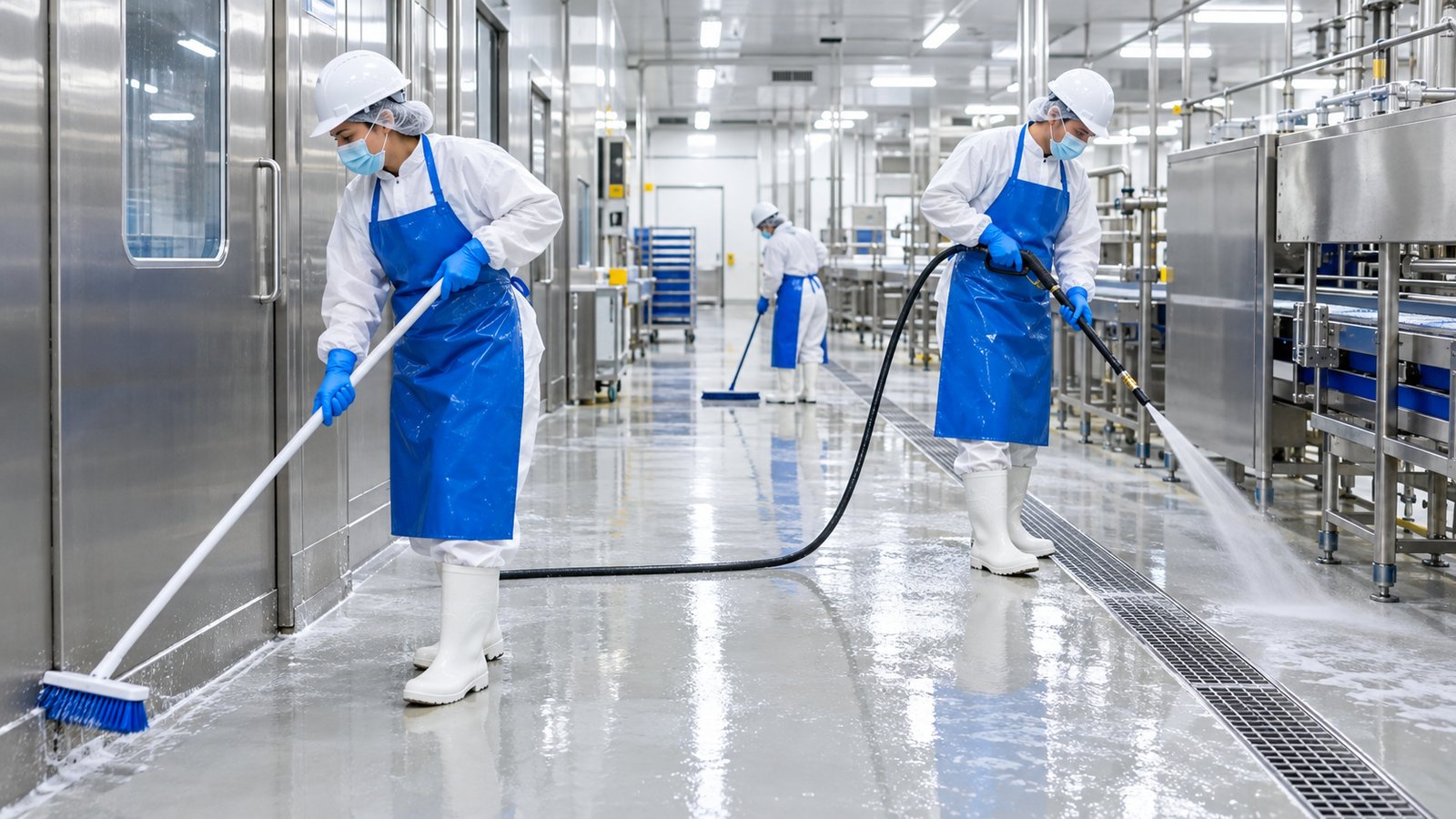
A food plant can look clean while still having an unclear division of responsibility. Production sanitation, food-contact equipment cleaning, environmental monitoring, and routine janitorial work are related but not interchangeable. The FDA's preventive-controls rule requires covered facilities to establish written food-safety plans and, where applicable, sanitation controls; FSIS-regulated meat and poultry operations have separate sanitation SOP requirements. GreenPoint Maintenance Services helps operations teams define a safe, auditable janitorial scope without taking over the plant's food-safety program. A walkthrough maps production boundaries, traffic routes, and shift windows before pricing. Call 347-332-9348 to schedule a tri-state facility walkthrough.
Separate plant sanitation from janitorial service
Begin the bid with a responsibility matrix. The plant's qualified food-safety team retains ownership of hazard analysis, sanitation preventive controls, pre-operational release, food-contact equipment, allergen changeovers, environmental monitoring, and corrective actions required by its regulatory program. A commercial janitorial provider may cover offices, staff corridors, locker rooms, restrooms, non-production floors, exterior entryways, and other explicitly designated surfaces. Some plants may authorize additional tasks after validating training, chemical use, and verification methods. GreenPoint does not assume that a signed cleaning checklist substitutes for the facility's hazard analysis or required records.
The FDA explains that sanitation controls can address cleanliness of food-contact surfaces and prevention of allergen cross-contact or cross-contamination. In USDA-regulated meat and poultry establishments, written SSOPs describe procedures that prevent direct product contamination or adulteration. Read the [FDA preventive controls rule](https://www.fda.gov/food/food-safety-modernization-act-fsma/fsma-final-rule-preventive-controls-human-food) and the [FSIS SSOP guidance](https://www.fsis.usda.gov/sites/default/files/media_file/documents/EIAO-08-SSOP.pdf), then have the facility's compliance lead decide what applies. GreenPoint Maintenance Services can price support work around that boundary; call 347-332-9348 to arrange a scope review.
Map hygiene zones, routes, and access rules
Food-processing buildings often have high-care, low-care, raw-material, finished-goods, dry, wet, and administrative zones. The plant should mark where outside cleaners may enter, what protective clothing or footwear is required, and how workers change tools at a zone transition. A route map can prevent a cart from moving from a restroom corridor into a production-adjacent hall. Separate clean equipment from used cloths, identify handwashing points, and state whether doors, drains, floor edges, or waste rooms are included. GreenPoint supervisors review these controls with the site contact before assigning a crew.
A 40,000-square-foot operation in Hunts Point, the Brooklyn Navy Yard, Elizabeth, Newark, or the Meadowlands may combine office space, warehouse aisles, employee amenities, and controlled production rooms. A generic square-foot estimate misses the number of thresholds, shift changes, washdown constraints, and access credentials. Some facilities near rail or port logistics corridors operate overnight; others need quiet work during production pauses. GreenPoint Maintenance Services documents the facility's authorized route and no-entry areas in the scope, then uses JaniTrack task assignment where appropriate. Schedule a GreenPoint walkthrough at 347-332-9348 before the bid is finalized.
Choose dry, wet, or controlled-wet methods by area
The cleaning method should match the process environment and the facility's written procedure. Dry processing areas may require careful removal of dust and residue with limited water; wet areas may have drainage, splash, and drying controls. The FDA's animal-food preventive-controls guidance discusses dry, wet, and controlled-wet cleaning approaches, including avoiding unnecessary water that could spread contamination. That guidance is not a universal recipe for every human-food plant, so the site food-safety lead must approve methods. A janitorial crew should never improvise by pressure-washing near exposed product, equipment, or electrical systems.
For floor care, specify the allowed tool, chemical, water volume, drain destination, squeegee or recovery method, drying time, and production-release authority. Identify whether the floor is sealed concrete, resinous coating, quarry tile, or another material; a wrong pad or overly aggressive chemical can damage the surface. GreenPoint provides Green Seal-certified product options where appropriate, subject to the plant's review and compatibility requirements. Our [green cleaning guide for commercial buildings](/blog/green-cleaning-commercial-buildings-guide/) and [chemical safety guide](/blog/osha-cleaning-chemical-safety-ghs-sds/) can help procurement prepare a product review checklist.
Coordinate service windows with production and sanitation shifts
The schedule should reflect when a space is genuinely available. A sanitation team may be dismantling equipment, a QA employee may be sampling surfaces, or maintenance staff may be repairing a drain. In those circumstances the janitorial crew needs an approved hold point, not an invitation to work around an active process. Document shift start and finish times, badge or escort rules, sign-in requirements, break periods, production alarms, and who releases a room after work. For facilities operating two or three shifts, an overnight office route can be separate from a production cleanup window.
For a planning example, a 55,000-square-foot facility may have 12,000 square feet of office and amenities, 8,000 square feet of non-production corridors, and production zones under separate control. The quote should price the measured janitorial areas and task frequencies, not silently include controlled rooms. GreenPoint Maintenance Services uses fixed pricing for the defined schedule rather than billing an unpredictable number of labor hours; changes in area, frequency, or access go through written approval. Call 347-332-9348 for a walkthrough and a line-by-line scope with no hidden fees.
Control chemicals, labels, PPE, and records
Before mobilization, agree on an approved chemical list, current safety data sheets, dilution method, secondary-container labels, storage location, spill response, and PPE. The food-safety lead should verify whether a product may be used in each area and whether a rinse or dry step is required. GreenPoint trains staff to follow product labels and facility rules; cleaners do not mix chemicals or substitute products without authorization. If the facility's policy restricts fragranced products, aerosols, or quaternary compounds in a zone, list that restriction in writing so purchasing and field staff use the same approved inventory.
Records should distinguish routine janitorial verification from food-safety verification. A daily task log may document the date, assigned area, completion time, cleaner, and exception; plant sanitation records, pre-operational inspections, and environmental test results remain in the facility's controlled system. JaniTrack can capture timestamped, GPS-tagged photos and show dashboard status for assigned tasks. ATP testing, if separately agreed, measures residual biological material as a cleanliness indicator; it does not prove absence of a specific pathogen. GreenPoint will report a blocked drain, damaged floor, or inaccessible room instead of marking it complete. Ask GreenPoint at 347-332-9348 how task evidence can fit your existing records.
Select a vendor through a matched, fixed-scope bid
Issue the same documents to every bidder: a zone plan, measured areas, shift calendar, authorized task list, product constraints, training requirements, access rules, service-level targets, and reporting format. Ask what is excluded, how temporary line changes are handled, and who approves extra labor or floor projects. A credible vendor should explain its supervision, backup staffing, insurance, MBE status if relevant to procurement, and how it responds to a failed inspection. GreenPoint Maintenance Services is MBE/MWBE certified in New York programs and SAM.gov registered; buyers should verify the specific certification and solicitation requirements that apply to their contract.
Compare total cost over the full term rather than a low monthly figure with vague allowances. Confirm the floor area, number of visits, consumables, periodic floor care, supply responsibilities, escalation rules, and renewal terms in writing. See [how to calculate true cleaning cost](/blog/calculating-true-cleaning-cost-tco/) and [commercial cleaning contract key terms](/blog/commercial-cleaning-contract-key-terms/) before signing. GreenPoint maintains a 98% client retention rate and uses JaniTrack verification for assigned service tasks. To build a comparable bid package or request a fixed-price walkthrough across NY, NJ, or CT, call 347-332-9348.
Before award, ask the bidder to describe onboarding in concrete terms: who supervises the first week, how absences are covered, what orientation is required before entering a controlled zone, how product substitutions are approved, and how a missed task is corrected. Ask for a sample checklist with the same fields you expect to use after launch. Confirm that the supplier's insurance, safety program, and any required registrations match the actual site and solicitation. GreenPoint Maintenance Services can present its MBE/MWBE credentials and SAM.gov registration for review, but the buyer should independently verify each item and assess whether it applies to the procurement. A careful pre-award review makes day-one expectations more predictable.
Plan a formal service review at 30, 60, and 90 days instead of waiting for an annual renewal. At the first review, confirm that staff understand the authorized route and that access badges, supply storage, and shift handoffs work as designed. At 60 days, compare completion records with supervisor inspections and identify repeat exceptions such as a locked room or a missing drain cover. At 90 days, confirm whether frequency and staffing still match the operation. GreenPoint supervisors can share task records and corrective-action notes for the assigned work, while plant leadership retains control of sanitation validation, product release, and regulatory records. This keeps the cleaning contract measurable without confusing it with a food-safety audit. Written reviews also give both parties a place to agree on retraining or a revised route before a small service issue becomes a persistent missed task.
Frequently asked questions
Can a janitorial contractor clean food-contact equipment? Only if the facility authorizes the work, validates the contractor's training and method, and includes the task in its own food-safety controls. Many operations reserve food-contact equipment and pre-operational release to trained plant personnel.
Does FDA require every food plant to use the same sanitation schedule? No. The requirements depend on facility coverage, hazards, process, and the facility's food-safety plan. The plant's qualified person should determine applicable controls and frequencies.
What should a food-processing cleaning quote include? It should define zone boundaries, areas and surfaces, authorized products, frequency, access windows, PPE and training, evidence records, exclusions, and how scope changes are approved.
Can GreenPoint provide fixed pricing? GreenPoint Maintenance Services quotes the approved scope at a fixed price, with written handling for additional tasks or changes. A walkthrough is needed to confirm area, soil load, shift windows, and access.
Does an ATP reading certify a plant as pathogen-free? No. ATP testing can support a defined cleanliness check, but it is not a pathogen-specific test and does not replace the facility's environmental monitoring or food-safety verification program.
GreenPoint Maintenance Services provides fixed-price commercial cleaning, documented JaniTrack task evidence, and MBE/MWBE credentials for eligible procurement. Call 347-332-9348 to schedule a food-processing walkthrough and separate janitorial work from controlled sanitation responsibilities.