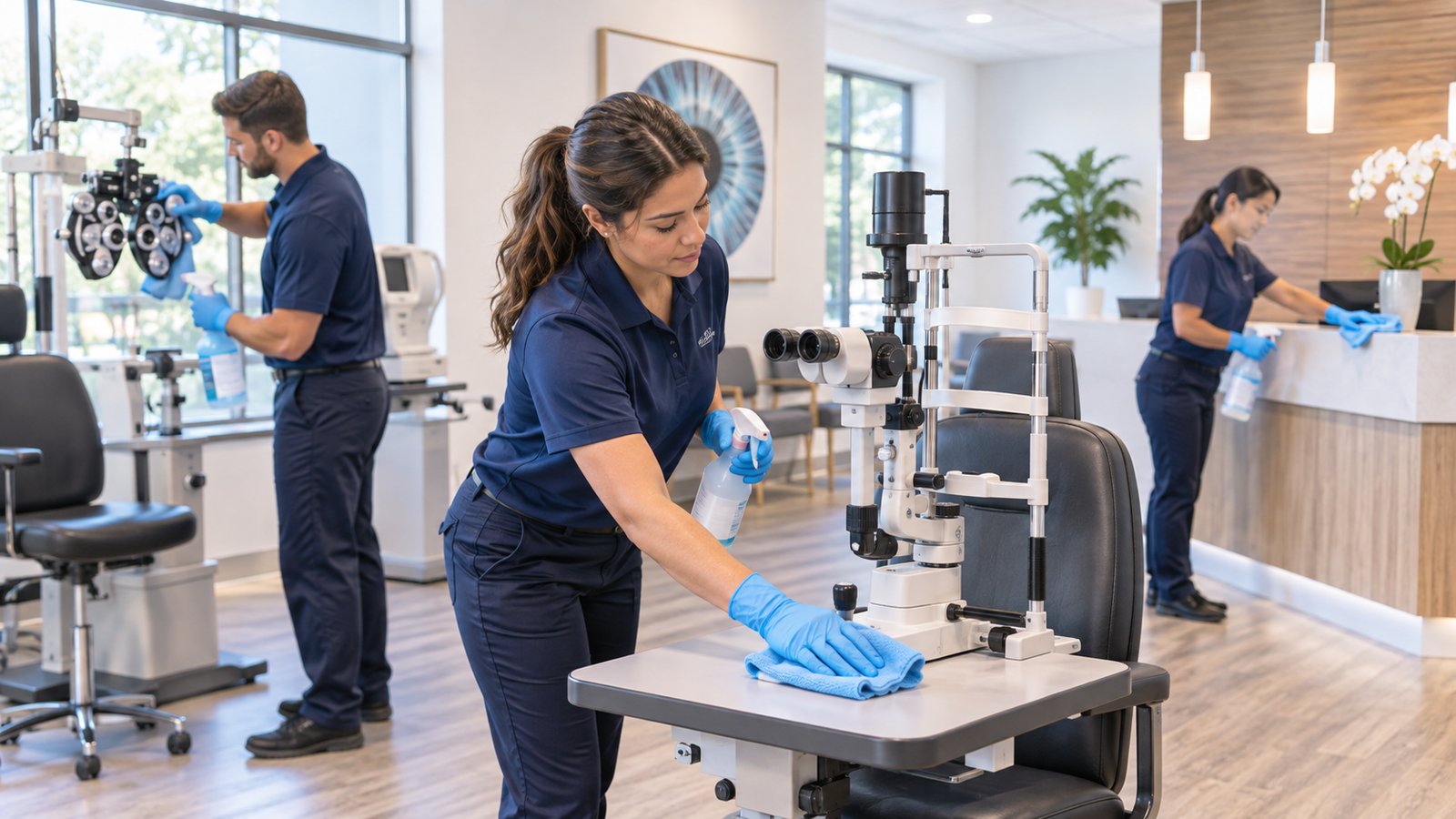
Optometry practices combine patient care, diagnostic instruments, retail eyewear, and high-contact reception areas in one compact workplace. A dependable cleaning plan must protect the patient experience without applying liquids or chemicals to lenses, slit lamps, tonometers, or other sensitive equipment. For clinic operators in Manhattan, the Bronx, Brooklyn, Queens, Staten Island, Westchester, Long Island, New Jersey, and Connecticut, the right commercial cleaning partner turns those daily details into a documented routine. GreenPoint Maintenance Services designs facility cleaning around access hours, material compatibility, traffic, and written responsibilities. This guide explains what to include in a scope, how to verify work, and what to ask before signing.
Why optometry clinics need a tailored cleaning scope
Local conditions change the service design. A ground-floor office near Fordham Road, a Midtown practice by Grand Central, and a suburban suite near White Plains or Stamford can have very different arrival peaks, elevator rules, and street-level debris. In Brooklyn or Queens, shared entrances and mixed retail tenants may require coordination with a building manager. Ask the provider to price the actual access and route, not assume a uniform visit based on a broad borough or county service area.
An eye-care clinic is not simply a small office. Patients move from reception to pretest stations, exam rooms, optical dispensing, and sometimes contact-lens teaching areas. Every zone has different soil, contact frequency, and equipment restrictions. A generic nightly checklist may vacuum the floor yet miss the chin rests, counters, door pulls, chair arms, and waiting-room touchpoints that patients notice. The written scope should name each zone and describe the task, method, frequency, responsible role, and exception process.
GreenPoint Maintenance Services starts with a walkthrough to map rooms, surfaces, water access, locked storage, waste streams, and the clinic's opening schedule. The practice manager should identify manufacturer instructions for diagnostic devices and clarify which tasks are reserved for clinical staff. A cleaning vendor must not improvise on optical surfaces or clinical instruments. For a broader framework on professional appearance and task verification, see our guides to ISSA appearance levels and commercial cleaning frequency standards.
Exam rooms, pretest stations, and optical equipment
Add a signed-off surface list to the clinic's onboarding packet and store it where the supervisor can review it without exposing patient information. Mark items as janitorial-cleaned, clinical-team-cleaned, or excluded, and identify the person who can authorize a change. If a manufacturer updates its instructions or the clinic replaces an instrument, revise the scope before the next service. This simple control prevents a well-intentioned worker from using a familiar method on a newly installed device.
Build room turnover and scheduled cleaning as separate responsibilities. Clinic employees generally manage between-patient instrument preparation according to the practice's clinical procedures; janitorial staff can handle approved room surfaces, floors, waste, and nonclinical touchpoints at the agreed service time. The scope should explicitly exclude lenses, optical elements, controls, and equipment openings unless the manufacturer and clinic have approved a specific procedure. A cleaner should never spray product toward a device or leave residue on a patient-contact surface.
List the permitted method for chair arms, counters, door handles, exam-room sinks, and floors, and distinguish cleaning from disinfection. Product labels govern dilution, wet contact time, surface compatibility, and required precautions. GreenPoint Maintenance uses Green Seal-certified products where appropriate to the task, while matching the selected product to the surface and facility's written requirements. Ask the vendor to train staff not to mix chemicals, not to decant unlabeled solutions, and to report damaged equipment or spills instead of attempting an unapproved repair.
Reception, retail displays, restrooms, and patient flow
Walk the route at the time the cleaning team would arrive. A building near Penn Station or Newark Penn may have a narrow freight-elevator window; a clinic on a busy commercial avenue may need entry glass checked more often after wet weather. Record which doors are public, which are alarmed, and where supplies can be staged. The practice manager should also identify accessible routes and avoid leaving carts, cords, signs, or wet-floor barriers in circulation paths.
Reception is the clinic's first visual impression, and it can experience concentrated traffic during morning appointments and after-work visits. Include the check-in counter, payment terminal exterior, waiting chairs, glass entry, handles, ledges, and visible floor edges in the schedule. Retail frames and display cases require dusting with a material-safe method; the scope should state whether staff or the cleaning provider handles merchandise and secured display surfaces. Avoid moving products, patient paperwork, or personal items without permission.
Restrooms need a sequence that prevents cross-contamination: separate cloths and tools for restroom fixtures, fresh materials for patient areas, and a clear route for waste and replenishment. Stock checks should record soap, towels, tissue, and dispensers that fail to operate. In multi-tenant buildings near Grand Central, Penn Station, Newark Penn, Stamford, or major bus corridors, arrival peaks and elevator access may affect service windows. GreenPoint can set a fixed cleaning schedule and quote after reviewing traffic, square footage, access limits, and requested frequencies.
A risk-based schedule for a small clinical footprint
Local obligations may come from a lease, building rules, health-care policies, or applicable state and city requirements rather than one universal optometry-cleaning code. New York City buildings can impose contractor registration and waste-handling procedures, while New Jersey and Connecticut properties may set their own access and fire-safety rules. Ask the facility manager to identify current requirements and put them in the vendor orientation. A cleaning provider should not promise regulatory compliance on behalf of the clinic.
Frequency should follow use, not a rule of thumb detached from the clinic. A 1,500-square-foot practice with four exam rooms, daily appointments, and a busy optical shop may need daily common-area and restroom service, with periodic detail work on less-used edges and high dust surfaces. A lower-volume satellite office may use a different frequency. Track patient volume, visible soil, seasonal respiratory illness, construction dust, and complaints; review the plan when any of these change.
The CDC's environmental-cleaning guidance emphasizes risk assessment, written procedures, and appropriate product use in healthcare settings. An optometry office should adapt applicable guidance to its actual clinical activities rather than treating every room as a hospital procedure area. Define who cleans between patients, who handles blood or body-fluid incidents, and who is called after a spill. OSHA's Bloodborne Pathogens Standard applies where occupational exposure is reasonably anticipated; the employer's exposure-control plan and training determine assigned duties. Never ask routine janitorial staff to take on clinical cleanup outside their training.
Verification, documentation, and JaniTrack
A service record is useful only when it describes work that can be checked. Require task-level completion records, time stamps, exception notes, and a way to report missed access or supply shortages. GreenPoint Maintenance uses JaniTrack verification with timestamped, GPS-tagged photos and a live dashboard for agreed checkpoints. Photos should show completed facility conditions, not patient records, faces, computer screens, or other protected information. Set privacy rules with the clinic before taking any image, and use ATP testing only when the clinic and vendor have selected a suitable location and interpretation protocol.
Review a small set of meaningful measures each month: completed visits, missed tasks, response time, repeat exceptions, supply issues, and audit results. ATP readings can indicate residual organic material but are not a pathogen test and should not be represented as proof of sterility. A manager should inspect the clinic at opening, record issues in one channel, and agree on a correction deadline. For more on digital records and testing limits, read digital cleaning verification systems and ATP bioluminescence testing.
Vendor qualifications, pricing, and access control
Before award, compare a sample inspection with your actual patient journey: entry, check-in, waiting, pretest, exam, dispensing, restroom, and exit. Ask who receives a service exception at 6 a.m. before the first appointment and how the issue is closed that day. A written escalation tree reduces calls to the optometrist for a simple supply shortage. For a walkthrough and fixed quote, call GreenPoint Maintenance Services at 347-332-9348; include your clinic's opening hours and preferred service window when requesting it.
Ask prospective providers for proof of insurance, references from medical or professional offices, supervisor coverage, background-screening practices where permitted, training records, product safety data sheets, and a written continuity plan. Confirm how keys, alarm codes, visitor logs, and after-hours access are controlled. New York City practices may also have building-specific requirements for waste, freight elevators, and contractor sign-in; suburban offices may have landlord rules or restricted loading areas. State and local requirements vary, so make the clinic's own policies and lease obligations part of vendor onboarding.
Compare bids by total scope rather than an unexplained hourly rate. Fixed pricing should state visit frequency, included tasks, periodic services, consumables, emergency callouts, exclusions, annual adjustments, and cancellation terms. GreenPoint Maintenance Services offers fixed-price scopes rather than hourly billing, with no hidden fees when the agreed requirements are clearly documented. GreenPoint Maintenance Services Corp is MBE-certified, SAM.gov registered, and reports 98% client retention; request the current certificate details and references relevant to your location. Call 347-332-9348 to schedule a clinic walkthrough or request a written quote.
Optometry clinic cleaning FAQs
Q: Can janitorial cleaners disinfect slit lamps or other diagnostic instruments? A: Only if the clinic and equipment manufacturer approve the exact procedure and the worker is trained. Most vendors should limit routine service to named, nonclinical surfaces and leave instrument preparation to clinical staff.
Q: How often should an optometry office be cleaned? A: Set frequency by patient volume, room use, surface type, soil, and opening hours. Many practices choose daily service for restrooms, floors, reception touchpoints, and waste, then schedule periodic detail work based on inspection results.
Q: Does ATP testing prove that a room is safe from infection? A: No. ATP is a cleanliness indicator for selected surfaces; it does not identify a specific pathogen or establish sterility. Use it as one quality-assurance measure alongside visual inspection and documented tasks.
Q: What should a tri-state clinic request before hiring a cleaning company? A: Request a room-by-room scope, insurance documents, healthcare-office references, product and training information, access controls, escalation contacts, and a sample service report. For a walkthrough and fixed quote, call GreenPoint Maintenance at 347-332-9348.
Need a reliable cleaning plan for an optometry clinic in NY, NJ, or CT? Call GreenPoint Maintenance Services at 347-332-9348 to schedule a walkthrough and fixed-price quote. JaniTrack can document agreed checkpoints with time-stamped, GPS-tagged verification; GreenPoint reports 98% client retention.