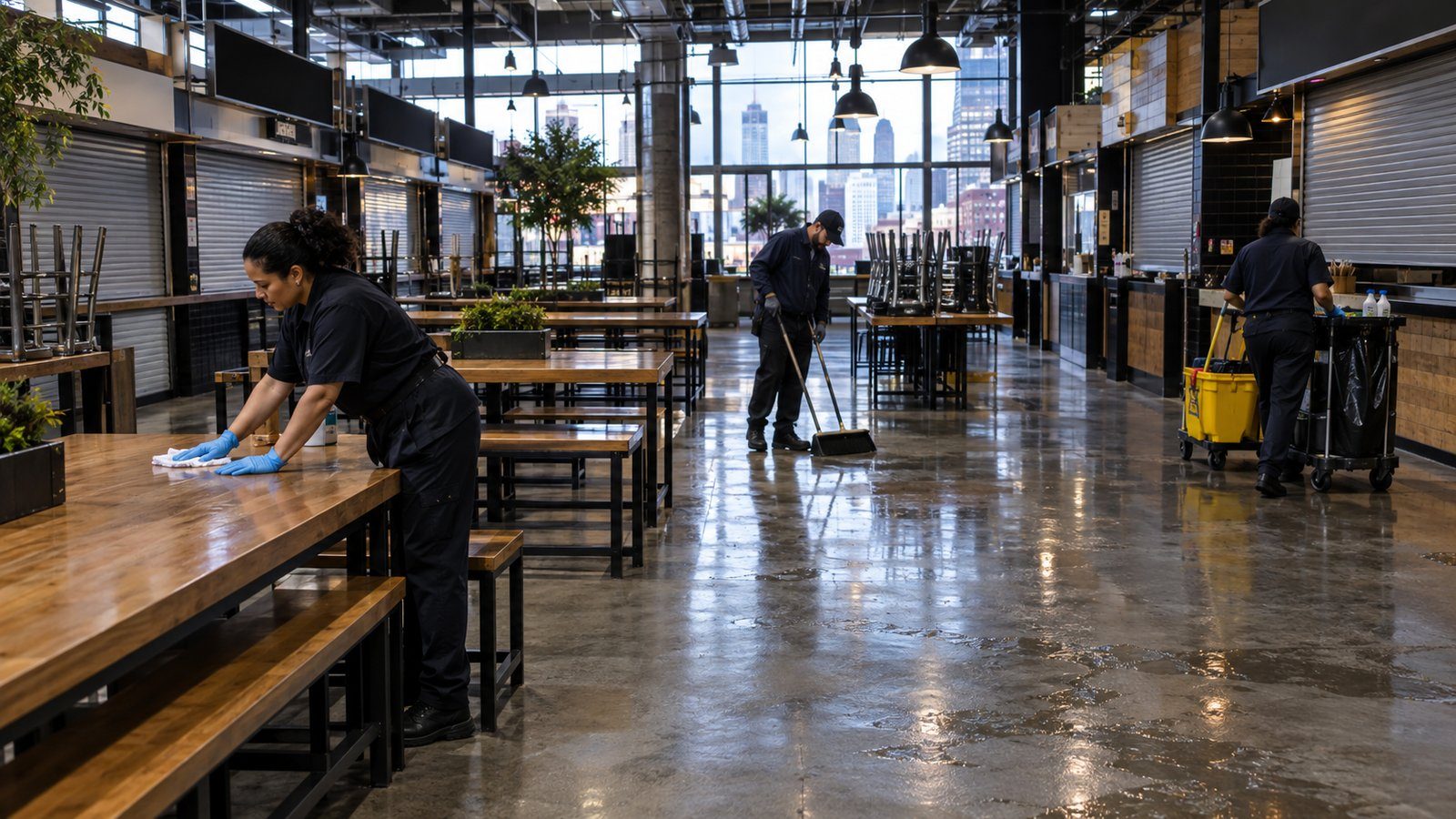
A New York food hall is a collection of businesses sharing a public dining room, restrooms, circulation routes, and waste infrastructure. Cleaning succeeds when the operator, stall vendors, landlord, and janitorial provider agree on who owns each surface and when it can be serviced. The NYC Health Code requires food establishments to keep non-food-contact surfaces free of accumulations and food-contact surfaces clean; grease and waste responsibilities also involve other rules and licensed service providers. GreenPoint Maintenance Services builds a coordinated scope for shared spaces without claiming responsibility for each tenant's food preparation or regulated equipment. Call 347-332-9348 to arrange a walkthrough for your NYC venue.
Draw the line between shared space and vendor responsibility
Create a responsibility map before pricing. The property operator may control the dining hall, public corridors, restrooms, entrances, elevators, and common waste staging area. Each stall may remain responsible for its counters, food-contact equipment, hand sinks, refrigeration, and tenant-specific procedures. Some leases assign shared dining-table resets to hall staff while requiring vendors to keep the floor immediately around their stall clean. GreenPoint Maintenance Services translates those lease and operating rules into a task chart, so staff do not cross into a tenant's kitchen or assume that a shared-services contract satisfies a vendor's own obligations.
NYC Health Code Article 81 addresses food establishment sanitation, including keeping non-food-contact surfaces free of dust, food residue, grease, and debris and maintaining food-contact surfaces clean. The [NYC Health Code Article 81](https://www.nyc.gov/assets/doh/downloads/pdf/about/healthcode/health-code-article81.pdf) should be read alongside the venue's permits, leases, and food-safety procedures. It does not turn a janitorial vendor into the food operator. GreenPoint can support the venue's common-area plan while each vendor manages its own food handling and surfaces. To set the division of duties at your location, call 347-332-9348 for a walkthrough.
Schedule resets around lunch, dinner, and event traffic
Food hall traffic arrives in waves. A venue near Grand Central Terminal, Vanderbilt Avenue, Chelsea Market, the Brooklyn waterfront, or the 14th Street subway corridor may see a sharp lunch rush followed by an event-driven evening peak. A practical staffing plan can use short table-and-floor sweeps during open hours, restroom inspections on a timed route, and a deeper closing reset after vendors finish service. Avoid leaving wet floors across a queue or blocking a service counter during peak traffic. The operating calendar should also list private events, holidays, deliveries, and late-night vendor schedules.
A 20,000-square-foot hall with 15 stalls and 500 seats does not need every square foot treated identically. High-touch tables, condiment points, elevator lobbies, and restrooms may need more frequent attention than a back-office corridor. Set objective triggers such as visible spills, full bins, an unavailable restroom fixture, or a reported broken glass. JaniTrack can record assigned sweep times, photos, and exceptions through a live dashboard. GreenPoint supervisors review whether a task was completed, not whether the hall was perfectly clean throughout every minute of service. Schedule a GreenPoint walkthrough at 347-332-9348 to map rush windows and service lanes.
Keep food spills, table touchpoints, and floors in sequence
For a shared dining area, a reset sequence can start with removing waste and food residue, followed by a detergent clean and then disinfection when required by the venue's approved product and procedure. Keep cleaning tools off tables and separate restroom tools from dining-room tools. Use a system for identifying a spill response, protecting the public from the work zone, and reopening a surface only after it is safe and dry. Glass, sauces, and greasy food scraps call for different pickup methods; never sweep broken glass into a cloth bag or push it toward a floor drain.
NYC rules require food-contact surfaces to be clean and kept free of contaminants, while tenant contracts often define who sanitizes dining tables between customers. State explicitly whether GreenPoint's scope covers table wiping, chairs, floors under movable seating, condiment shelves, wall splash zones, and entry mats. For facilities that want additional assurance, ATP testing can be included by agreement on a defined surface sample; it is not a pathogen test. Our [restroom cleaning best practices](/blog/restroom-cleaning-best-practices-high-traffic/) and [color-coded microfiber systems guide](/blog/color-coded-microfiber-systems-guide/) offer supporting ideas for non-food-contact tasks and tool separation.
Coordinate waste, grease, and contractor handoffs
Waste areas can create odor, pest, slip, and compliance problems if the responsibility chain is vague. The operating plan should show where bags are staged, who moves them, when the hauler arrives, how leaks are handled, and who cleans the container exterior. NYC Department of Environmental Protection guidance states that food-service businesses generating grease need properly sized and maintained grease interceptors; installation requires a NYC Licensed Master Plumber. Grease-interceptor pumping, waste hauling, and hood-exhaust cleaning are not interchangeable with routine janitorial work, and should be assigned to qualified vendors under the applicable requirements.
NYC's [grease disposal guidance for businesses](https://home4.nyc.gov/site/dep/water/disposing-of-grease-as-a-business.page) describes interceptor and grease-disposal responsibilities, while FDNY rules may govern commercial cooking exhaust systems and approved service companies. A janitorial bid should clearly exclude licensed mechanical or exhaust-system work unless the bidder separately proves authorization and scope. GreenPoint Maintenance Services coordinates timing and handoffs with the venue's building manager and vendors, but does not hide specialized contractor costs inside a general cleaning line. For a transparent map of cleaning, waste, and licensed-trade boundaries, call GreenPoint at 347-332-9348.
Protect entrances, transit-facing glass, and neighborhood operations
The entry plan needs to account for foot traffic, delivery carts, wet weather, and sidewalk debris. A hall near Union Square, Columbus Circle, Fulton Street, or Atlantic Terminal may have repeated surges from subway and commuter-rail connections. In Dumbo and the Brooklyn Navy Yard, waterfront wind can carry dust into vestibules; in Midtown, lunch queues can load an entrance mat in a short period. Set mat inspection intervals, glass-touchup expectations, and a safe process for spot-mopping without blocking a queue. Operators should also coordinate delivery access and public-area work with building security.
GreenPoint offers fixed pricing against a documented schedule rather than charging an open-ended number of hours. A walkthrough records floors, entrances, stall count, seats, restroom fixtures, service hours, public event schedule, and the locations of water and chemical storage. The quote identifies included supplies, day coverage, after-close work, floor projects, and excluded licensed services. GreenPoint Maintenance Services is MBE/MWBE certified in New York programs, which may help eligible public or institutional buyers meet stated participation goals; certification is not a substitute for checking solicitation rules. Call 347-332-9348 to request a venue walkthrough and written quote.
Verify service with simple, shared operating records
A food hall manager needs evidence that connects a complaint to a time, location, and owner. Use a floor map with zones, scheduled rounds, restroom checks, spill reports, supply shortages, and after-hours completion. A timestamped image can clarify a missed or blocked area, while the dashboard can show whether a route was completed. Keep tenant-specific food-safety logs in the tenant's own controlled records; a vendor cleaning report should not be represented as a health inspection or food-safety certification. A monthly review of repeat issues can expose a broken trash lid, poor mat placement, undersized bin, or staffing mismatch.
JaniTrack supports timestamped, GPS-tagged photos and live task status for GreenPoint assignments. Managers can audit samples, compare completion to service levels, and record corrective actions. GreenPoint has a reported 98% client retention rate, but every venue should verify service references and confirm the actual scope before award. Use our [commercial cleaning audit checklist](/blog/cleaning-audit-checklist-facility-managers/) and [how to choose a commercial cleaning company](/blog/how-to-choose-commercial-cleaning-company/) when preparing a bid. For a shared-space dashboard walkthrough, contact GreenPoint Maintenance Services at 347-332-9348.
Set escalation tiers so employees can act quickly without making decisions outside their authority. A small dry crumb near a table may be handled on the next sweep; broken glass, a bodily-fluid spill, a blocked exit, or a leak near electrical equipment should trigger immediate isolation and manager notification. The venue should choose the response owner, record the time, and decide when the public can safely use the area again. A monthly review can compare incident times with staffing coverage and determine whether a second peak-period sweep is worthwhile. GreenPoint can report an exception and secure the agreed work zone, while the venue's manager directs any safety or food-operation response.
Food halls also need a clear close-to-open handoff. The closing manager can record which vendors finished late, whether a private event left extra waste, which restrooms were taken out of service, and whether the public floor was released for the overnight crew. The opening manager should know about any incomplete area before guests arrive, not discover it during the first rush. A short shared log with time, location, status, and responsible contact is usually more actionable than a long narrative report. GreenPoint can attach an exception to the scheduled route, while the operator decides whether the issue requires a maintenance technician, pest-control provider, licensed waste vendor, or extra cleaning visit.
Frequently asked questions
Who cleans dining tables between guests? The lease and operating plan should name the party. Some venues assign table resets to hall staff; others require guests or vendors to follow a different process. Put frequency and approved products in writing.
Does a janitorial contract cover a stall's food-contact equipment? Not unless that work is expressly included, authorized, and aligned with the stall's food-safety procedures. Food operators retain responsibility for their own operations.
How often should restrooms be checked? Set the interval from customer volume, event schedule, fixture count, and observed complaint patterns. During peak periods, a documented timed route and trigger-based spot response are more useful than a once-per-shift assumption.
Can GreenPoint clean a grease interceptor or exhaust hood? Routine janitorial service does not replace licensed or specially approved interceptor, hauling, or hood-exhaust services. The operator should hire qualified contractors and coordinate their schedules with the cleaning plan.
What should an NYC food hall include in a cleaning RFP? Provide a common-area map, stall boundaries, operating hours, seating count, event calendar, restrooms, waste routes, approved products, service frequency, response expectations, and exclusions for regulated or licensed work.
GreenPoint Maintenance Services provides fixed-price common-area cleaning with JaniTrack task evidence and a 98% client retention rate. Call 347-332-9348 to schedule an NYC food hall walkthrough and clarify vendor, waste, restroom, and shared-space responsibilities.