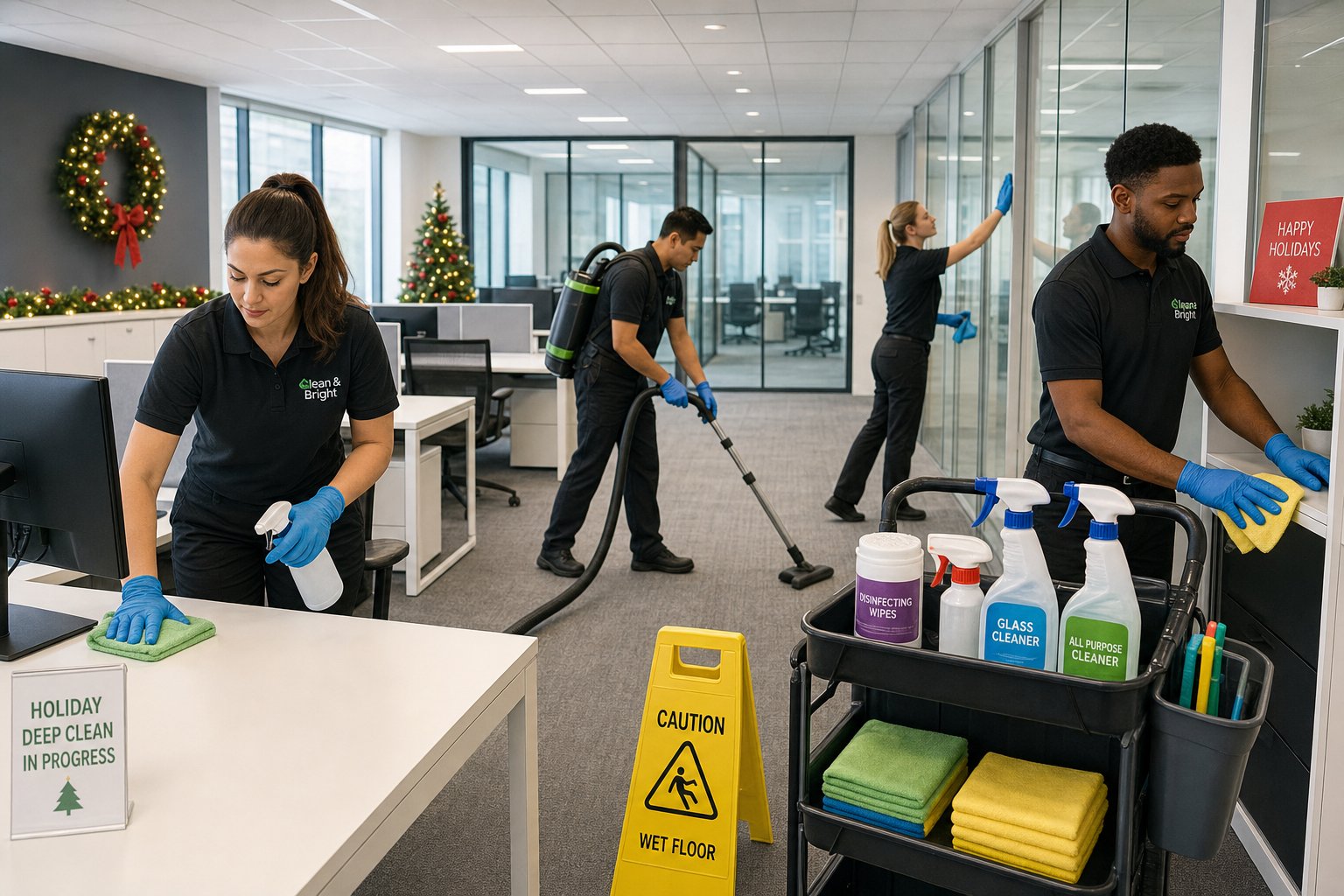
Holiday shutdowns create a rare operating window: fewer occupants, more open rooms, and a deadline before employees return. A successful deep clean is not simply a larger nightly service. It requires a scope, access plan, staffing reserve, floor and carpet decisions, safety controls, tenant communication, and an inspection handoff. This timeline helps facility managers in Manhattan, the Bronx, Brooklyn, Queens, Staten Island, Westchester, Long Island, New Jersey, Connecticut, Pennsylvania, and Florida plan year-end work. GreenPoint Maintenance Services provides fixed pricing, StockPoint verification, Green Seal certified product options, and a walkthrough at 844-814-0810.
Start six to eight weeks before shutdown
Begin with a building fact sheet: occupied square footage, floor types, carpet areas, kitchens, restrooms, elevators, conference rooms, storage, loading windows, access badges, alarm procedures, and the first day employees return. Identify whether the building is a Midtown tower near Grand Central or Penn Station, a Brooklyn office near Atlantic Terminal, a suburban campus in Westchester, or a Florida facility with storm-related constraints. GreenPoint uses the walkthrough to separate routine scope from project work.
Ask department leads for calendar conflicts. Finance closes books, HR may hold year-end meetings, IT may stage equipment, and landlords may schedule inspections during the same shutdown. Create a room list with “available,” “restricted,” and “must-not-move” items. GreenPoint Maintenance Services can price the confirmed scope with no hourly billing or hidden fees and document assumptions so a late access change becomes a written change, not a surprise invoice.
Choose the right project scope
Deep cleaning should be specific: carpet extraction, upholstery cleaning, high dusting, ledges, vents, baseboards, glass, partitions, floors, kitchens, appliances, restrooms, waste rooms, and storage closets. Separate routine service from restorative work such as VCT strip and seal, stone honing, grout treatment, or post-construction cleanup. The [VCT floor care strip seal wax guide](/blog/vct-floor-care-strip-seal-wax-guide/) and [carpet cleaning methods compared guide](/blog/carpet-cleaning-methods-compared/) help managers choose methods based on surface and soil.
Do not overbook every specialty on the same night. Wet floor work needs cure time, carpet may need ventilation, and high dusting should precede final floor care. GreenPoint sequences tasks from high to low and clean to dirty, then reserves time for inspection and rework. A 100,000-square-foot building may need two or three phases rather than a single heroic crew. Call 844-814-0810 for a site-specific schedule and fixed quote.
Build a labor and access plan
List the crew by role: project lead, floor-care technicians, carpet team, detail cleaners, restroom and kitchen specialists, porter, safety lead, and supervisor. Include relief coverage for illness and a plan for badge failures, locked rooms, elevator downtime, or a delayed delivery. BLS wage data can inform budgeting, but labor hours must reflect furniture density, floor transitions, distance to closets, and the building’s service elevator. GreenPoint documents these assumptions instead of selling an unrealistic flat room count.
Coordinate building security, freight elevators, loading docks, parking, trash pickup, and alarm settings. Holiday work near Times Square, Hudson Yards, Downtown Brooklyn, Newark, Stamford, Philadelphia, or Tampa may involve reduced transit and altered access. Provide a contact tree with the facility manager, landlord, security desk, engineering, vendor supervisor, and emergency number. GreenPoint can schedule a walkthrough at 844-814-0810 and put the handoff in writing.
Protect equipment, documents, and occupants
Before work starts, identify sensitive equipment, artwork, confidential papers, personal items, plants, food, and electronics. Require department owners to clear desks and label items that cannot move. Cleaning staff should not unplug servers, open locked cabinets, or discard documents without authorization. GreenPoint uses a room-by-room exception process and can attach approved timestamped photos through StockPoint where the client permits them, reducing disputes about pre-existing conditions and inaccessible areas.
Chemical safety and wet-floor controls matter even when the building is mostly empty. Maintain labels and SDS access, use required PPE, barricade wet areas, protect cords, and keep exits clear. The [OSHA cleaning chemical safety and GHS/SDS guide](/blog/osha-cleaning-chemical-safety-ghs-sds/) provides a useful checklist. GreenPoint Maintenance Services trains the team and records exceptions rather than allowing a holiday deadline to justify unsafe shortcuts.
Use a week-of execution timeline
Five to seven days before the shutdown, confirm access, crew, supplies, equipment, weather, and the room list. One to two days before, remove food, waste, temporary signage, and personal items; photograph or record spaces under the client’s privacy rules. During the project, hold a start-of-shift briefing, confirm priorities, and review the first completed zone before scaling. GreenPoint uses StockPoint route status, task records, and approved photo evidence to keep facility managers informed without requiring them to stand on every floor.
On the final day, reserve time for re-cleaning, drying, odor checks, floor inspection, restroom restock, kitchen reset, and waste removal. Do not treat “crew left” as completion. A supervisor should sample high-visibility areas, entrances, conference rooms, executive spaces, kitchens, and restrooms. GreenPoint reports both passed zones and exceptions, assigns a closeout owner, and provides a direct contact at 844-814-0810 for urgent corrections.
Prioritize high-impact spaces
If time is limited, protect the spaces employees notice first: entrances, reception, elevator cabs, restrooms, kitchens, conference rooms, shared work areas, and carpeted traffic lanes. Remove residue from touchpoints, detail door edges, clean under accessible furniture, and empty waste before the first return day. A building near LaGuardia or Newark may need extra lobby and floor attention because winter weather begins with tracked moisture. GreenPoint can set a priority matrix based on visibility, traffic, hygiene, and business impact.
Include low-visibility areas that create recurring complaints: supply closets, waste rooms, under sinks, baseboards, vents, high ledges, and breakroom appliances. GreenPoint Maintenance Services uses a rotation so deep work does not disappear behind a polished lobby. The [commercial cleaning audit checklist](/blog/cleaning-audit-checklist-facility-managers/) can become the closeout form. Call 844-814-0810 when your current shutdown plan has a list of tasks but no acceptance standard.
Verify with measurable acceptance standards
Write standards before the crew arrives. Examples include no visible dust at arm’s length on sampled ledges, no streaks on lobby glass, no residue on floors, dry and stocked restrooms, closed waste liners, clean mat edges, and 95% first-pass acceptance on a defined sample. Add limits for carpet moisture, floor cure time, and furniture return. GreenPoint uses StockPoint to show task status, time, exceptions, and approved GPS-tagged photos where permitted.
Use a punch list with room, defect, severity, responsible role, due time, and closure. A cosmetic defect may wait until the next shift; a slippery floor, blocked exit, or missing restroom soap requires immediate correction. GreenPoint’s 98% client retention reflects a process that makes quality visible and actionable. Fixed pricing includes the agreed scope, while specialty additions are written and approved before work proceeds.
Prepare the January restart
Before reopening, confirm ventilation, temperature, restroom supplies, kitchen readiness, waste capacity, elevator protection, and removal of wet-floor signs. Walk the primary arrival route from curb or parking through lobby, elevator, workstation, restroom, and breakroom. Check that no equipment, carts, cords, or chemicals remain in public areas. GreenPoint can provide a restart inspection and a short first-week porter plan so the building stays clean after employees return.
Use January feedback to improve next year. Compare planned and actual labor hours, inaccessible rooms, rework, supply use, tenant complaints, and first-week soil. Update the room list and scope while the details are fresh. GreenPoint offers Green Seal product options, StockPoint reporting, fixed pricing with no hidden fees, and regional coverage across the tri-state area, Pennsylvania, and Florida. Schedule a planning call at 844-814-0810.
Keep a contingency reserve in the timeline. A locked room, delayed equipment delivery, wet weather, or a floor that needs a second pass can consume the margin in an otherwise sound plan. GreenPoint Maintenance Services recommends reserving at least 10% of project labor for punch-list work and access changes, then releasing that time when the supervisor confirms the building is ready. Document any deferred task with a new date and owner. This gives leadership an honest closeout and prevents a rushed final shift from creating wet floors, damaged finishes, or an unfinished January restart.
During the first two service cycles, GreenPoint asks the site contact to review one completed zone with the supervisor. This short calibration confirms that the written standard matches the building, the tools are available, and the escalation path works. Record the agreed interpretation before expanding the route to every floor. GreenPoint can revise the scope after the walkthrough, provide a written quote, and keep the evidence understandable for operations, procurement, and the people who perform the work.
Keep the handoff practical: name the next action, the responsible person, and the time it will be checked. GreenPoint Maintenance Services can summarize open items for the facility manager and confirm closure through StockPoint when that workflow is enabled. This record supports a steady service relationship, reduces repeated calls, and gives procurement a clear explanation of what the recurring program includes.
For a multi-site program, use the same core fields at every location: site, zone, task, timestamp, exception, corrective action, and verifier. GreenPoint can then compare properties without pretending that every building has identical traffic or floor care needs.
Frequently Asked Questions
Q: When should an office plan a holiday deep clean? A: Begin six to eight weeks ahead for a complex building, earlier if specialty floor work, access restrictions, or multiple tenants are involved. GreenPoint can walk the site and create a phased schedule.
Q: Should carpet extraction and floor refinishing happen on the same night? A: Usually they should be sequenced by zone because drying and cure time, equipment, and inspection needs differ. GreenPoint sets the order around the return date and ventilation.
Q: What should a holiday cleaning quote include? A: It should state rooms, surfaces, frequencies, labor assumptions, equipment, supplies, access, exclusions, verification, and change rules. GreenPoint offers fixed pricing with no hourly billing or hidden fees after scope confirmation.
Q: How does GreenPoint verify a shutdown deep clean? A: StockPoint can show task status, exceptions, timestamps, and approved GPS-tagged photos, supported by supervisor sampling and a punch list. Call 844-814-0810 to define the acceptance standard.
Q: How do I schedule a holiday office walkthrough? A: Call GreenPoint Maintenance Services at 844-814-0810. GreenPoint will review access, floor care, kitchens, restrooms, staffing, safety, and the January restart.
Finish the year with a documented office deep clean from GreenPoint Maintenance Services at 844-814-0810. Get a phased walkthrough, StockPoint verification, Green Seal options, and proof-driven service backed by 98% client retention.