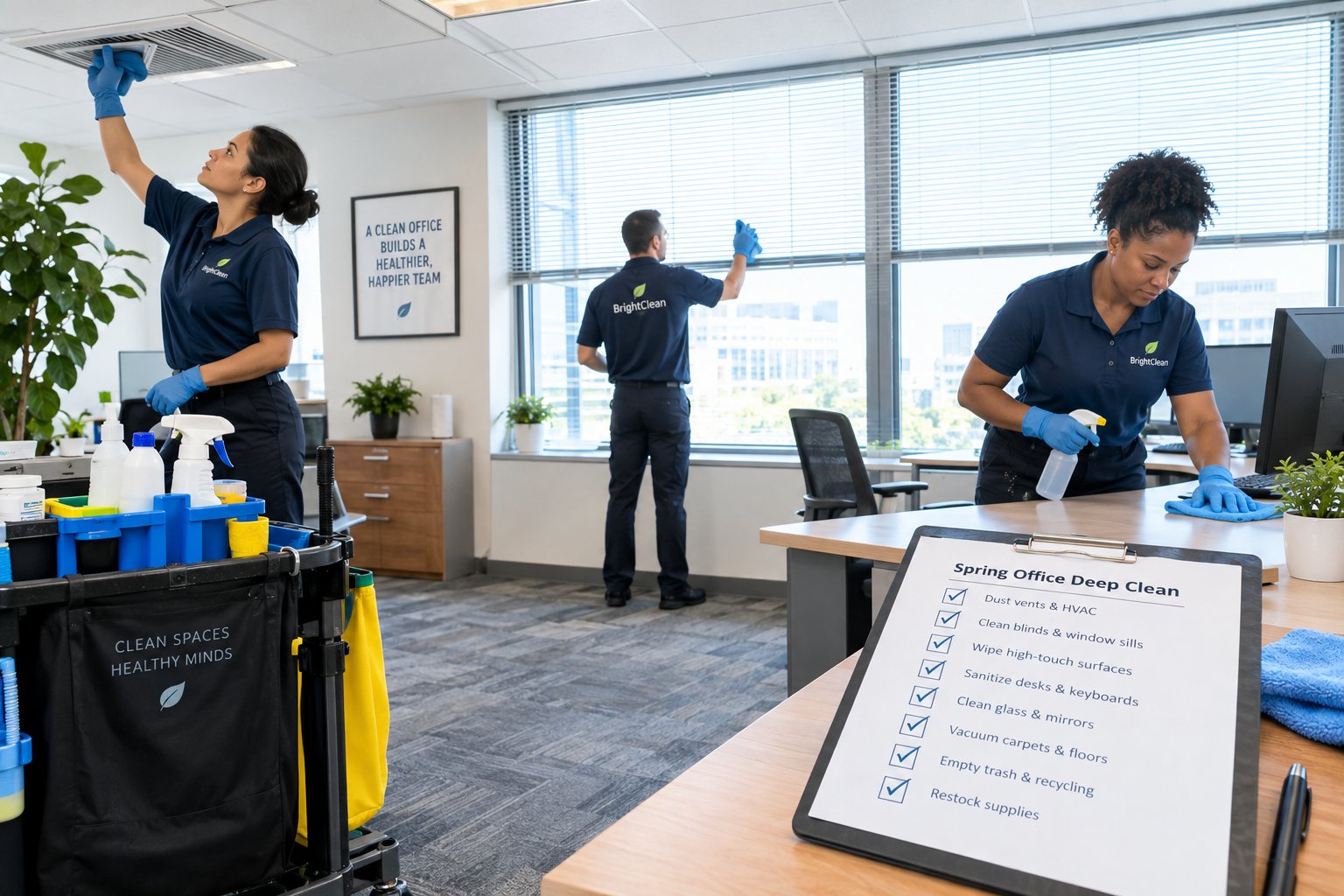
Spring office cleaning works best as a controlled dust-removal program, not as a one-day fragrance treatment. Pollen and settled dust can accumulate on window sills, blinds, ledges, upholstery and return-air grilles, then become airborne again when surfaces are disturbed. GreenPoint Maintenance Services helps New York, New Jersey and Connecticut offices prioritize the surfaces that staff touch and the places where dust actually collects. A manager can pair the plan with [commercial cleaning and indoor air quality practices](/blog/indoor-air-quality-commercial-cleaning/) and the [HEPA filtration guide](/blog/hepa-filtration-commercial-cleaning/) while keeping ventilation maintenance with qualified building engineers.
Inspect dust-prone rooms before scheduling
Before assigning spring detail work, walk representative rooms and note visible dust, renovation residue, open windows, water stains and recurring complaints by location. A dusty return grille may call for facilities or HVAC investigation; a cleaning crew should not open equipment or claim that housekeeping has corrected an air-quality problem. Record whether the concern is on a horizontal ledge, fabric surface, floor edge or supply/return area so the right trade owns the follow-up. GreenPoint uses a zone list to separate accessible cleaning from restricted mechanical work and can schedule an assessment at 844-814-0810.
Schedule detail work when surfaces can be reached safely. Conference rooms may be empty early in the morning, while private offices need occupant permission before moving desk items. Identify furniture that may be shifted and the surfaces that must remain untouched, such as personal papers, medication, food, confidential files or client equipment. If a room cannot be released, record it as not serviced and agree on a return window. GreenPoint’s fixed scope makes the access assumption visible: a quote should identify whether desks are cleared by occupants and whether moving heavy furniture is excluded.
Sequence seasonal office dust removal
Use a simple sampling map for a multi-floor office: select reception, one open-plan zone, one conference room, a pantry and a representative private office. Mark high shelves and narrow ledges that routine routes miss, and note surfaces the tenant has asked the crew not to move. For an office around Bryant Park or the Flatiron District, seasonal window opening and construction nearby may change which areas collect visible dust; Brooklyn and Jersey City buildings can have different façade, street and loading conditions. GreenPoint’s [cleaning frequency standards by facility type](/blog/cleaning-frequency-standards-by-facility-type/) help managers distinguish a one-time seasonal detail from a change to daily service.
Dust tools should be selected for the surface and maintained between tasks. A damp microfiber cloth can capture soil on many hard surfaces, while a compatible vacuum tool may suit upholstery or carpet; neither method should be used blindly on delicate coatings or electronics. Fold cloths to expose clean working faces and change them when soiled so a crew does not transfer residue from one desk bank to another. GreenPoint trains teams to keep clean and used textiles separated on the cart. Supervisors can sample a few high ledges and horizontal surfaces after service to confirm the agreed finish.
Keep HVAC and janitorial responsibilities clear
Do not infer that an employee’s symptoms were caused by a particular surface or cleaning product. Ask the facilities or occupational-health contact to coordinate any indoor-air investigation, and pass on observable conditions such as a persistent odor, visible moisture or repeated dust deposits. GreenPoint can document what the crew sees and where it was found, while engineering staff assess filtration, outside-air settings and equipment condition. The cleaning work order should specify the boundary: remove settled dust from approved surfaces, report inaccessible or damaged components, and do not change thermostat or ventilation controls. That keeps a spring clean useful without turning it into an unsupported health claim.
If building engineering wants an HVAC filter check, assign it to the person qualified to access the unit and retain that maintenance record separately from janitorial work. A cleaning ticket can note that a grille face is visibly dusty or that a filter access panel is blocked; it should not say a filter was replaced unless the authorized technician performed and recorded that work. At older Midtown offices and renovated Brooklyn lofts, access panels and controls may be in tenant or landlord areas with separate permissions. GreenPoint asks the client to identify those boundaries before crews enter mechanical spaces.
Protect surfaces and occupants
A defined dust-removal sequence limits re-deposition. Work from higher accessible surfaces to lower ones, use a suitable damp microfiber method where the surface allows it, vacuum carpet and fabric with the approved filtration equipment, and finish with floors after overhead dusting. Change cloths between zones and replace them when they become visibly soiled; dry feathering can scatter particles and make it difficult to show what was removed. GreenPoint uses task cards that identify the approved tool, surface and sequence. Ask for a walkthrough at 844-814-0810 to identify high ledges, blinds, fabric panels and other detail tasks that need separate labor.
Use a product register to prevent an ad hoc spring “freshening” spray from becoming a new exposure. Choose only a client-approved product suited to the surface, follow its dilution and label directions, and avoid unnecessary fragrance or mixing. Workers should have access to the applicable safety information and know how to report irritation, a spill or a damaged container through the employer’s process. GreenPoint can supply the product list for a walkthrough at 844-814-0810. Product certification or an environmental label is not, by itself, evidence that a cleaner removes pollen or treats an allergy.
Verify spring detail work
Protect the building’s finishes and people while cleaning. Check whether a surface is painted, coated, untreated wood, electronics, acoustic fabric or a delicate screen before wetting it. Keep liquid away from electrical equipment, follow the manufacturer’s method and do not mix products. If a product is used, the crew follows its label and the facility’s approved chemical list. GreenPoint’s green-cleaning program uses Green Seal-certified products where the applicable task and product certification fit; certification is not a claim that every product treats allergens or disinfects. The [green cleaning guide](/blog/green-cleaning-commercial-buildings-guide/) explains how to separate environmental preferences from a product’s specific intended use.
A practical quality review compares a small sample of the work with a pre-service baseline. Photograph only approved, nonconfidential areas; record the same ledge or room identifier before and after; then note whether an access issue prevented completion. Use occupant feedback to identify a missed location, not to diagnose a health condition. GreenPoint can combine supervisor observations and StockPoint task records into a closeout summary for the facility manager. A trend of visible dust near a grille or moisture on a sill belongs with building operations, even if the adjacent surface was cleaned successfully.
Scope and price office cleaning in spring
Treat filters and ducts as a boundary, not a shortcut. Office cleaning can remove dust from accessible grille faces after the equipment owner approves the method, but only qualified maintenance personnel should open HVAC equipment, replace filters or change system settings. Keep a log of observations: date, floor, grille or room identifier, visible condition and referral to facilities. GreenPoint can include that non-invasive check in a route where the client authorizes it, then attach an exception in StockPoint for follow-up. Call 844-814-0810 if a spring scope should include accessible vent faces while excluding internal mechanical work.
Coordinate the project with real travel and freight conditions. A Manhattan office may need a freight-elevator booking and after-hours access, while a Queens or Long Island site may permit daytime work but restrict parking or loading. A phased plan can limit disruption: complete one floor or suite, review the result, then release the next group. GreenPoint will identify the crew window, client contact and building access requirements before confirming price. For an office spring cleaning quote in Manhattan, Brooklyn, Jersey City or Stamford, call 844-814-0810 and share the floor plan, square footage and task list.
Plan tenant access and project timing
Evaluate the spring project with the same clarity used for recurring janitorial work. Identify square footage by surface and task, not only by the suite’s gross area: a large open floor with few obstructions differs from dense workstations, extensive glass partitions or high shelving. Write down whether desks must be cleared, whether occupants are present, where furniture may be moved, and what counts as completed. GreenPoint Maintenance Services Corp. offers fixed pricing based on the agreed scope, with no hourly billing or hidden fees. GreenPoint can provide a walk-through quote at 844-814-0810 and set a reinspection date to verify the detail work without promising medical outcomes.
Give occupants a concise notice that describes timing, rooms affected, desk-clearing expectations and how to request that a private area remain untouched. Avoid telling staff that a spring project prevents allergies or removes every airborne particle; those claims depend on factors outside the cleaning scope. A post-service note can list completed zones, areas deferred for access, visible maintenance observations and the contact for corrections. GreenPoint can provide that summary with timestamps while excluding confidential desk contents. A clear notice is especially helpful in shared offices near Grand Central, Downtown Brooklyn and Journal Square, where visitors and tenants may use the same circulation areas.
Frequently Asked Questions
Q: Does spring cleaning eliminate office pollen or allergies?
A: Cleaning can remove visible settled dust from approved surfaces, but it cannot guarantee that pollen is eliminated or prevent symptoms. Ventilation, outdoor conditions and individual sensitivities are separate considerations.
Q: Should janitorial staff clean inside air ducts?
A: Not unless the work is specifically authorized and performed by qualified personnel. Routine crews can report visible issues at accessible surfaces and refer equipment concerns to building engineering.
Q: What areas are commonly missed in routine office cleaning?
A: Depending on access and layout, managers often review blinds, high ledges, tops of cabinets, fabric seating, baseboard edges and accessible grille faces for seasonal detail needs.
Q: How long does an office spring detail take?
A: It depends on square footage, furniture density, access, surface types and the amount of work excluded from daily service. A site walkthrough is more reliable than a universal square-foot estimate.
Q: Can GreenPoint use HEPA filtration?
A: GreenPoint can specify approved vacuum equipment for tasks and surfaces where it is appropriate. The equipment’s role and maintenance should be documented; it is not a substitute for HVAC service.
Request an office spring-cleaning walkthrough from GreenPoint Maintenance Services at 844-814-0810 or info@greenpointms.com. Our MBE-certified team records approved dust-detail zones with StockPoint evidence.