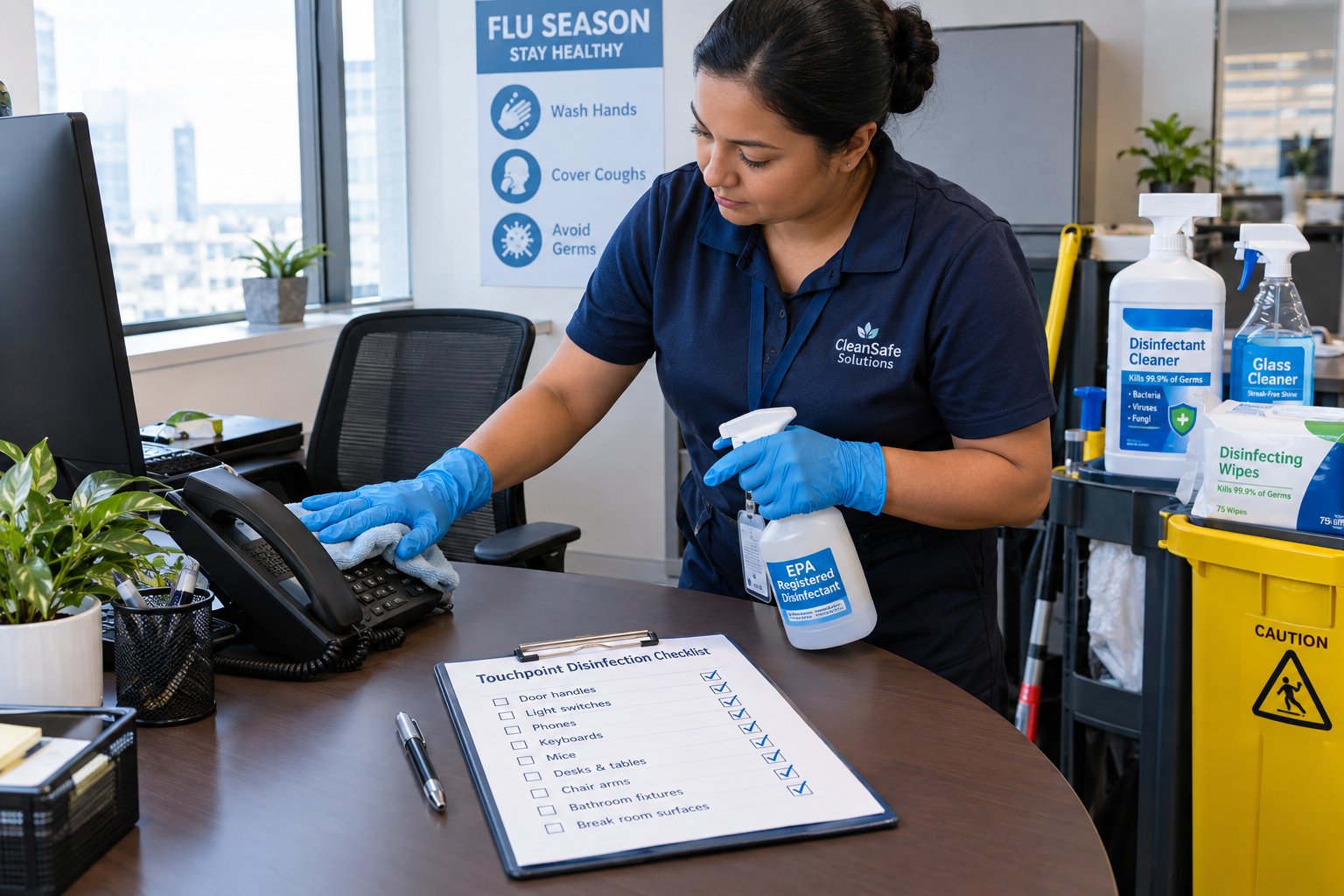
A flu-season office cleaning scope should describe routine soil removal, priority touchpoints, restrooms, shared equipment, product directions and escalation when a space is visibly contaminated. No cleaning vendor can promise that a workplace will avoid respiratory illness or that disinfection alone will reduce absences by a specific percentage. GreenPoint Maintenance Services builds a practical, label-compliant program for offices in Manhattan, Brooklyn, Queens, the Bronx, New Jersey and Connecticut. For broader planning, see [indoor air quality and commercial cleaning](/blog/indoor-air-quality-commercial-cleaning/) and [electrostatic disinfection: uses and limitations](/blog/electrostatic-disinfection-explained/).
Define the flu-season cleaning objective
The objective is to maintain a clean, usable workplace and perform any targeted disinfection required by the facility’s risk assessment—not to claim a guaranteed health outcome. The [CDC respiratory virus prevention guidance](https://www.cdc.gov/respiratory-viruses/prevention/hygiene.html) emphasizes everyday practices such as hand hygiene and cleaning frequently touched surfaces. The facility’s public-health or occupational-health lead decides whether a particular event warrants additional steps. GreenPoint documents the contracted work and keeps medical or absence information outside the janitorial record.
Write the scope in plain operational language that a night supervisor can use without interpreting medical policy. List the surface, room, method, schedule, product approval and who can authorize a change. Avoid vague instructions such as “disinfect everything” or “sanitize the office.” Those words can obscure which surfaces are included and whether the product is appropriate. GreenPoint’s [quality assurance program guide](/blog/quality-assurance-commercial-cleaning-program/) shows how a manager can connect a written standard to an inspection and corrective action. A Q1 review should update the route before an illness event occurs, not during a rushed overnight response.
Prioritize office touchpoints by use
Build a priority list from how people use the space. Door pulls, elevator buttons, conference-room controls, shared printers, break-room handles and restroom fixtures may warrant attention because they are frequently touched, while a wall or an unused high shelf may not be a disinfection priority. The list should name the location, approved method and frequency, and distinguish routine cleaning from a triggered response. For a multi-tenant tower near Grand Central or a shared workspace in Downtown Brooklyn, coordinate common areas with building management so tenants know which party owns each surface. GreenPoint can map those boundaries during a walkthrough; call 844-814-0810.
A touchpoint inventory should follow tasks, not just room labels. A conference table may be wiped after a booking, but its control panel and remote may need a separate method; a shared printer’s screen may not tolerate a liquid product. The facility should identify manufacturer restrictions and privacy controls for each shared device. In a coworking office near Downtown Brooklyn, occupancy can turn over throughout the day, while an office near Newark Penn Station may concentrate arrivals around commute periods. GreenPoint can phase service around those use patterns and record where access or device compatibility limits the contracted method.
Select products by label and task
Choose products by intended use, not by marketing language. When a facility requests disinfection, confirm the product’s EPA registration and the label’s approved surface, organism claim, dilution, application method, personal protective equipment and contact time. EPA’s [List N product information](https://www.epa.gov/pesticide-registration/list-n-disinfectants-use-against-sars-cov-2-covid-19) is a search tool for products with claims against SARS-CoV-2; it is not a substitute for reading the product label or a statement that every listed product treats every pathogen. GreenPoint records approved products and asks the client before substitutions.
A product substitution deserves a review even when the replacement appears similar. Verify the new product’s label, registration, surface compatibility, application directions, required PPE and contact time, then train staff before the first task. Keep old stock from being confused with newly approved material and update the closet inventory. GreenPoint maintains a site list and uses StockPoint to identify the product associated with a designated task where the client requests that record. Call 844-814-0810 for a product and scope walkthrough. GreenPoint’s [chemical safety guide](/blog/osha-cleaning-chemical-safety-ghs-sds/) explains why a current Safety Data Sheet and a disinfectant label serve different purposes.
Plan room access and incident response
Keep cleaning and disinfection as distinct steps when the label or soil condition requires it. Remove visible dirt with the appropriate cleaner, then apply the disinfectant to the specified hard, nonporous surface and keep it visibly wet for the full labeled contact time. If a surface dries too quickly, the method has not followed that direction; a staff member cannot shorten contact time just to fit a route. GreenPoint’s [cleaning and disinfection verification guide](/blog/what-is-atp-bioluminescence-testing-cleaning/) explains why visible verification, ATP testing and pathogen claims are different measures. ATP readings do not prove that a virus was removed or that a surface is sterile.
The incident protocol should specify who can release a room, who provides PPE and who receives the completion notice. Cleaning staff should not be asked to identify an illness, access a patient record or tell coworkers that a space was contaminated. Use a room number or facility zone rather than a person’s name in routine service records. If a room remains occupied, the crew should record that access was unavailable and notify the manager, not quietly mark the task complete. GreenPoint can provide an exception alert and return when authorized, with additional work handled under a separately documented scope.
Coordinate surface cleaning with facilities
Define a response path for reported illness or contamination. The manager—not a cleaner acting alone—decides whether a room should be closed, whether a targeted cleanup is required and which contacts must be notified. Provide the crew with a no-entry signal, a safe route, the product and PPE requirements, and a way to record completion without sharing a person’s health details. GreenPoint can log a room as unavailable, note the manager’s instruction and record the task when access is released. Call 844-814-0810 to set up a walkthrough that separates routine office cleaning from incident response and any additional service authorization.
Facilities teams can keep a maintenance referral alongside but separate from cleaning verification. A blocked grille, stained ceiling, failed dispenser or persistent leak should go to its building owner; the janitorial completion record should say whether the contracted surface work was performed. The CDC’s respiratory-virus guidance emphasizes several prevention measures beyond environmental cleaning, so property managers should coordinate communications with their occupational-health policy. GreenPoint does not set medical rules, recommend employees’ return-to-work decisions or promise fewer absences. It reports the cleaning performed and any visible issue that needs another trade.
Measure a compliant cleaning program
Coordinate cleanable surfaces with ventilation and occupant practices. A janitorial vendor should not alter HVAC settings, recommend a particular air-exchange rate or claim that cleaning resolves poor ventilation. Facilities or engineering staff maintain filters and controls; managers communicate handwashing, staying-home and respiratory etiquette guidance through their own channels. GreenPoint will report visible dust or a maintenance concern, but it does not diagnose air quality. A floor-by-floor route can include approved accessible surfaces and a separate escalation ticket for blocked grilles, persistent moisture or other visible conditions.
Review a flu-season program monthly using a short set of measures: scheduled tasks completed, inaccessible zones reported, approved product checks passed, exceptions resolved and complaints linked to a documented follow-up. Do not measure success by chemical volume or the number of rooms sprayed; those figures do not establish an effective result. GreenPoint can share timestamped, GPS-tagged photos where site privacy rules allow and can provide non-photo verification in sensitive spaces. The fixed-price proposal identifies included routine tasks and approved response options. Call 844-814-0810 to arrange a walkthrough and align the scope with the facility’s current policy.
Train teams and review scope changes
Measure service quality with records tied to the written scope. StockPoint can capture time, zone, completed task, permitted photo, product or exception, with supervisor review for missed or inaccessible touchpoints. Avoid collecting employee names, symptoms, medical records or photos of screens in routine cleaning documentation. A monthly review should compare scheduled versus completed work, recurring exceptions, product substitutions and corrections closed. GreenPoint Maintenance Services Corp. offers fixed pricing for a defined program, without hourly billing or hidden fees; ask for a walkthrough quote at 844-814-0810. GreenPoint’s 98% client retention is a company-reported service metric, not evidence of a health outcome.
Brief new hires and relief staff before they join the route, not after a supervisor discovers a missed step. Training should include the room list, approved cloth or applicator, product label, dwell time, PPE, no-entry signal, privacy boundaries and the method for reporting an unavailable surface. Test understanding by asking staff to demonstrate a task and explain what they would do if the product is out of stock. GreenPoint documents site orientation and supervisor follow-up, then reviews changes when the client adds a room, changes a product or revises the response process. The customer remains responsible for its own health policy and employee communications.
A written revision log makes seasonal updates easier to audit. Record who approved a new surface, product or frequency, the effective date, the training completed and whether the fixed-price scope changed. Keep the prior version available so a supervisor can explain which instruction applied to a service date. GreenPoint can attach the revision to the site task plan and schedule a short review with the client contact. A documented change prevents an informal email or verbal request from silently becoming an unpriced recurring obligation or an unverified disinfection claim.
Frequently Asked Questions
Q: Can a cleaning vendor promise fewer flu absences?
A: No responsible cleaning scope can guarantee that outcome. Cleaning is one workplace practice; exposure, vaccination, ventilation, hand hygiene and employee behavior also matter.
Q: How often should high-touch surfaces be disinfected?
A: Set frequency by occupancy, touch patterns, facility policy and applicable label directions. A site-specific risk review is more useful than a universal number.
Q: Does an EPA-registered disinfectant work immediately?
A: Use the specific product label. It identifies the required surface preparation, application and wet contact time for the stated claim.
Q: Should every office surface be disinfected every night?
A: Not necessarily. The facility should identify priority surfaces and tasks, avoid unnecessary chemical use and follow product labels and site policy.
Q: What belongs in a vendor’s service record?
A: Task, approved zone, time, completion or exception, product where needed and correction status. Avoid employee health details and unnecessary personal information.
For a fixed-price flu-season office scope, call 844-814-0810 or email info@greenpointms.com to request a GreenPoint walkthrough. GreenPoint Maintenance Services is MBE/MWBE certified, with timestamped StockPoint evidence for agreed tasks.