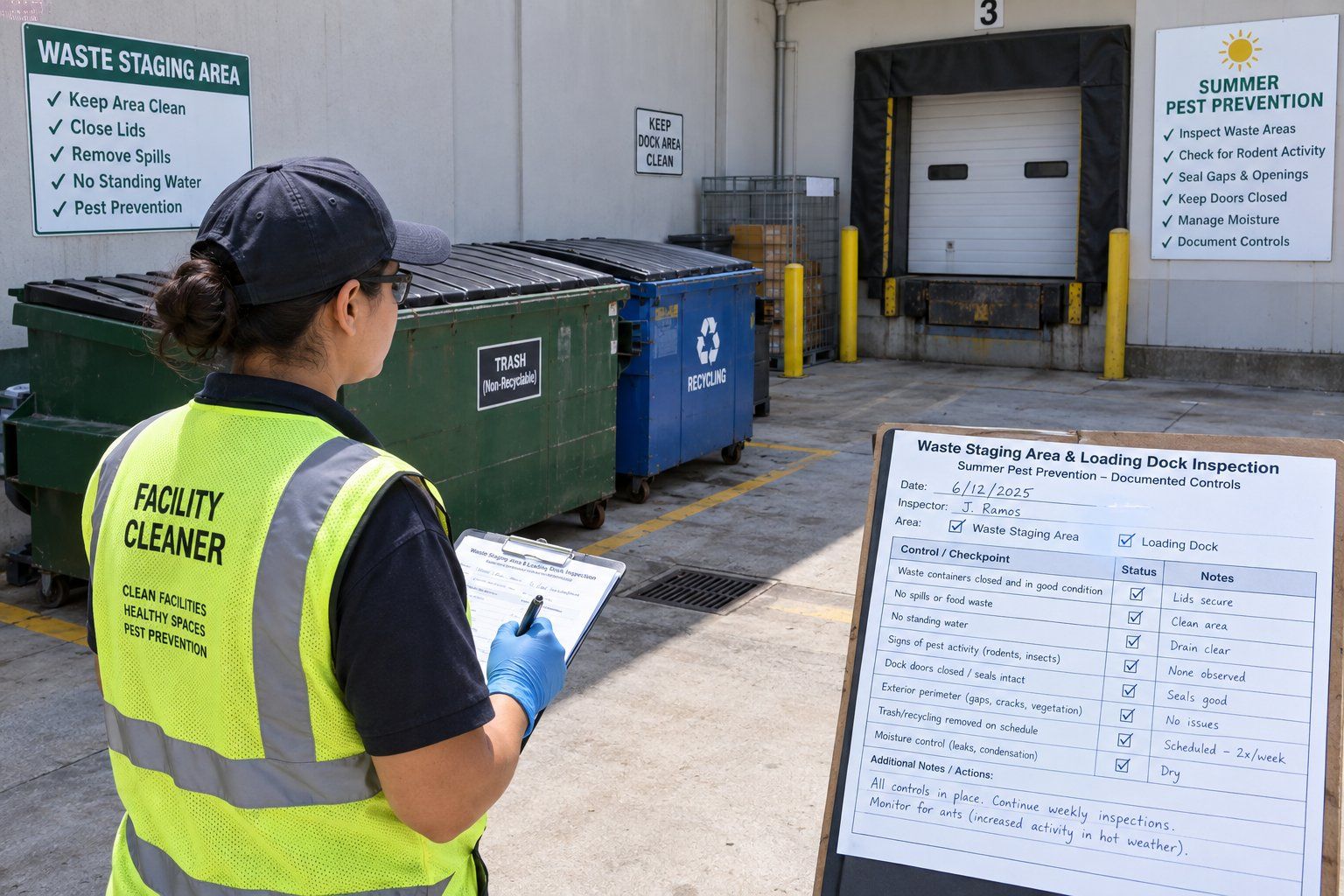
Summer pest prevention starts with denying pests food, water and shelter, then documenting the conditions that need repair or licensed pest-control attention. Cleaning crews can keep waste areas, pantry floors, loading docks and drains on a dependable routine, but sanitation alone does not replace exclusion work or a pest professional’s inspection. GreenPoint Maintenance Services helps commercial properties in New York, New Jersey, Connecticut and Pennsylvania make those responsibilities explicit. Use the [commercial restroom and high-traffic cleaning guide](/blog/restroom-cleaning-best-practices-high-traffic/) and [commercial cleaning audit checklist](/blog/cleaning-audit-checklist-facility-managers/) to build a related inspection trail.
Inspect waste routes and loading areas
Begin with a walk through the waste path from tenant pantry to collection point: interior bins, service corridors, compactor or dumpster, loading area and the exterior approach. Look for food residue, standing water, open containers, torn liners, gaps under doors and clutter against walls. The cleaning team can record those visible conditions but should not identify an insect or rodent species from a casual sighting. GreenPoint’s report separates cleaning defects from building repairs and pest-control referrals so the manager can send each item to the right owner.
A waste-room checklist should make safe boundaries explicit. List the approved bins, floor and wall areas, cleaning tools, personal protective equipment, spill response steps and prohibited materials. Staff should never reach into a compactor, handle sharps or sort unknown waste to improve appearance. If a bag leaks or a container has an unusual odor, follow the site’s exposure and emergency plan and notify the manager. GreenPoint’s team records the area as an exception and waits for direction where the task exceeds the approved janitorial scope. That protects the crew and preserves the evidence a pest professional may need.
Set waste-room cleaning frequencies
A summer plan needs special attention to access and weather. In Queens industrial corridors, deliveries can leave a dock door open; in Manhattan, refuse may wait in a narrow service space; in Stamford or Newark, exterior collection areas may be shared with other tenants. Assign a contact who can address an overflowing container or a door that fails to close. GreenPoint can set a service walkthrough at 844-814-0810 and note where crews may safely clean, where they must not handle waste and how a concern reaches property management after business hours.
Inspect the exterior interface after the building’s refuse pickup, not only before it. Check whether lids close, containers are returned to the designated pad, food residue remains on the ground or cardboard is accumulating beside the enclosure. Do not wash debris into a storm drain or apply a chemical that is not authorized for that area. Ask the property manager to coordinate with the hauler about missed pickups and with maintenance about broken gate hardware. GreenPoint can clean authorized surfaces and report conditions; container repair, exclusion and waste-hauler service should be assigned to their respective providers.
Coordinate sanitation with integrated pest management
Keep trash and recycling streams separate according to the property’s rules and municipal requirements. A cleaner should not compress an unknown container, handle a leaking chemical or open a bag to identify contents. If a container is damaged, leaking or contaminated, isolate it according to the site procedure and notify the manager. GreenPoint’s written scope identifies acceptable bagging, bin wiping, floor cleaning and the handoff for special waste. For food-serving clients, the operator remains responsible for its food-safety controls; the contractor’s sanitation visit supports but does not replace them.
When a pest-control contractor is scheduled, coordinate cleaning so the two vendors do not undo each other’s work. Agree on timing, restricted rooms, any treatment re-entry interval and the order in which floors or surfaces may be cleaned. The pest professional determines its treatment instructions; GreenPoint follows the property’s approved access direction and does not touch bait stations or monitoring devices unless specifically authorized. A joint meeting can establish who takes before-and-after photos, who records a sighting and how a closed work order is verified. That simple division of responsibility is particularly helpful for shared retail and food-service buildings.
Control moisture and drains
Frequency should follow observed use and response time. A pantry with lunch service can need midday attention, while a low-use conference floor may need only a scheduled end-of-day pass. Measure overflow and residue at repeat inspections, then adjust container size, pickup coordination or cleaning frequency as a documented change. GreenPoint suggests a 30-day baseline for a new waste route: record the time, location, fullness, overflow and reported pest evidence without guessing at the cause. The [cleaning frequency guide](/blog/cleaning-frequency-standards-by-facility-type/) offers a framework for aligning route frequency with the facility rather than applying one schedule everywhere.
Moisture entries should identify the possible source without pretending to diagnose plumbing. State whether water was pooled, recurring or near a visible leak; note the nearest room or equipment identifier and whether an area was blocked off. Report wet cardboard, condensation and slow drains promptly because each may require a different facilities response. GreenPoint can record the observation on the service task and alert the named contact; the engineer or plumber determines the repair. If the area is unsafe or contains an unknown substance, crew members follow the site escalation procedure rather than adding water or cleaner.
Document findings and corrective actions
Use an integrated approach. The [EPA integrated pest management guidance](https://www.epa.gov/ipm) describes prevention and monitoring as core parts of IPM; facility sanitation is one part of that system. Cleaning staff may report a gap, moisture or droppings, but a licensed pest professional or qualified building representative should determine treatment. GreenPoint never directs a crew to apply pesticide or place bait outside approved authority. A useful record names the observation, exact location, time, person notified and any work-order number, allowing the pest contractor to respond to facts instead of a vague note that pests were seen.
A corrective-action log should remain open until an owner confirms closure. For example, “dock door gap” can be assigned to building maintenance with a due date; “overflowing bin after pickup” can go to waste services; “food residue on pantry floor” can return to the cleaning route. Attach a location and date, not an assumption about a pest species or source. StockPoint lets GreenPoint connect a site observation to a follow-up status, so managers can see which partner has the next action. Review overdue items weekly during summer rather than relying on a seasonal kickoff meeting alone.
Price a practical pest-prevention scope
Manage moisture and drains as carefully as food waste. Note a slow floor drain, leaking pipe, wet cardboard, condensation or standing water and route it to building operations; do not pour unapproved chemicals into a drain or dismantle plumbing. Clean accessible drain covers only when the site authorizes the task and safe access is available. GreenPoint records recurring wet areas in StockPoint with a location and date so property staff can compare reports over several visits. Call 844-814-0810 to include designated moisture checks in a commercial cleaning walkthrough; repairs and pest treatment remain separate work streams.
Compare service plans using the whole operating picture: number of collection points, access windows, pickup frequency, waste type, route distance and time spent cleaning each room. A large container yard with scheduled access can require less attention per bin than several small indoor pantries with frequent use. GreenPoint Maintenance Services Corp. prices defined tasks on a fixed basis, with exclusions for licensed pest treatment, special waste and structural repairs. Ask for a walkthrough at 844-814-0810; GreenPoint can map the cleaning route and provide a separate line for optional inspection checks without suggesting that sanitation guarantees pest elimination.
Coordinate waste partners and building teams
Set a scorecard that rewards early reporting rather than superficial appearance. Track on-time service, bins returned to the agreed position, visible residue removed, high-priority exceptions escalated and corrective actions closed. Do not set a target that encourages staff to hide a pest sighting or move evidence before the responsible vendor sees it. GreenPoint Maintenance Services Corp. uses fixed pricing for defined cleaning scope rather than hourly billing, and the proposal states what is excluded, including licensed pest control, structural exclusion, special waste and repair work. GreenPoint can review a draft program at 844-814-0810 and help coordinate task boundaries with the property manager.
Agree on what counts as an escalation and how quickly the manager expects a response. A routine residue finding can go in the next service report, while an open container, active leak or unsafe waste condition may need an immediate call under the property procedure. Give the crew one primary contact and one backup, with instructions for nights and weekends. GreenPoint can route an observation through StockPoint and confirm whether the site contact acknowledged it. Managers should review examples at the start of the summer so staff know how to distinguish an ordinary cleaning correction from a condition that requires maintenance, security or pest-control response.
If the same location repeatedly requires cleanup, treat it as a root-cause question for the property team. Check whether the container is undersized, pickups are late, a door closer is failing, a tenant is storing food improperly or a leak is recurring. Cleaning can restore the surface after a problem, but the underlying condition may remain until its owner changes the process or repairs the building. GreenPoint can report repeat observations by location and date so the manager can request a targeted review. Do not use a cleaner’s observation to identify a pest or prescribe a pesticide treatment.
Frequently Asked Questions
Q: Can commercial cleaning alone eliminate a pest problem?
A: Cleaning can reduce food residue and moisture, but a pest response may also require monitoring, exclusion, repairs and treatment by a qualified professional.
Q: What should a cleaner do after finding droppings or a pest?
A: Follow the facility’s safety and escalation procedure, avoid disturbing material unnecessarily, record the location and time, and notify the designated manager or pest-control contact.
Q: How often should a loading dock be cleaned in summer?
A: Set frequency from delivery volume, waste handling, weather exposure and inspection findings. Review the service level after a baseline period and adjust it if residue or overflow recurs.
Q: Who handles chemical pest treatment?
A: The authorized pest-control professional and property representatives. Janitorial staff should not apply pesticide unless they are specifically authorized and qualified under applicable requirements.
Q: What makes a useful pest-prevention cleaning record?
A: A dated, location-specific task record with observations, actions taken, exceptions, notifications and closure status. Photos should follow privacy and safety rules.
Contact GreenPoint at 844-814-0810 to schedule a fixed-price sanitation walkthrough. GreenPoint Maintenance Services is MBE/MWBE certified and can document waste-route checks, photos and corrective actions in StockPoint.