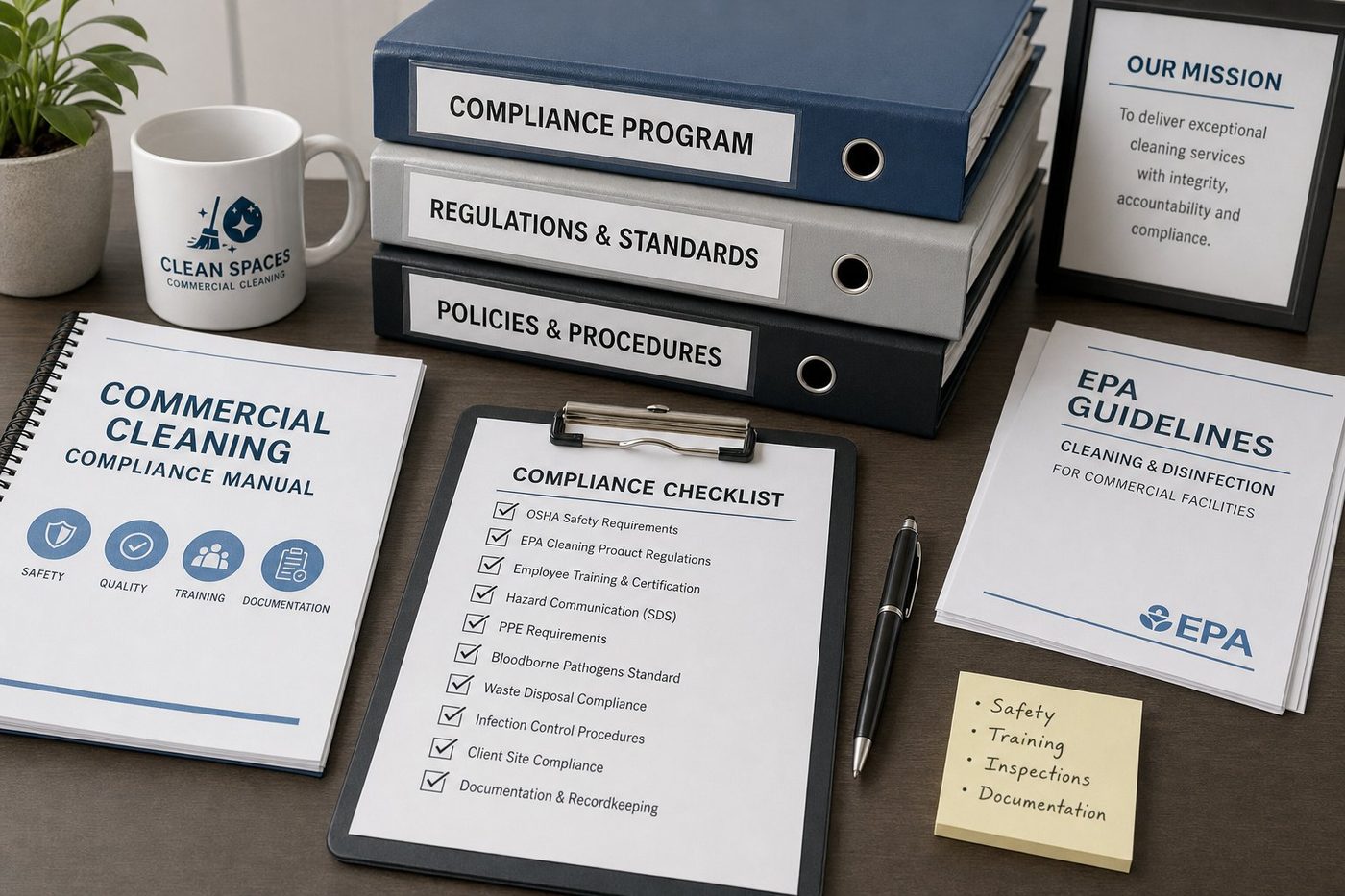
New Jersey commercial cleaning compliance is not one rule or one agency. Facility managers must coordinate federal OSHA requirements, New Jersey Department of Environmental Protection expectations, local fire and building rules, waste contracts, and the property's own safety policies. This guide gives offices, schools, healthcare-adjacent spaces, warehouses, and mixed-use buildings a practical vendor checklist for Newark, Jersey City, Hoboken, Fort Lee, Paramus, Edison, Princeton, and the wider tri-state region. GreenPoint Maintenance Services is MBE/MWBE certified, SAM.gov registered, and uses documented training, Green Seal certified products, fixed pricing, and StockPoint verification. Call 844-814-0810 to schedule a compliance walkthrough.
Start with the rules that apply to the site
The first step is to identify the facility's use, square footage, occupancy, chemicals, waste streams, and contracted services. OSHA's Hazard Communication Standard, 29 CFR 1910.1200, is central to chemical labels, Safety Data Sheet access, employee training, and non-routine hazards. Other OSHA standards may apply to personal protective equipment, walking-working surfaces, bloodborne pathogens, respiratory protection, or lockout/tagout depending on the work. GreenPoint documents the cleaning tasks it performs and escalates regulated work to qualified specialists instead of treating every spill as ordinary janitorial service.
New Jersey requirements can also intersect with NJ DEP rules, municipal ordinances, fire-code storage limits, sewer and stormwater protections, and the landlord's environmental plan. A contractor should not promise that a generic product list satisfies every local rule. GreenPoint reviews the site-specific requirements, approved products, storage rooms, loading route, and waste vendor before issuing a scope. Call 844-814-0810 or email info@greenpointms.com for a vendor-readiness review.
Chemical inventory and SDS controls
A compliant chemical program starts with an inventory that matches what is physically in the building. The list should include product name, manufacturer, use, maximum quantity, storage location, SDS status, and responsible supervisor. Secondary containers must be labeled, incompatible products separated, and spill supplies available according to the site's hazard assessment. GreenPoint can reduce complexity by standardizing products, maintaining an accessible SDS library, and recording approved substitutions rather than allowing cleaners to bring untracked bottles.
Training has to reach the person who actually uses the product. A cleaner should understand labels, dilution, personal protective equipment, first response, and the prohibition on mixing chemicals. A manager should know how to retrieve the SDS and report an exposure. GreenPoint's [OSHA cleaning chemical safety GHS/SDS guide](/blog/osha-cleaning-chemical-safety-ghs-sds/) and [fire-code chemical storage guide](/blog/fire-code-cleaning-chemical-storage/) provide practical checklists, while StockPoint can record training and inspections. Call 844-814-0810 for a sample inventory template.
Waste, recycling, and discharge controls in New Jersey
Waste handling should be scoped by stream, container, route, and final vendor. Office recycling, cardboard, food waste, confidential paper, e-waste, universal waste, and regulated materials should not be treated as one bag. GreenPoint can label collection points, train staff on contamination, protect loading areas, and record overflow or vendor misses. A property near Newark Penn, Journal Square, the Hudson River waterfront, or a tight Main Street corridor may need scheduled dock access to keep waste from blocking life-safety routes.
Liquid discharge also deserves attention. Cleaning solutions should be used at label dilution and disposed of according to the product instructions, site policy, and applicable sewer or environmental requirements; never assume a storm drain is a disposal route. GreenPoint can coordinate with the building engineer and waste contractor, but the owner remains responsible for permits and regulated waste decisions. [Our waste stream management guide](/blog/waste-stream-management-commercial-buildings/) helps managers separate routine janitorial work from special handling.
Storage, fire safety, and building access
A janitorial closet is a work area, not a place to stack every product and machine. Keep aisles clear, maintain labels, secure chemicals from unauthorized access, separate incompatible materials, and follow the building's fire-code and insurer requirements. Do not block electrical panels, exits, sprinkler valves, or mechanical access. GreenPoint includes closet photos and exception notes in supervisor inspections, and it can recommend a storage reset when a site has accumulated unapproved stock.
New Jersey service windows are often shaped by PATH, NJ Transit, and freight-elevator schedules. A tower in Jersey City or Newark may restrict carts during tenant arrival; a campus in Princeton may have lab or classroom access rules; a retail or office property in Paramus may require night delivery. GreenPoint records badges, escort rules, dock reservations, and emergency contacts in the operating plan. A written access plan reduces both safety exposure and missed tasks. Schedule a walkthrough at 844-814-0810.
Special environments require clear boundaries
Medical suites, schools, food areas, laboratories, and warehouses add task-specific requirements. A medical office may need bloodborne-pathogen training and regulated sharps handling by a qualified vendor; a school may coordinate with district protocols; a food area may require approved food-contact methods; a warehouse may need aisle, dock, and powered-equipment coordination. GreenPoint defines what is included, what is excluded, and who owns the escalation. [Our medical office cleaning requirements guide](/blog/medical-office-cleaning-requirements-osha/) is a useful starting point for healthcare-adjacent space.
OSHA compliance is also about safe work, not just paperwork. Wet floors need controls and signage, equipment cords need management, ladders and high dusting need approved methods, and PPE must match the hazard. GreenPoint supervisors use checklists and StockPoint photos to show conditions and corrective actions, then communicate any issue that the owner or specialist must resolve. Fixed pricing does not mean cutting corners; it means defining the work before service begins.
Use inspections and records to manage vendors
A facility manager should expect a current scope, product register, SDS access, training confirmation, insurance certificates, emergency contacts, and an inspection cadence. GreenPoint adds StockPoint task records, timestamped GPS-tagged photos, room-level exceptions, and a live dashboard when requested. Optional ATP testing can help evaluate selected touchpoints, but it does not replace a hazard assessment or regulatory inspection. The evidence should answer: what task was completed, where, when, by whom, with which approved method, and what happened when the result was not acceptable?
Review the program at least quarterly and after a product, tenant, renovation, or regulation change. Track completion, repeat complaints, supply-outs, response time, chemical substitutions, and open corrective actions. GreenPoint's 98% client retention reflects a focus on ongoing service rather than one-time promises. MBE/MWBE certification can support supplier-diversity procurement, but compliance still depends on the actual operating controls at the facility. Call 844-814-0810 to request a fixed-price scope and documentation checklist.
Vendor onboarding should include more than a certificate of insurance. Ask for the service scope, chemical inventory, SDS process, training confirmation, PPE expectations, emergency contact, waste boundaries, and supervisor inspection cadence. GreenPoint can provide these items as part of a documented launch file and update them when the building changes products or use. A manager in Jersey City, Newark, Fort Lee, Paramus, Edison, or Princeton should also confirm parking, badge access, freight rules, and after-hours contacts because an inaccessible site can turn a compliant plan into missed work.
Keep the compliance conversation fact-specific. A routine office floor, a blood spill in a clinic, a leaking container in a closet, and a drum of unknown material are not the same job. GreenPoint trains staff to pause, secure the area, notify the responsible contact, and follow the written escalation path. The facility should retain incident records and specialist documentation when required. A quarterly review of products, tasks, complaints, and corrective actions costs less than discovering a gap during an inspection or after an exposure. Call 844-814-0810 for a New Jersey site review.
During a site review, GreenPoint also checks the practical details that cause preventable failures: an SDS that is not reachable after hours, a cart parked in an exit path, a mislabeled spray bottle, a chemical closet without a spill kit, or a cleaner who has not received the current product training. These are correctable management issues. A written inspection cadence turns them into assigned actions instead of repeat findings.
For procurement, the best New Jersey cleaning proposal distinguishes routine service from regulated or specialist work. GreenPoint can state which products, equipment, training, inspections, and response controls are included, which records are delivered, and which conditions require owner or specialist action. That clarity helps an office, school, medical suite, warehouse, or mixed-use property compare bids fairly. It also makes renewal easier because the next team can see the baseline, the issues, and the corrective actions that improved safety.
The walkthrough should end with a written baseline: service hours, approved products, chemical storage, high-priority rooms, response targets, inspection cadence, and the person who approves changes. GreenPoint can revisit that baseline after 30 days, then quarterly or whenever occupancy changes. A concise baseline makes the New Jersey compliance discussion practical for cleaners, facility managers, engineers, and safety reviewers.
FAQ: New Jersey commercial cleaning regulations
Q: Does a cleaning company need to provide SDS documents in New Jersey? A: A facility using hazardous chemicals must maintain accessible SDS and required training under OSHA's Hazard Communication Standard. GreenPoint keeps an approved product register and SDS access process for the products in its scope; the site should also retain the records required by its own safety program.
Q: Can a janitorial cleaner handle every spill? A: No. Routine cleaning spills and some small product incidents may fit the scope, but blood, sharps, unknown substances, large releases, and regulated waste require a site-specific plan and potentially a qualified specialist. GreenPoint documents the boundary and escalates instead of improvising.
Q: What should be in a New Jersey cleaning chemical closet? A: Only approved, labeled products and equipment should be present, stored according to the hazard assessment and fire-code requirements. Keep access, panels, exits, and sprinkler controls clear; separate incompatible materials and maintain spill supplies as required.
Q: Does NJ DEP regulate ordinary office cleaning? A: Environmental obligations can attach to products, discharge, waste, stormwater, and regulated materials, while municipal and building rules add local requirements. A contractor should review the site's exact operations rather than claim that one checklist covers every property.
Q: Can GreenPoint serve Newark, Jersey City, Hoboken, Fort Lee, Paramus, Edison, and Princeton? A: GreenPoint serves New Jersey and the broader NY/NJ/CT, Pennsylvania, and Florida markets, subject to site schedule and scope. Call 844-814-0810 to confirm a walkthrough and response plan.
Make New Jersey cleaning compliance operational. Call GreenPoint Maintenance Services at 844-814-0810 for a walkthrough covering OSHA controls, NJ DEP-sensitive waste and discharge questions, storage, training, and StockPoint proof. GreenPoint is MBE/MWBE certified, SAM.gov registered, and retains 98% of clients.