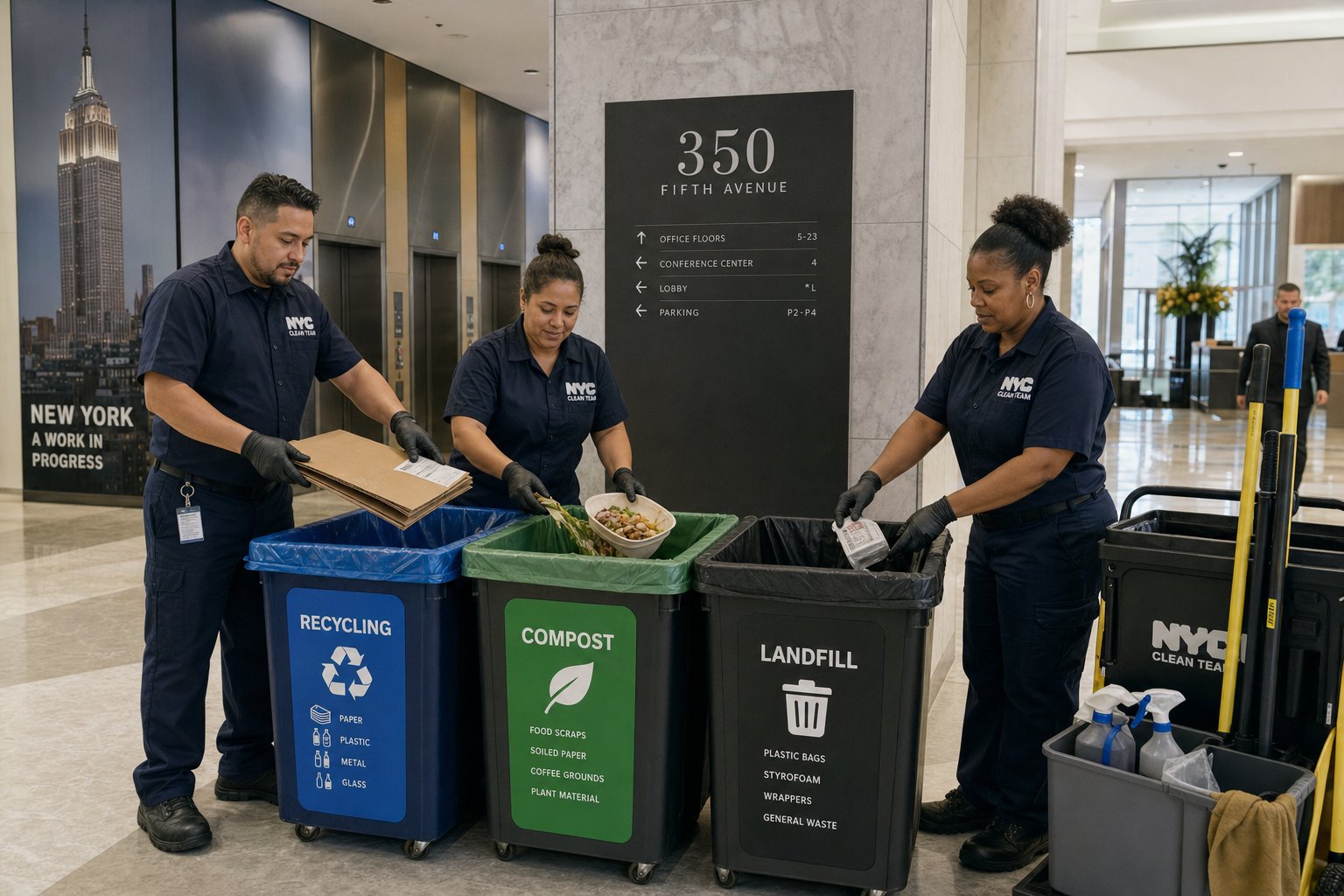
New York City commercial waste sorting is an operations problem, not just a poster problem. Cleaners, tenants, food-service staff, building engineers, carting companies, and property managers all touch the waste stream. If a bin is mislabeled, a tenant puts food in recycling, or a janitorial cart mixes liners, the building may lose material value, create contamination, or miss a collection requirement. This guide gives facility teams a practical procedure for offices, schools, restaurants, retail, medical suites, and mixed-use properties in Manhattan, Brooklyn, Queens, the Bronx, and Staten Island, with notes for Westchester and Long Island operations.
Map the building’s waste streams
Start with a room-by-room inventory: tenant pantries, kitchens, copy areas, restrooms, loading docks, mailrooms, event spaces, receiving, compactor rooms, and outdoor storage. Record which material is generated at each point, which bin is available, who empties it, where it travels, and who hands it to the collector. A tower near the World Trade Center or Grand Central Terminal may have dozens of tenant floors and a small loading dock; a school in Queens or a restaurant in Astoria may have more food scraps and grease-related waste. GreenPoint Maintenance Services maps the route before proposing a cleaning frequency.
Separate at least the streams required by the building and collector: metal, glass, plastic, paper and cardboard, organics where applicable, refuse, e-waste, batteries, lamps, confidential documents, and regulated medical or chemical waste. Do not combine a regulated stream with ordinary trash. The building’s hauler and the NYC Department of Sanitation rules control what can be set out and when. GreenPoint can schedule a walkthrough at 347-332-9348 to review the property’s current service, tenant behavior, and collection constraints.
Use labels that people can follow
A successful station uses a clear label, consistent color, a short list of accepted items, a short list of common contaminants, and a bin opening that matches the material. “Recycling” alone is too vague for a busy breakroom. Show clean paper, bottles, cans, and cardboard with plain words, while warning against liquids, food residue, plastic film, and compostable products unless the program accepts them. GreenPoint Maintenance Services can standardize labels across floors and coordinate the visual system with the building’s sustainability or LEED requirements.
Place refuse, recycling, and organics close enough together that people do not have to choose between compliance and convenience. In a Midtown office, a recycling bin across the corridor will lose to the nearest trash can during a meeting rush. In a hospital-adjacent medical suite, sharps and regulated clinical waste must never share a station with ordinary janitorial liners. GreenPoint trains cleaners and tenants on the boundary and uses floor plans to keep collection routes away from patient and food-prep areas.
Avoid “wish cycling,” the habit of putting an uncertain item in recycling. Put a “when in doubt” instruction on the station that points to a building contact or approved reference. Train cleaners not to reach into contaminated material with bare hands; isolate hazardous or sharp items and escalate to the supervisor. GreenPoint uses documented exception handling through JaniTrack, with timestamped GPS-tagged photos where approved, so the manager can see recurring contamination without exposing unnecessary personal information.
Create a daily janitorial procedure
At each service, inspect the station, replace liners with the correct stream, remove visible contamination according to the building’s procedure, wipe touchpoints, and keep the area dry and odor-controlled. Do not pour liquids into a recycling liner. Flatten cardboard where permitted and keep it free of food residue. Close and label bags before moving them to the collection room. GreenPoint uses separate tools and gloves for waste handling, then follows hand hygiene and cart-cleaning steps before returning to other zones.
The collection room needs its own checklist. Keep streams in marked bays, protect egress, maintain safe clearance around sprinklers and electrical equipment, control pests and odors, and avoid blocking the compactor or loading route. Document overflows, leaking bags, broken glass, and rejected loads. A property near Penn Station, Atlantic Terminal, or a busy bridge approach may have narrow dock windows, so the route should include the collector’s arrival and the building’s freight-elevator rules. GreenPoint can price waste-room service separately and transparently.
High-traffic buildings may need daytime touchpoints. Schedule checks around breakfast, lunch, tenant events, school dismissal, or restaurant service rather than only at the end of the night. Restrooms and kitchens often need more frequent inspection than private offices. The [cleaning frequency standards by facility type guide](/blog/cleaning-frequency-standards-by-facility-type/) can help managers set a baseline, while GreenPoint adjusts it after observing actual volume, occupancy, and contamination patterns.
Coordinate with NYC collection and local rules
The facility manager should confirm current NYC Department of Sanitation requirements, building set-out instructions, commercial carting arrangements, and any organics or special-material obligations that apply to the property. Rules and collection conditions can change, so the written procedure should name the person who checks updates and the date of the last review. GreenPoint does not substitute a generic blog checklist for the collector’s current requirements; it helps turn those requirements into a reliable cleaning route and escalation process.
Commercial buildings must also manage materials outside ordinary bins. Batteries, lamps, electronics, toner, paint, chemicals, sharps, and medical waste need approved channels. A janitorial contractor should never guess that a leaking container belongs in refuse. Isolate it, protect staff, notify the designated manager, and use the approved vendor or emergency procedure. GreenPoint trains crews on labels, SDS access, PPE, and spill escalation; the [OSHA hazard communication guide](/blog/osha-hazard-communication-cleaning/) explains why chemical containers require particular care.
NYC’s dense streets add practical constraints. Collection windows, alternate-side parking, pedestrian traffic, rain, snow, and construction can affect a safe transfer. Buildings in the Bronx, Staten Island, and outer-borough industrial areas may have longer internal routes or different dock layouts than Midtown towers. GreenPoint Maintenance Services plans for the actual handoff, keeps fixed pricing clear, and can be reached at 347-332-9348 for a waste-route walkthrough.
Measure contamination and service quality
Use a simple audit sample. Inspect 10 to 20 stations per week or a defined percentage of the building, record the stream, contamination type, overflow status, label condition, liner correctness, and corrective action. Trend the results by floor, tenant, meal period, and station design. A 15% contamination rate on a food-service floor tells a different story from 15% at private-office stations. GreenPoint can use JaniTrack for route completion, exception tickets, and dashboard visibility, then share a monthly summary with the property manager.
Set measurable service standards: no overflowing bags at scheduled pickup, collection room checked each shift, damaged labels corrected within one business day, high-risk spills escalated immediately, and rejected loads reviewed within 24 hours. Keep the standard achievable and tie it to the responsible role. GreenPoint’s 98% client retention is supported by showing both completion and exceptions. When a contamination pattern repeats, the response may be a better opening, a tenant briefing, a new food-bin location, or a frequency adjustment rather than simply blaming the cleaner.
Use signage and feedback to change behavior. A short tenant email can show the top three contamination errors, while a school or restaurant may need a five-minute shift huddle. Do not shame individuals or photograph personal information. GreenPoint’s supervisors can conduct a station demo, explain what the collector accepts, and verify improvement in the next audit. Call 347-332-9348 when a building has the right bins but no reliable results.
Design safe and efficient cleaning routes
Waste routes should minimize carrying distance, sharp turns, public exposure, and cross-traffic with food or patient zones. Choose carts with lids and stable wheels, keep loads within safe handling limits, and define elevator and dock procedures. A cleaner should not push a leaking bag through a lobby or leave a cart beside an emergency exit. GreenPoint includes route timing, cart cleaning, PPE, hand hygiene, and storage in the written scope and trains relief staff on the same sequence.
Waste work also affects indoor air quality and pests. Close liners, clean residue from bins, address leaks promptly, and maintain ventilation in collection rooms. Do not use fragrance to mask an organic-waste odor; find the source, remove residue, and coordinate with pest or building engineering teams when needed. GreenPoint uses Green Seal certified products where appropriate and follows label directions. A property can request a fixed quote for daily collection plus a periodic waste-room deep clean.
Document who owns tenant communication, who calls the hauler, who approves a special pickup, and who handles after-hours incidents. GreenPoint Maintenance Services can provide a single point of contact for a portfolio across New York, New Jersey, Connecticut, Pennsylvania, and Florida, while each NYC site keeps its local collection instructions. Schedule a walkthrough at 347-332-9348 to identify responsibilities before an overflow or rejected load becomes a complaint.
Review the program every quarter
Quarterly, compare collected volume, contamination, overflow calls, rejected loads, tenant feedback, labor hours, and supply use. Walk the route during a busy period and after the final collection. Review whether stations are placed near actual waste generation and whether labels match current acceptance rules. GreenPoint Maintenance Services can use JaniTrack records and client meetings to update the task frequency without quietly changing the scope or billing.
The best waste-sorting program is specific enough to train and flexible enough to improve. Start with the collector’s current rules, then build a station design, daily route, collection-room standard, special-material procedure, audit sample, and correction loop. GreenPoint offers fixed pricing, no hourly billing, and no hidden fees after the walkthrough. Call 347-332-9348 for a written plan for a single building or a multi-site portfolio.
For broader facility quality controls, review the [digital cleaning verification systems guide](/blog/digital-cleaning-verification-systems/) and [green cleaning commercial buildings guide](/blog/green-cleaning-commercial-buildings-guide/). GreenPoint combines documented routes, trained teams, Green Seal product options, and visible exception handling so a property manager can explain what happens to waste after it leaves a tenant’s desk.
Frequently Asked Questions
Q: Who is responsible for sorting waste in a commercial building? A: Responsibility is shared among tenants, food service, cleaners, building management, and the collector. The written procedure should assign each handoff. GreenPoint can build that responsibility matrix during a walkthrough.
Q: Can cleaners remove contaminated recycling by hand? A: Only under a documented safe procedure with appropriate PPE and escalation. Sharp, chemical, medical, or unknown materials must be isolated and handled through the approved channel. GreenPoint trains teams not to guess.
Q: How often should NYC office recycling stations be serviced? A: At least daily for ordinary offices, with additional checks around meals, events, and high-traffic periods. GreenPoint adjusts frequency to volume, occupancy, and overflow history.
Q: Does NYC commercial waste sorting include organics? A: Requirements depend on the property, business type, size, and current city rules or program. Confirm with DSNY and the building’s collector; GreenPoint translates the current requirement into labels and routes.
Q: How do we request a waste-sorting walkthrough? A: Call GreenPoint Maintenance Services at 347-332-9348. GreenPoint will map stations, routes, collection rooms, local constraints, training, and JaniTrack verification before providing fixed pricing.
Pilot the revised waste route on one representative floor before rolling it across the portfolio. Observe a breakfast period, a normal afternoon, an event or delivery, and the final collection. Track walking distance, bag counts, contamination, overflow, elevator waits, and time spent correcting labels. GreenPoint uses the pilot to reposition stations and set a frequency that reflects behavior instead of relying on a floor plan created before the tenants moved in. Once the route works, publish the same station standard and handoff fields for every participating floor.
Improve NYC commercial waste sorting with GreenPoint Maintenance Services at 347-332-9348. Get a building-specific route, clear station labels, JaniTrack reporting, and proof-driven service backed by 98% client retention.