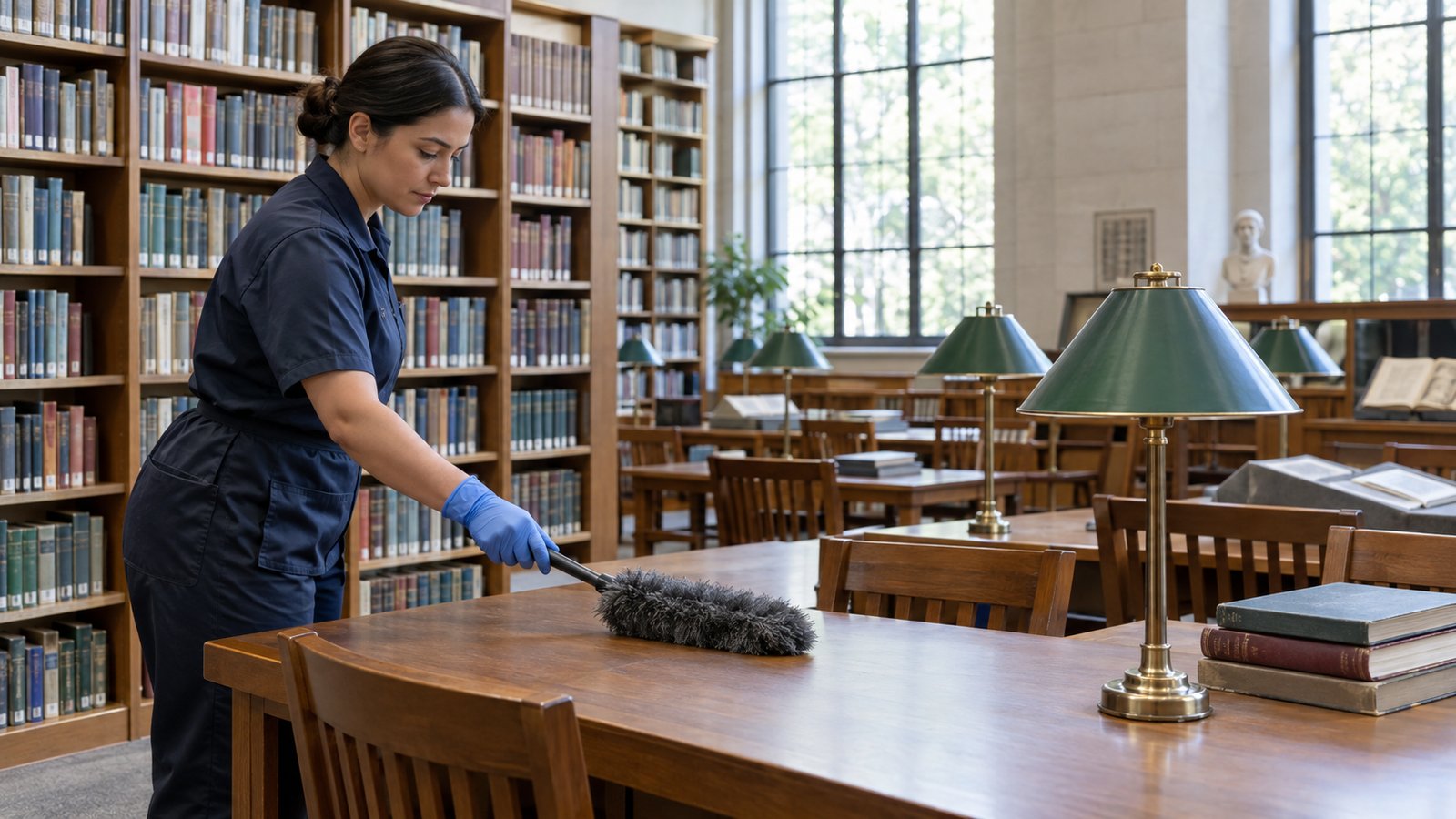
Public libraries and archives need to feel open, safe, and welcoming without putting books, manuscripts, maps, or equipment at risk. A useful cleaning specification separates public circulation areas from collection storage, assigns the right tools to each zone, and defines what can be cleaned, when, and with which products. GreenPoint Maintenance Services Corp supports institutional facilities across New York, New Jersey, Connecticut, Pennsylvania, and Florida with fixed-scope janitorial programs, documented inspections, and supervisor review. This guide gives library directors and procurement teams a practical framework for comparing a public library cleaning service or archive facility janitorial contractor.
Begin with zones, access rules, and collection risk
Map the building into public, staff-only, and collection-sensitive zones before requesting prices. Public zones usually include vestibules, service desks, reading rooms, meeting rooms, restrooms, elevators, stairwells, and staff break areas. Back-of-house zones may include sorting rooms, compact shelving, special collections, loading areas, and records storage. Each zone needs a defined access window and a named facility contact. GreenPoint asks whether collection rooms are open to contractors, whether escorts are required, and which shelves or objects are strictly off limits. A written access map reduces accidental handling and makes bids comparable.
For an archive, routine janitorial work is not conservation treatment. Staff should identify fragile materials, high-density shelving, dust-sensitive equipment, and areas where moisture is prohibited. A cleaner can remove waste and clean designated floors without moving archival objects or reaching into shelving. If a space needs specialized conservation, pest remediation, or mold assessment, the library should engage a qualified conservator or environmental specialist. GreenPoint Maintenance Services keeps the cleaning scope separate from those disciplines so that the buyer knows what is included and which issues require a specialist.
Before mobilization, record the room name, access window, authorized contact, approved surfaces, prohibited actions, and emergency route on a one-page zone card. Include a process for reporting a leaking pipe, pest evidence, or damaged collection box without touching it. GreenPoint can review these cards with the library supervisor during onboarding and update them when a room changes use or access status.
Set daily, weekly, and periodic tasks by traffic
A neighborhood branch on a busy transit route has different needs from a climate-controlled archive with scheduled researcher visits. Daily service commonly covers entrance mats, visible litter, touchpoint cleaning, restroom sanitation, spot mopping, and waste removal. Reading rooms may need quiet, low-odor cleaning before opening or after closing. Meeting rooms should be reset after booked programs, while children’s areas and computer stations may need more frequent spot checks during peak hours. The schedule should state both the regular visit and the response process for spills or unusually heavy use.
Weekly and periodic work should be specified rather than treated as an informal extra. Examples include edge vacuuming, detail dusting on approved surfaces, floor machine work, carpet spotting, glass cleaning, and high-level dust removal where safe access is available. The buyer should distinguish ordinary dust control from cleaning collection materials. GreenPoint can build a task calendar around public hours and seasonal programs, then record completion in JaniTrack with time-stamped, location-tagged service evidence. Review the [cleaning frequency standards by facility type](/blog/cleaning-frequency-standards-by-facility-type/) when setting the baseline.
Build the calendar around school visits, author events, tax-season assistance, summer reading, and community-room bookings. If the building is open seven days or hosts evening programs, specify which tasks move to a porter shift and which wait for a quiet closing window. A weekly manager review of missed tasks and recurring requests gives the library a practical way to adjust frequency without rewriting the whole contract.
Choose tools and products that respect books and finishes
Use the least disruptive method that achieves the required result. Microfiber cloths, controlled damp wiping on approved hard surfaces, and vacuum equipment with appropriate filtration can reduce dust movement compared with dry sweeping or aggressive air blowing. Never spray liquid directly near open books, paper, computers, or collection cases. Product selection should account for the surface, ventilation, user sensitivity, and manufacturer instructions. GreenPoint uses Green Seal certified products where suitable for the task and confirms that the facility approves the product list before deployment.
A cleaning specification should also address dilution, labeling, storage, and access to safety data sheets. Staff should not substitute chemicals without written approval, especially in rooms containing paper, textiles, metals, or historic finishes. Wet floors need controlled signage and a drying plan so visitors are not exposed to slip hazards. In New York City, the library’s own building rules and applicable fire and workplace-safety requirements govern storage and access; the contractor should coordinate with facilities personnel rather than assume a universal rule. GreenPoint documents approved methods and trains assigned staff on the room-specific restrictions.
Ask the vendor to explain how equipment is kept clean between zones and how cloths, mop heads, and vacuum attachments are stored at the end of a shift. A product list is useful only if the crew can identify the approved bottle and use it according to its label. GreenPoint supervisors can spot-check dilution and storage practices and report unavailable supplies before a substitution is made.
Account for New York and tri-state public-building conditions
In Manhattan, a branch near Grand Central or a downtown subway entrance can see fast-changing foot traffic, wet-weather soil, and queueing at service points. Bronx locations around Fordham Road, Kingsbridge, and the Grand Concourse may need robust entry-mat and stairwell plans. Brooklyn branches near Atlantic Terminal, Downtown Brooklyn, or busy commercial corridors often combine public programming with high restroom demand. Queens facilities near Jamaica Station, Flushing, or Jackson Heights benefit from clear coverage for entrances, elevators, and community rooms. Long Island, Westchester, Newark, Jersey City, and Stamford sites bring different building layouts and commuting patterns.
A vendor should adapt route timing and staffing to the actual property, not promise identical service everywhere. Ask how the crew is admitted, how keys or badges are controlled, what happens when a building closes unexpectedly, and who authorizes after-hours access. Public procurement may also call for insurance, background screening, prevailing-wage terms, MWBE documentation, or a formal service-level schedule; requirements vary by owner and solicitation. GreenPoint Maintenance Services Corp is MBE-certified and SAM.gov registered, and can provide relevant documentation for review. Buyers should put each required credential in the bid checklist instead of relying on a verbal assurance.
Weather plans are worth spelling out for Northeast buildings. Salt, slush, and umbrellas can increase entrance and elevator cleaning needs during a storm, while a power or transit disruption may change staff arrival times. Agree in advance how the library reports a closure, how the vendor confirms coverage, and whether a temporary mat or porter adjustment is part of the baseline or a separately authorized service.
Measure quality with visible evidence and clear escalation
A useful quality plan tells the library what evidence it will receive and how defects are corrected. A supervisor can inspect a rotating sample of rooms, check task completion against the service calendar, and record a corrective action with an owner and due time. JaniTrack supports GreenPoint’s service verification through timestamped, GPS-tagged photos, an activity dashboard, and ATP testing where the facility’s protocol and surface make it appropriate. ATP readings indicate residual biological material on a sampled surface; they do not identify a pathogen or certify a room as sterile. Explain that distinction in staff training and reports.
Agree on response categories before service begins: immediate hazards, same-shift issues, routine defects, and scope changes. For example, a spill in a public aisle needs prompt attention, while a damaged baseboard may be logged for facilities maintenance. The library should have one route for routine requests and one emergency contact. GreenPoint offers fixed pricing with no hourly billing or hidden fees, so additional work can be authorized transparently rather than folded into an unclear monthly invoice. Call 347-332-9348 to schedule a walkthrough and define the inspection and escalation process for your building.
Set a monthly review of response time, repeat complaints, inspection scores, and open corrective actions. If the same entrance repeatedly fails after rain, the answer may be more mat coverage or a building repair rather than more end-of-day mopping. GreenPoint can present documented trends for the library to review and agree on a corrective owner, due date, and follow-up check.
Budget a comparable scope and evaluate the contractor
A meaningful price comparison needs the same assumptions: cleanable square footage, number of public days, shift length, restroom count, floor types, event calendar, consumables, day-porter coverage, and periodic floor or carpet work. Ask bidders to price routine service separately from project work and to state whether paper products and liners are included. A small branch may be driven by restroom and opening routines rather than square footage; a central library may require distinct teams for public areas and staff zones. The [commercial cleaning cost per square foot guide](/blog/commercial-cleaning-cost-per-square-foot/) explains why unit price alone can be misleading.
Ask for a supervisor’s contact, training outline, backup coverage plan, sample inspection report, insurance certificate, and references for public-facing properties. GreenPoint Maintenance Services can provide a no-obligation walkthrough and a written scope that sets hours, tasks, exclusions, approved products, and verification measures. The company reports 98% client retention; prospective buyers should still check references and assess whether the proposed staffing and reporting meet their own needs. If the library serves multiple boroughs or counties, request one coordinated service calendar with site-specific access notes rather than a generic regional promise.
When comparing bids, ask each company to explain its supervision hours and how many locations one supervisor covers in a shift. Clarify whether consumables, floor equipment, and periodic carpet extraction are included, and identify any assumptions about furniture movement. A written walkthrough record prevents later disputes about inaccessible rooms, unusually soiled surfaces, or a change in the library’s opening schedule.
Frequently asked questions
Q: Can a janitorial contractor clean an archive collection room? A: Only within the access and task limits approved by the archive. Routine floor and designated-surface care is different from handling or cleaning collection objects, which should remain under conservator or archivist direction.
Q: How often should a public library restroom be cleaned? A: Set the base frequency from opening hours, traffic, fixture count, and event use, then add documented checks during peak periods. A walkthrough can establish a realistic schedule and trigger points for additional service.
Q: Does ATP testing prove that a room is germ-free? A: No. ATP is a hygiene-monitoring measurement for sampled surfaces, not a pathogen test or sterility certificate. Use it as one quality indicator alongside visual inspection and task records.
Q: What should a New York library request from a cleaning vendor? A: Request a room-based scope, proof of insurance and required certifications, approved product list, staff access procedures, emergency response plan, and sample quality report. Call 347-332-9348 to schedule a GreenPoint walkthrough.
Need a public library cleaning plan for Manhattan, the Bronx, Brooklyn, Queens, Staten Island, Westchester, Long Island, or New Jersey? Call GreenPoint Maintenance at 347-332-9348 or email info@greenpointms.com to schedule a walkthrough and receive fixed pricing. GreenPoint reports 98% client retention and provides JaniTrack service verification with timestamped, GPS-tagged evidence.