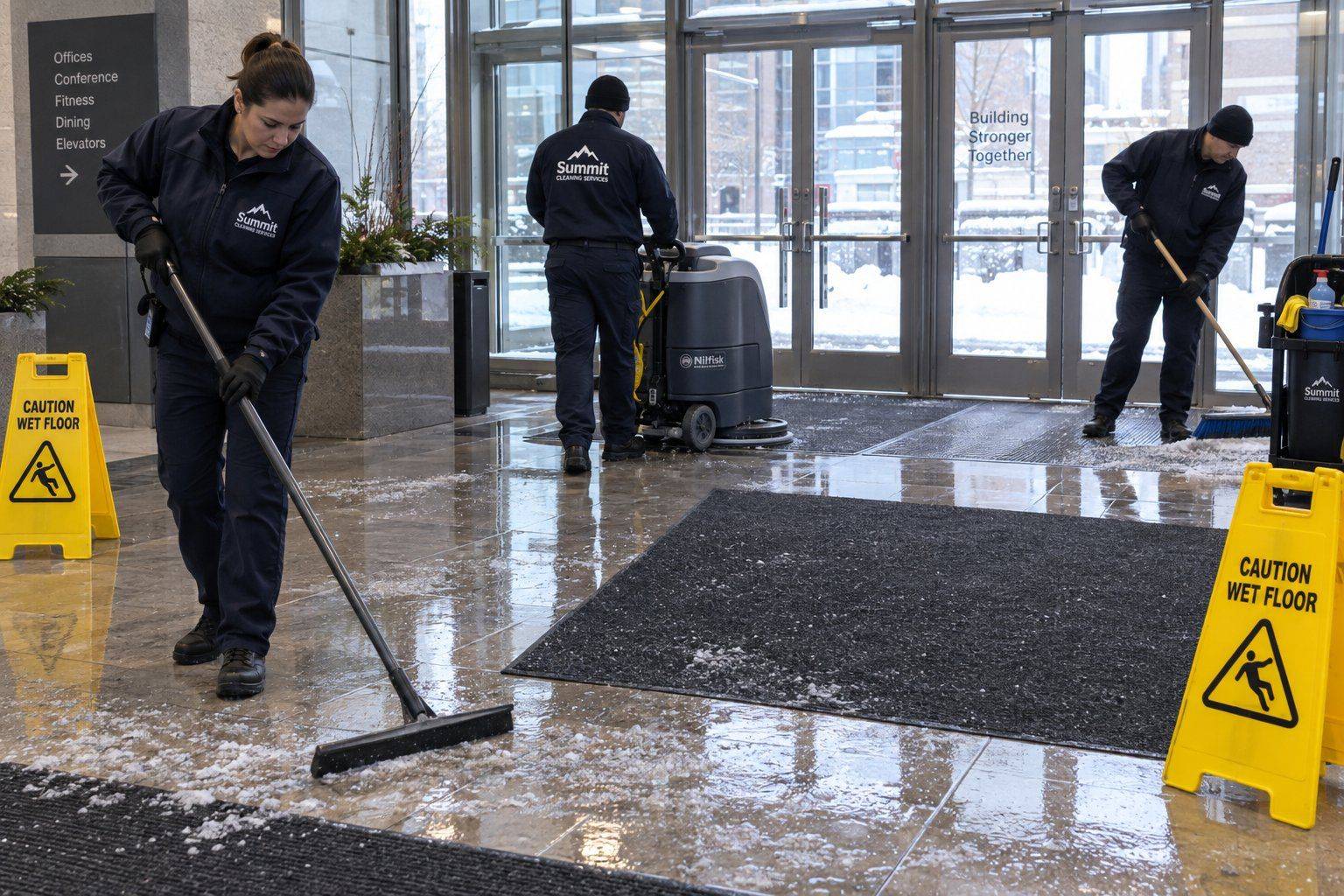
Winter weather creates a predictable but manageable chain of facility risks: snow and slush enter at the door, dissolved de-icing salt dries into a residue, and grit gets tracked across hard floors and carpet. A winter commercial cleaning plan should protect entrances first, then keep the interior floor program safe and measurable. GreenPoint Maintenance Services works with property teams across New York, New Jersey, Connecticut and Pennsylvania to set those tasks by site conditions, not by a generic calendar. The company’s [winter facility maintenance checklist](/blog/winter-facility-maintenance-checklist-northeast/) and [commercial restroom cleaning best practices](/blog/restroom-cleaning-best-practices-high-traffic/) are useful starting points for a broader seasonal scope.
Why winter entry soil needs a written plan
A building entry is a changing work zone, not just another floor. Snow becomes water indoors, salt crystals remain after the water evaporates, and grit can act as an abrasive under shoes and carts. A wet patch also changes how a visitor approaches the doorway, especially when a queue forms at reception. The [NIOSH slip, trip and fall prevention guide](https://www.cdc.gov/niosh/docs/2011-123/pdfs/2011-123.pdf) recommends housekeeping controls such as maintained walk-off mats, prompt cleanup and suitable floor procedures. GreenPoint translates that principle into a site map: entry doors, mat edges, elevator lobbies, loading entrances and the safe route to a wet-floor response kit.
A map is most useful when it includes the routes people really use. Ask security where visitors enter before the lobby opens, ask the loading-dock lead when deliveries peak and check whether employees cut across a secondary door to reach transit. A mat can be correctly placed at the main entrance and still leave a wet path at a garage elevator or a side door near the subway. GreenPoint includes those less obvious thresholds in a walkthrough when the client identifies them. In Midtown Manhattan, changing pedestrian volume around Penn Station can make the entry route different from a suburban office with one parking approach.
Set mat coverage and inspection triggers
Do not assume a single mat will handle every storm. The building team should inspect whether mats are flat, secured, absorbent and long enough for several steps; if water or salt tracks beyond the mat, replace or extend it. At high-traffic Manhattan buildings near Penn Station or Grand Central, two vestibule transitions may need different mat sizes and more frequent checks than a low-traffic office side door. GreenPoint can review traffic patterns, thresholds and storage space during a walkthrough; call 844-814-0810 to set a winter entry assessment. The scope should identify who moves saturated mats, who dries the floor beneath them and how pedestrians are rerouted while a crew works.
Set a clear saturation threshold that an inspector can apply consistently. The trigger might be visible standing water beyond the mat, a curled edge, a saturated surface or grit collecting on a transition; the property should choose the threshold based on its floor and safety program. Record whether a mat was exchanged, dried or moved, and whether the floor beneath it was checked. A short inspection entry is more useful than a vague “lobby clean” status. GreenPoint supervisors can review the threshold with the site manager and document the agreed response in StockPoint before the first storm.
Choose floor methods for salt and grit
Translate the weather forecast into a practical service trigger rather than a promise that the floor will remain dry. For example, a property can schedule extra checks during active precipitation, a post-event salt removal after tracked soil stabilizes, and a closeout inspection after the final peak. The manager sets the building’s trigger, while the cleaning supervisor logs what happened and whether staffing or access changed. GreenPoint recommends recording the entrance, time, visible condition and corrective action so a repeat salt line is distinguished from a one-time spill. That distinction helps managers adjust the next storm plan without inflating every routine visit.
A residue treatment should be tested on a representative, inconspicuous area when floor-care instructions require it. Confirm the diluted solution, dwell, agitation and recovery method with the product and flooring guidance, and verify the appearance after the surface dries. Avoid applying a restorative coating to a floor that has not been identified or prepared. For a property with mixed stone, terrazzo and resilient flooring, label each zone so a crew does not carry one method across all materials. GreenPoint can identify cleaning scope versus specialist restoration, then provide a separate written quote when a finish needs repair.
Coordinate storm response and occupant safety
Keep the housekeeping plan aligned with the building’s safety program. Wet-floor signs are a temporary warning, not a substitute for removing soil, drying the surface or isolating an unsafe route. The site should tell the crew which entrances may be closed, how to notify security and where to direct occupants if a vestibule becomes slick. GreenPoint’s [facility cleaning audit checklist](/blog/cleaning-audit-checklist-facility-managers/) can help managers assign a named person to review each exception. If the usual access path is blocked by snow removal, freight delivery or construction, the crew records a stop and contacts the manager instead of improvising an unapproved route.
A public route may need phased cleaning to avoid leaving occupants to choose between a wet surface and an unsafe detour. The property manager should approve temporary barriers, alternate paths and timing around tenant arrivals; security can communicate route changes to visitors. Keep the warning visible from the approach, not only next to the work area, and do not remove it before the surface is dry under the facility procedure. GreenPoint can schedule a post-close detail where access permits, but a contractor cannot control weather or all daytime foot traffic. The service plan should state the boundary and a daytime notification method.
Verify service with useful records
Salt residue calls for a deliberate floor method. Identify the floor finish and manufacturer’s maintenance instructions before choosing a cleaner or dilution; aggressive chemistry, excess moisture or abrasive pads can damage coatings, natural stone and resilient flooring. Start with dry soil removal, apply the approved solution with controlled water, recover rather than spread dirty liquid, then inspect the floor when it dries. GreenPoint separates daily soil removal from periodic floor restoration, and avoids presenting a one-time scrub as permanent protection. For facilities comparing restoration options, the [VCT floor-care guide](/blog/vct-floor-care-strip-seal-wax-guide/) explains why finish condition and traffic should shape the plan.
Compare evidence across several storms rather than treating a single photo as a performance score. A useful review includes weather, traffic conditions, inspections, saturated mats, salt observations, callback time and any floor damage referred to maintenance. The manager can decide whether an entrance needs more mat length, a different pickup frequency or a change in snow-removal coordination. GreenPoint’s 98% client retention is a reported company figure, not a building-safety measurement. Its StockPoint entries can show service events and exceptions, while the property’s safety lead evaluates incidents using its own records and procedures.
Price a tri-state winter cleaning scope
Close out each high-risk zone with a dry-floor check and a record of unresolved issues. A timestamped photo can show the floor after service, but it cannot prove that an entire public route stayed dry throughout the shift. StockPoint records can pair the image with the entrance identifier, the crew’s checklist and an exception note, giving the property manager a more useful sequence of evidence. GreenPoint’s supervisor also records whether a mat was saturated, a drain was slow or a floor finish needs a separate repair. Ask about a StockPoint walkthrough at 844-814-0810; the dashboard is intended to make service verification visible, not to replace a building’s safety review.
A tri-state property may have doors managed by different parties: a landlord, tenant, snow contractor, security team and janitorial vendor. Put the handoff in writing, particularly for sidewalk clearing, garage access, salt storage and storm callouts. Municipal sidewalk responsibilities and timing can vary by jurisdiction, so the owner or property manager should confirm current local requirements rather than asking a cleaner to interpret them. GreenPoint’s fixed-price proposal names included indoor tasks and any separately authorized surge work. Call 844-814-0810 for a winter cleaning walkthrough in Manhattan, Westchester, Long Island, New Jersey or Connecticut.
Coordinate vendor and property responsibilities
Set measurable winter service levels before the first storm. A useful specification names each entrance, visit or inspection window, acceptable condition, response contact, mat responsibility and escalation time. It can also separate included routine work from unplanned storm response so the property understands what is covered by its fixed price and what requires written authorization. GreenPoint Maintenance Services Corp. uses fixed pricing rather than hourly billing, with no hidden fees; that makes the defined scope especially important. GreenPoint can price a base plan plus a separately approved surge option after a walkthrough. Call 844-814-0810 to compare a proposed scope with the actual traffic, floor types and opening hours.
Before the season, stage the supplies the route will actually use: clean replacement mats, compatible floor tools, signs, barriers and a safe place for saturated material. Count them by entrance and assign the person who replenishes them, rather than assuming every closet has stock. A short tabletop exercise can test what happens if a mat is missing, the entrance floods or the freight elevator is unavailable. GreenPoint can list the response contact, service trigger and supply boundary in the site plan. For a multi-location contract, review Manhattan, Bronx, Queens, Staten Island, Westchester and Long Island sites separately because access and foot traffic differ.
Frequently Asked Questions
Q: How often should a commercial entrance be checked during a snow event?
A: Set inspection intervals from actual traffic, precipitation and floor conditions. A busy lobby may need checks more often than a quiet entrance; document each check and add service when mats are saturated or salt tracks beyond them.
Q: Can salt be removed with any general-purpose cleaner?
A: Not safely in every case: confirm the floor material, finish and product directions first. Use a method that removes dissolved salt and recovered soil without leaving excess moisture or damaging the surface.
Q: What should a winter cleaning contract specify?
A: Name the entrances, mat duties, storm triggers, inspection windows, response contact, floor methods, documentation, exclusions and approval process for extra work. Separate routine service from surge response.
Q: Does a wet-floor sign eliminate slip risk?
A: No, it is only a temporary warning while a hazard is addressed. It does not remove water or salt; use barriers where needed, clean and dry the route, and reopen it only under the site’s procedure.
Q: How can GreenPoint verify a winter floor visit?
A: GreenPoint can record task completion, time, zone, a permitted photo and exceptions in StockPoint. The facility manager still decides whether a route is safe to reopen.
Call GreenPoint Maintenance Services at 844-814-0810 to book a fixed-price winter walkthrough. GreenPoint is MBE/MWBE certified and can document storm-response tasks with StockPoint timestamped, GPS-tagged evidence.