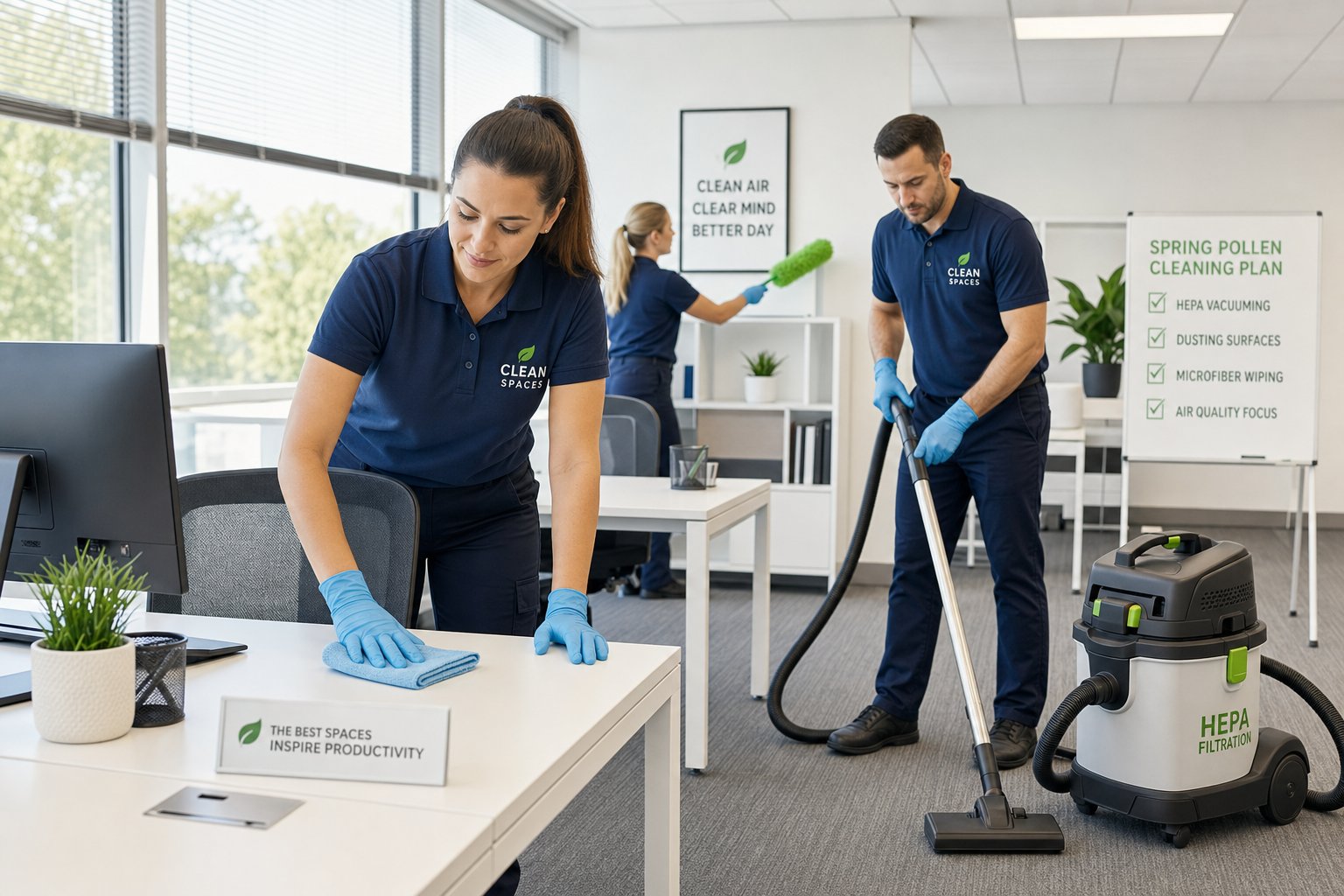
A spring office cleaning plan should address the particles employees actually bring indoors: tree pollen, fine dust, soil tracked from sidewalks, and residue that settles on HVAC-adjacent surfaces. A quick vacuum pass may improve appearance while leaving reservoirs on blinds, upholstery, ledges, and entry mats. This evidence-based guide helps facility managers in Manhattan, the Bronx, Brooklyn, Queens, Staten Island, Westchester, Long Island, New Jersey, Connecticut, Pennsylvania, and Florida sequence spring work, set measurable standards, and protect occupied-space air quality. GreenPoint Maintenance Services combines HEPA equipment, microfiber methods, Green Seal certified products where appropriate, and StockPoint verification so seasonal cleaning is a controlled program rather than a one-day promise.
Why spring changes the office soil load
Spring brings a different mix of soil than winter. Pollen can enter through revolving doors and open windows, while dried salt, street dust, and construction particles collect at lobby thresholds. Offices near Grand Central Terminal, Penn Station, Atlantic Terminal, and subway entrances may see especially heavy foot traffic during commuting peaks. GreenPoint starts with a walkthrough at 844-814-0810 to identify entrances, mat lengths, elevator lobbies, HVAC returns, and high-occupancy zones before setting a frequency.
Use an observation sample instead of guessing. Check ten representative locations on each floor: door tracks, reception counters, window sills, workstation ledges, carpet edges, restroom vents, and return-air grilles. Record visible dust, mat saturation, odor, and the time since the last detail. A 50,000-square-foot Midtown office may need daily entrance attention but only monthly high dusting. GreenPoint Maintenance Services turns the sample into a written scope with fixed pricing and no hourly billing.
Build a pollen-control entry sequence
Entry control is the first line of defense. Use properly sized walk-off mats at exterior and interior doors, vacuum them with a HEPA-filtered machine, and replace or clean them before they become saturated. Keep vestibule floors dry and remove grit before wet mopping. In Brooklyn Heights, Astoria, or the Bronx, a mat route may be interrupted by deliveries, school traffic, or street construction, so the schedule should include a mid-day inspection. GreenPoint can log route completion and exceptions through StockPoint.
Place high-touch and high-soil tasks in the same route: door pulls, turnstiles, elevator buttons, lobby seating, and reception counters. Use damp microfiber rather than dry dusting that redistributes particles. Do not spray cleaner into electronics or near occupants. The [indoor air quality commercial cleaning guide](/blog/indoor-air-quality-commercial-cleaning/) explains how product choice, filtration, and timing work together. GreenPoint supervisors train cleaners on direction of travel and clean-to-dirty sequencing.
Use HEPA vacuuming and microfiber correctly
HEPA equipment is useful when it is maintained and used on the right surfaces. Vacuum carpet slowly enough to capture settled soil, use edge tools at walls and under furniture, and inspect bags, filters, cords, and seals. Hard floors still need a soil-removal plan; a HEPA vacuum or dust mop should precede damp cleaning so grit does not become a slurry. GreenPoint records equipment checks and can provide timestamped GPS-tagged photos through StockPoint where the client approves imagery.
Microfiber works best when cloths are clean, folded, and assigned by zone. Use separate cloths for desks, glass, restrooms, and food-service support areas. Change them before they become visibly loaded, and launder them under a defined process. Avoid feather dusters and dry sweeping in occupied offices. GreenPoint Maintenance Services uses color-coded microfiber and Green Seal product options where appropriate, then confirms the result through visual inspections and targeted ATP testing when trending residual soil is useful.
Clean HVAC-adjacent surfaces without disrupting occupants
Dust around return-air grilles, supply diffusers, ceiling ledges, fan-coil cabinets, and radiator covers can be moved into the breathing zone if cleaned carelessly. Coordinate with building engineering before opening equipment or removing panels. High dusting should use controlled tools and a spotter, with barriers below when needed. GreenPoint will document what janitorial staff can safely clean and what belongs to a licensed HVAC or maintenance provider, especially in a high-rise near the World Trade Center or Hudson Yards.
Air quality is not improved by adding fragrance. Select low-odor methods, ventilate as the building allows, and schedule disruptive work after hours. Confirm filters, dampers, and condensation issues with engineering; cleaning staff should report mold-like growth, leaks, or damaged insulation rather than disturbing it. The [HEPA filtration commercial cleaning guide](/blog/hepa-filtration-commercial-cleaning/) provides a companion checklist. GreenPoint can include an escalation field in StockPoint so a defect reaches the right owner.
Set spring frequencies by space and traffic
Frequency should follow occupancy and soil, not a generic seasonal label. Lobbies, elevator cabs, cafeterias, restrooms, and shared conference rooms typically need daily or multiple-times-daily touchpoint checks. Private offices may need routine service plus a rotating detail. A coworking floor in Long Island City or Downtown Brooklyn may require more frequent kitchen and phone-booth cleaning than a low-occupancy back office. GreenPoint uses square footage as one input, then adjusts for furniture density, doors, transit exposure, and tenant events.
A useful pilot can sample 2,000 to 5,000 square feet per zone for a week, recording labor minutes, soil findings, complaints, and rework. Use the data to choose daily entrance vacuuming, weekly ledge detailing, and monthly high dusting where those intervals fit the building. BLS labor data can inform staffing discussions, but local access and task complexity determine the actual plan. GreenPoint offers a fixed quote after a walkthrough at 844-814-0810 rather than hiding uncertain assumptions in an hourly rate.
Protect sensitive occupants and shared spaces
Office populations include people with asthma, allergies, fragrance sensitivity, and immune concerns. A cleaning plan should minimize aerosolized product, avoid unnecessary fragrance, protect food-contact surfaces, and announce floor work that creates wet or odor-prone conditions. Coordinate with tenants before carpet extraction, upholstery cleaning, or ceiling work. GreenPoint can schedule detail work for evenings, use damp methods, and place clear wet-floor controls so employees are not surprised at a lobby entrance or near a cafeteria.
Medical offices, schools, and government spaces require tighter handoffs. A school near Flushing or a DOE facility may need cleaning around arrival and dismissal, while a medical suite in Westchester may have patient-area restrictions. Review the [school cleaning checklist for custodial staff](/blog/school-cleaning-checklist-custodial-staff/) and the [medical office cleaning requirements guide](/blog/medical-office-cleaning-requirements-osha/) when those uses apply. GreenPoint Maintenance Services documents access, approved products, and escalation contacts for each site.
Verify results with evidence
Visual inspection should ask specific questions: Are entry mats free of visible soil? Are ledges dust-free at arm’s length? Are touchpoints streak-free? Are trash liners closed? Are floors dry? A supervisor should sample each zone and record the defect, correction, and time closed. GreenPoint uses StockPoint for live dashboard visibility, route status, and timestamped GPS-tagged photos where permitted. The record helps a facility manager compare floors and identify repeat issues instead of relying on a general “clean” rating.
Objective tools have a defined role. ATP testing may help trend residual organic soil on selected touchpoints, but it does not measure pollen and does not replace visual checks or an indoor-air assessment. Track complaints, re-clean requests, filter issues, and entrance soil by week. GreenPoint’s 98% client retention reflects a focus on visible corrective action: the team reports exceptions, assigns ownership, and checks closure. Call 844-814-0810 when your spring program needs a measurable baseline.
Coordinate seasonal deep-clean work
Schedule spring detail in phases so the building does not lose every shared space at once. Phase one can cover entrances, mats, and lobby upholstery; phase two can rotate carpet extraction, workstation ledges, vents, and conference rooms; phase three can review closets, carts, supplies, and equipment. GreenPoint Maintenance Services can plan around tenant move-ins, board meetings, school calendars, and transit-related delivery restrictions in Manhattan, New Jersey, Connecticut, and Pennsylvania.
Include a recovery plan for rain, pollen peaks, and construction dust. Add temporary matting, an extra porter shift, or a targeted vacuum route when weather changes. Avoid promising a one-time “allergen-free” result; no cleaning contractor can control outdoor pollen or building ventilation. GreenPoint provides evidence-based reduction and maintenance, uses fixed pricing with no hidden fees, and can quote a recurring program after a walkthrough at 844-814-0810.
Before declaring the spring program complete, compare the first week with the same zones after four weeks. Review mat soil, vacuum maintenance, dust findings, tenant requests, re-clean minutes, and any HVAC or moisture referrals. GreenPoint Maintenance Services uses this review to adjust frequencies without overservicing low-risk rooms or leaving entrance zones under-covered. Share the result with the property manager and tenant contacts in plain language: what changed, what was measured, and what still belongs to engineering. A documented review makes the next seasonal quote more accurate and gives GreenPoint a defensible basis for recommending a porter shift, a mat change, or a different detail rotation.
During the first two service cycles, GreenPoint asks the site contact to review one completed zone with the supervisor. This short calibration confirms that the written standard matches the building, the tools are available, and the escalation path works. Record the agreed interpretation before expanding the route to every floor. GreenPoint can revise the scope after the walkthrough, provide a written quote, and keep the evidence understandable for operations, procurement, and the people who perform the work.
Keep the handoff practical: name the next action, the responsible person, and the time it will be checked. GreenPoint Maintenance Services can summarize open items for the facility manager and confirm closure through StockPoint when that workflow is enabled. This record supports a steady service relationship, reduces repeated calls, and gives procurement a clear explanation of what the recurring program includes.
For a multi-site program, use the same core fields at every location: site, zone, task, timestamp, exception, corrective action, and verifier. GreenPoint can then compare properties without pretending that every building has identical traffic or floor care needs.
Frequently Asked Questions
Q: Does office cleaning remove pollen? A: It can reduce settled pollen and tracked-in soil through mat maintenance, HEPA vacuuming, damp microfiber, and controlled scheduling, but it cannot eliminate outdoor pollen or correct HVAC defects. GreenPoint designs a practical reduction plan and escalates building issues.
Q: How often should a commercial office be vacuumed in spring? A: Entrances and high-traffic corridors may need daily or multiple daily attention; other areas depend on occupancy, carpet, mat performance, and soil data. GreenPoint sets frequency after a walkthrough rather than using a universal promise.
Q: Is HEPA vacuuming enough for indoor air quality? A: No. It is one cleaning control. Ventilation, filtration, moisture management, product selection, and source control also matter. GreenPoint coordinates with engineering and documents what the cleaning team can verify.
Q: Can GreenPoint clean occupied offices for allergy-sensitive employees? A: Yes. GreenPoint can use low-odor methods, damp microfiber, controlled vacuuming, after-hours detail work, and clear notifications. Call 844-814-0810 to discuss occupant needs and access windows.
Q: How do I schedule spring allergen office cleaning? A: Call GreenPoint Maintenance Services at 844-814-0810 for a walkthrough, zone sample, fixed quote, and StockPoint verification plan.
Plan a lower-dust spring with GreenPoint Maintenance Services at 844-814-0810. Schedule a walkthrough for HEPA and microfiber methods, StockPoint proof, Green Seal options, and a program backed by 98% client retention.