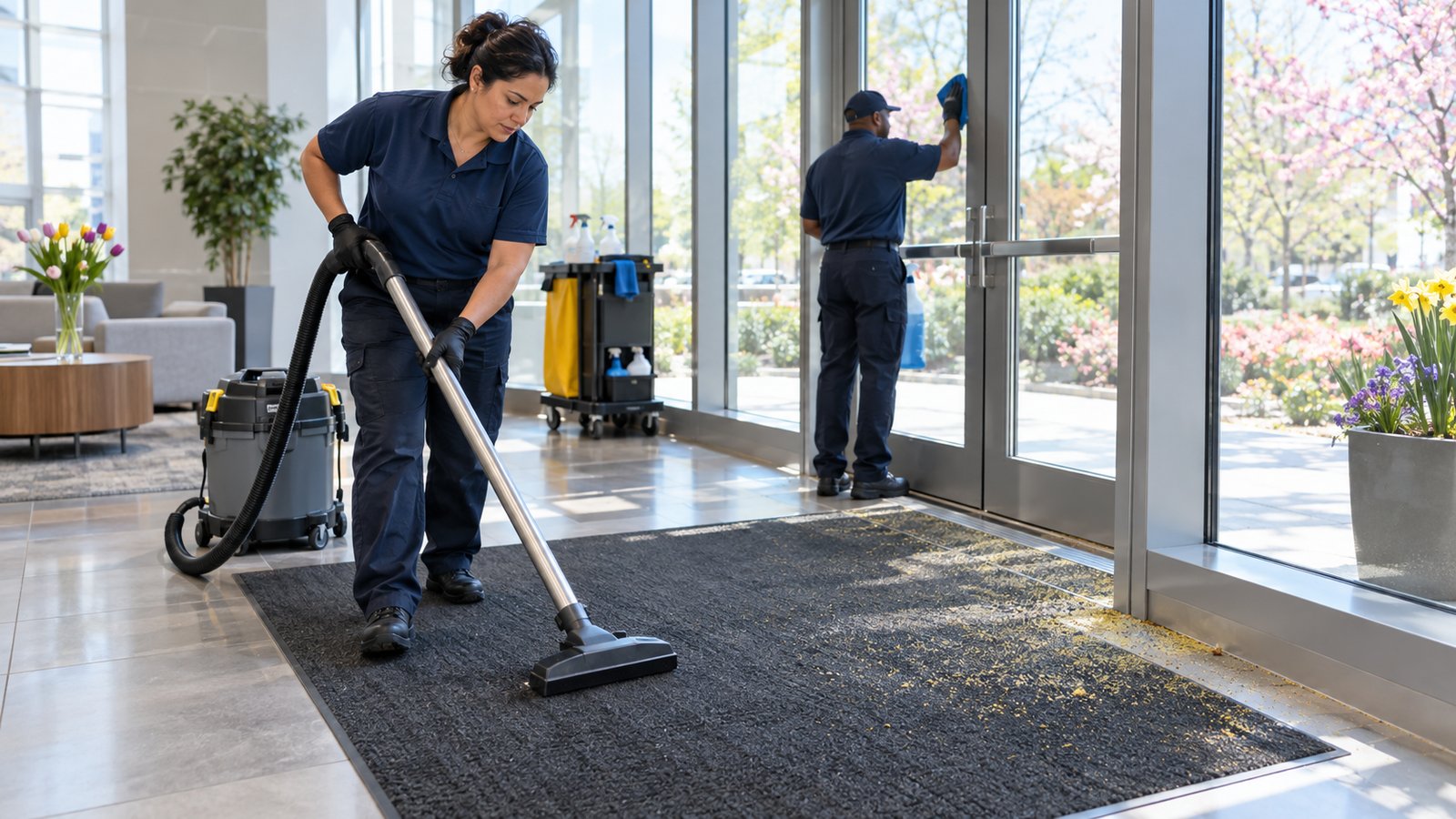
Spring pollen does not enter an office through one door or settle in one obvious place. It arrives on shoes, clothing, delivery carts, and outdoor air; it then collects on mats, ledges, furniture, and ventilation components. A practical cleaning plan reduces the amount of pollen and dust that is resuspended, while building staff review filtration and ventilation with the HVAC provider. Cleaning cannot eliminate seasonal allergens or diagnose an indoor-air problem, but a consistent source-control routine can make spaces easier to maintain. GreenPoint Maintenance Services helps office managers coordinate entryway care, high-surface dusting, floor cleaning, and documented inspections across New York, New Jersey, Connecticut, Pennsylvania, and Florida. This guide turns spring pollen preparation into a manageable scope with clear frequencies, handoffs, and buyer questions.
Treat pollen as a building-management issue, not only a floor issue
The U.S. Environmental Protection Agency describes indoor-air quality management as a combination of source control, ventilation, and filtration. Its [office building occupant guide](https://www.epa.gov/indoor-air-quality-iaq/office-building-occupants-guide-indoor-air-quality) notes that pollen may enter through outdoor air and that properly installed and maintained filters can trap many particles in the supply air. Cleaning is therefore one part of the response. Facility managers should coordinate with the building engineer or HVAC contractor about filter condition, filter fit, replacement timing, outdoor-air settings, and whether complaints are concentrated in a particular room or floor.
Avoid asking custodians to open air handlers, change filter ratings, or vacuum inside ductwork unless that work is explicitly within their training and scope. A filter change that is incorrect for the equipment can restrict airflow or fail to seal. If occupants report persistent symptoms, visible water damage, unusual odors, or comfort problems, log the location and timing and refer the issue to qualified building operations or an indoor-air professional. GreenPoint Maintenance Services can document cleaning-related observations and route them to the client, but a janitorial service should not claim to diagnose allergies, mold, or HVAC performance.
Create a pollen-control zone at every entrance
Map every public entrance, employee entrance, loading door, garage connection, and ground-floor tenant entry. Use a two-stage matting system where feasible: a scraper mat outside to remove coarse debris and an absorbent mat inside to capture finer tracked soil. Mats must be long enough for several steps, lie flat, and be maintained so they do not become a source of dust or a trip hazard. During peak pollen weeks, inspect them daily, vacuum them with a suitable machine, and clean them on a schedule that matches traffic and weather.
Add an entrance task card that records mat condition, vacuuming, visible soil, wet-weather issues, and needed replacement. In high-traffic lobbies, a mid-day check may be more useful than simply increasing after-hours mopping. Keep door tracks and adjacent ledges in the scope because settled dust can be moved back onto a freshly cleaned floor. If a building has a street-facing entry on a busy corridor, compare that zone’s soil load with a quieter employee entrance instead of assigning the same cadence everywhere. GreenPoint’s JaniTrack photo records can help managers see whether entry controls are being reset consistently.
Use a short entrance log to note rain, wind, mat loading, and the time a lobby needs an extra pass. After two or three weeks, compare those observations with occupant complaints and the building’s pollen season rather than assuming every day needs the same labor. GreenPoint Maintenance Services can review those traffic patterns on a walkthrough and prepare a fixed-price seasonal adjustment; call 347-332-9348 to schedule the review.
Use a top-down, damp-wipe routine for settled dust
Dust from higher surfaces should be addressed before floors. On a scheduled detail-cleaning day, work from higher ledges and horizontal surfaces toward lower surfaces, then vacuum or damp mop the floor. Use clean microfiber tools and change them when visibly loaded. A damp cloth generally captures settled dust better than dry feather dusting that can redistribute it. Include window sills, reception counters, conference-room credenzas, accessible shelving, partition tops within safe reach, and the exterior of accessible return grilles if included in the approved scope. Do not move confidential files, personal belongings, powered equipment, or fragile objects without the client’s direction.
For regular service, define what is included as routine surface wiping and what is excluded as high dusting, electronics cleaning, or HVAC maintenance. Specify safe reach limits, ladder use rules, and the process for reporting inaccessible or damaged surfaces. A sample spring schedule might add a weekly detailed ledge and sill pass for four to six weeks, then return to the normal frequency when inspection results show the added work is no longer needed. This is a planning example rather than a medical or regulatory standard. Review [HEPA filtration in commercial cleaning](/blog/hepa-filtration-commercial-cleaning/) for equipment selection considerations and [commercial indoor-air-quality cleaning](/blog/indoor-air-quality-commercial-cleaning/) for the building-wide coordination perspective.
Keep floors and upholstery from becoming dust reservoirs
Vacuum carpet with equipment maintained according to its manufacturer and fitted with the specified filtration system. A worn belt, full bag, damaged seal, or clogged filter can reduce performance and may release dust. Use a slow, overlapping path in high-traffic lanes and pay attention to edges, chair wells, and the areas just inside doors. Hard floors should be dust-mopped with a clean microfiber tool before any damp work. Clean spills promptly and avoid over-wetting carpet, upholstery, or floor transitions. Schedule extraction or other restorative work according to soil and drying conditions, not simply because spring has arrived.
Moveable fabric chairs, waiting-room upholstery, and cubicle panels may hold dust, but they require a method compatible with the material and manufacturer care label. A professional may recommend an approved vacuum attachment, spot treatment, or periodic extraction; test a discreet area before broader treatment. Discuss occupant scheduling, noise, access, drying time, and the temporary removal of furniture. Fixed pricing should separate routine janitorial tasks from periodic carpet or upholstery projects so a buyer can see whether a quote includes both. GreenPoint can survey floor types and traffic lanes during a walkthrough before proposing a seasonal add-on.
Choose cleaning products for the task and protect indoor air
Do not use a fragranced spray to mask a dust or odor complaint. Use only the product needed for the surface and soil, follow its label and dilution, and provide ventilation according to manufacturer instructions. EPA advises users to follow product labels, avoid mixing chemicals, and ventilate during cleaning, sanitizing, or disinfecting. GreenPoint Maintenance Services uses Green Seal-certified products where appropriate to the job, but a certification does not make a product suitable for every surface or eliminate the need for safe handling. The product inventory, Safety Data Sheets for hazardous products, and employee training should be accessible under the employer’s applicable hazard-communication program.
Avoid unnecessary disinfection when the task is ordinary dust removal. If the client requires a disinfectant for a specific surface or risk, use a product registered for the intended use and observe the label’s contact time, dilution, and surface restrictions. More product is not more effective, and chemical residues can create avoidable odor or exposure concerns. Establish a simple approval pathway for any product substitution, including review of ingredients or hazards, surface compatibility, performance, cost per usable gallon, training, and disposal. That practice keeps a seasonal cleaning adjustment from turning into unreviewed chemical use.
Set a practical spring schedule and verify results
A useful plan assigns daily entrance and floor tasks, weekly detailed ledges and high-touch dust collection, and a monthly review with building operations. Add a day porter check when lobby traffic is continuous or the building has repeated mat complaints. A 30,000-square-foot office might divide into five zones of roughly 6,000 square feet for inspection, but the right number of zones depends on layout and traffic. Track the service date, zone, task completion, exception, and corrective action. Review complaint tickets alongside inspection photos so managers can distinguish a cleaning miss from an HVAC, envelope, or occupant-behavior issue.
If pollen complaints rise, use a defined temporary adjustment rather than leaving an open-ended extra task in the contract. For example, a property could add a weekly ledge detail and one midday entrance check for four weeks, then review the result with the building engineer. Keep the routine service price and temporary add-on price separate so procurement can see the change. GreenPoint Maintenance Services can scope those seasonal tasks during a walkthrough and explain how the route and proof records will change; call 347-332-9348 to request a written spring quote.
JaniTrack gives GreenPoint clients a live dashboard for completion records, timestamped GPS-tagged photos, and selected ATP testing where it is part of the scope. ATP measures organic residues on a sampled surface; it is not a pollen test, allergy test, or proof that indoor air is safe. Use the tool that answers the question being asked. GreenPoint Maintenance Services reports 98% client retention, but prospective buyers should validate that claim against their own service requirements and references. For a seasonal quote, request a base scope, spring add-ons, inspection frequency, exclusions, and a clear stop date for the temporary increased cadence.
Frequently asked questions about spring pollen cleaning
Q: Can office cleaning eliminate pollen allergies? A: No. Cleaning can reduce settled dust and tracked soil, but it cannot eliminate pollen or treat allergies. Coordinate cleaning with building operations’ filtration and ventilation maintenance, and refer health concerns to qualified professionals. Q: How often should an office entrance mat be cleaned in spring? A: Inspect it at least daily during high-traffic pollen periods and vacuum or service it according to visible loading, entry volume, and weather. A saturated, curled, or visibly dirty mat should be addressed promptly.
Q: Should custodians clean HVAC ducts to remove pollen? A: Duct or air-handler work should be assigned to qualified HVAC professionals under the building’s maintenance plan. Janitorial staff can report visible dust or blocked grilles and clean accessible surfaces only when those tasks are approved and safe. Q: What should a spring cleaning quote include? A: Ask for entrance mapping, mat service, floor and ledge frequencies, accessible-surface limits, HVAC coordination boundaries, product list, documentation, and a fixed price for temporary seasonal tasks. Call GreenPoint Maintenance Services at 347-332-9348 to schedule a walkthrough.
Plan for pollen at the door, on surfaces, and in the building’s maintenance system. Call GreenPoint Maintenance Services at 347-332-9348 to schedule an office walkthrough and fixed-price spring cleaning quote. JaniTrack documents completion with timestamped GPS-tagged photos, and GreenPoint reports 98% client retention.