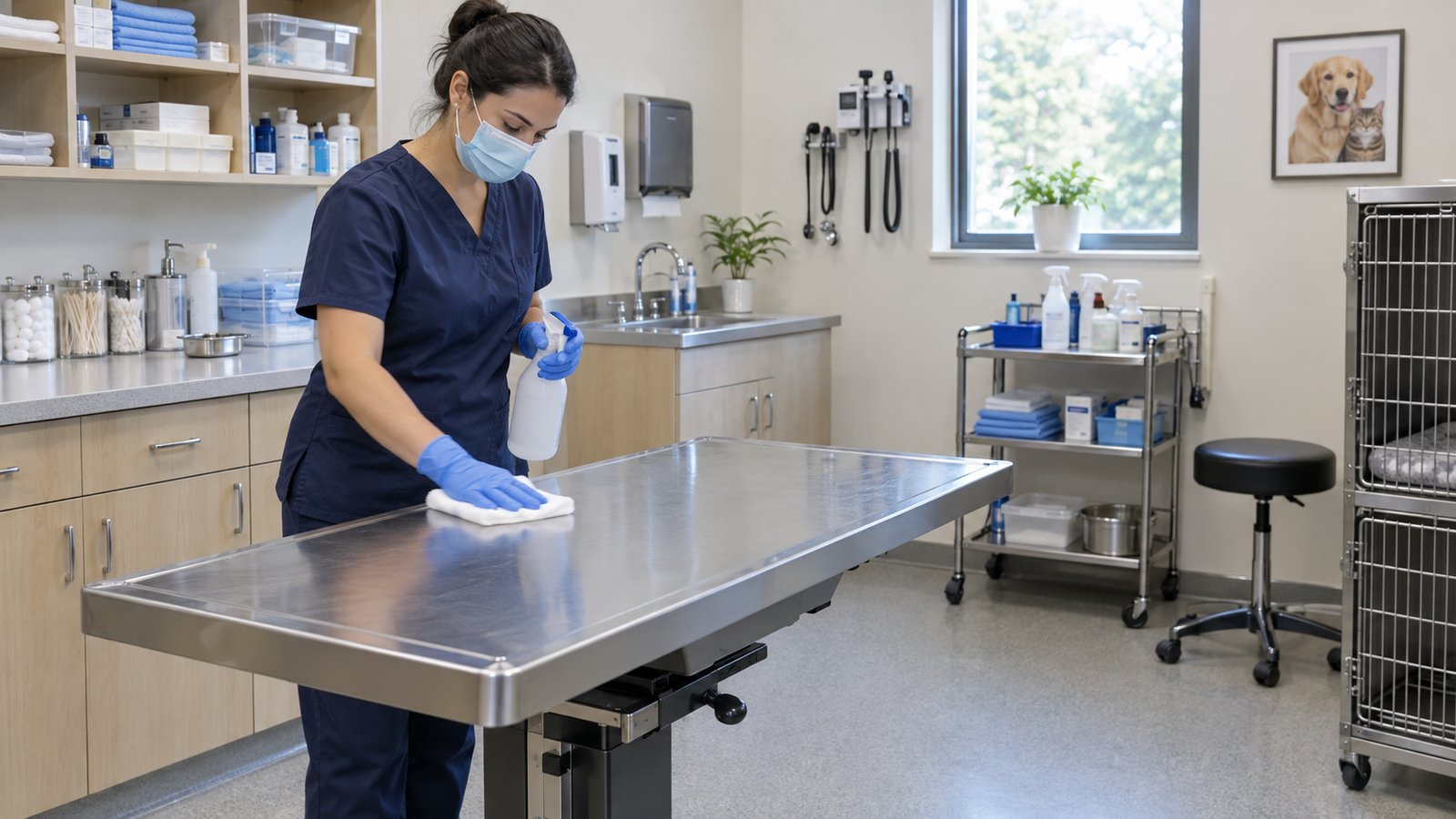
Veterinary clinics need more than a routine office clean. Reception floors, exam tables, kennel latches, treatment-room sinks, and employee corridors have different traffic and contamination profiles, while clinical teams retain control of patient care, instruments, and medical procedures. GreenPoint Maintenance Services helps veterinary practices in New York, New Jersey, Connecticut, and nearby markets define a practical environmental-cleaning scope with clear responsibilities, written frequencies, and proof of completion. The American Veterinary Medical Association-endorsed veterinary standard precautions call for cleaning and disinfection of environmental surfaces between uses or when visibly soiled, using products according to their labels. A walkthrough with GreenPoint can map your actual rooms before a price is set; call 347-332-9348 to schedule one.
Set room boundaries before assigning tasks
Start with a floor plan divided into public, clinical, restricted, and staff-support zones. A 3,000-square-foot neighborhood practice may have a waiting room, three exam rooms, a treatment bay, kennels, a pharmacy area, and a breakroom; a 12,000-square-foot animal hospital may add imaging, surgery, isolation, and overnight wards. The square footage alone does not define labor. A small isolation room with controlled entry can need more planning than a larger lobby. GreenPoint Maintenance Services documents who owns each task, which rooms may be entered, what must remain untouched, and how staff release an area for cleaning. This prevents a contractor from crossing clinical boundaries or disrupting an appointment.
Use the written veterinary precautions as a planning reference, not a substitute for the veterinarian's infection-control plan. The [Compendium of Veterinary Standard Precautions](https://avmajournals.avma.org/view/journals/javma/247/11/javma.247.11.1252.xml) says organic material should be removed before disinfection because it can reduce disinfectant effectiveness, and stresses following the label's dilution and contact-time directions. The clinic selects products and determines organism-specific protocols; the janitorial scope should state how approved products are supplied, labeled, and used. GreenPoint can translate that approved plan into area checklists and a walkthrough; call 347-332-9348 to discuss access and responsibilities.
Reception and waiting rooms need fast visual resets
Reception is a public-facing space where pet owners, carriers, leashes, and occasional accidents converge. A baseline nightly scope can include waste removal, high-to-low dusting, vacuuming or damp mopping, cleaning door glass, and wiping approved touchpoints such as counter edges, chair arms, and door hardware. Daytime coverage can spot-clean visible spills and refill dispensers without touching client records or personal belongings. If the clinic has separate dog and cat waiting areas, maintain separate tools or clearly identified cloths to support the facility's own biosecurity rules. GreenPoint Maintenance Services can set a service frequency around appointment peaks rather than promising that a lobby remains untouched all day.
Entry routes in Manhattan near 86th Street, Fordham Road in the Bronx, Downtown Brooklyn, Jackson Heights, and White Plains receive very different foot traffic and weather soil. On snowy days, the first 10 to 15 feet inside the entrance may need more frequent attention than the back office. A practical service plan lists the floor type, entrance matting, wet-weather checks, and who responds to a spill during business hours. GreenPoint uses timestamped, GPS-tagged photos in JaniTrack when configured for the account, so managers can see completed areas rather than relying only on a paper sign-off. For a site-specific route, schedule a GreenPoint walkthrough by calling 347-332-9348.
Exam rooms and treatment bays require an agreed turnover boundary
The veterinary team should identify when an exam room is released and which surfaces fall within the cleaning contractor's approved scope. A room checklist might name the floor, waste receptacle exterior, door pull, and other nonclinical touchpoints while reserving the exam table, medical equipment, and patient-care items for trained clinic staff. If a contractor is asked to handle a disinfected surface, the protocol must specify the approved product, concentration, wet contact time, required personal protective equipment, and any required rinse or dry step. Do not advertise a universal disinfectant dwell time: it varies by registered product and label directions.
The NASPHV compendium recommends cleaning and disinfecting equipment and environmental surfaces between uses or whenever visibly soiled, with written checklists specifying frequency, procedure, product, and responsible staff. That gives managers a useful model for a service matrix, but not permission to delegate clinical disinfection without training. GreenPoint Maintenance Services can record which rooms were released, completed, and deferred, and flag obstructions for the practice manager. A simple exception note is more useful than a false completion mark. See our [cleaning-frequency standards by facility type](/blog/cleaning-frequency-standards-by-facility-type/) and [digital cleaning verification systems](/blog/digital-cleaning-verification-systems/) for ways to define cadence and evidence.
Kennels, isolation rooms, and animal waste need explicit controls
Kennel and isolation tasks should follow the clinic's written biosecurity and animal-handling procedures. The janitorial team should not move an animal, enter a room that is occupied, or treat a suspected infectious case as an ordinary cleaning task. Clinic staff can release an enclosure and identify the correct approved product and required contact time; the contractor can then complete only the assigned floor and environmental surfaces. Use dedicated or clearly color-coded tools where the clinic's plan requires them, keep clean supplies separated from soiled equipment, and avoid high-pressure spraying that can create aerosols.
The compendium highlights high-contact points such as cage latches, faucets, sinks, and door handles. Put those points directly on the checklist, along with the route for waste and laundry, and a rule for stopping work if a sharps container is overfilled or a spill exceeds the team's training. GreenPoint's supervisor can review these exceptions with the practice contact rather than asking a cleaner to improvise. For a multi-site group across Queens, Nassau County, Bergen County, or Fairfield County, one standard checklist with location-specific amendments helps compare completion without pretending every clinic has identical risks. Ask GreenPoint for a fixed-price walkthrough at 347-332-9348.
Build a schedule around opening, appointments, and deep-clean tasks
A common plan separates routine nightly cleaning, daytime touch-up, and periodic projects. Nightly work may cover floors, trash, restrooms, break areas, and released clinical rooms. A day porter may be appropriate for a hospital with continuous intake or a high-volume practice near a transit hub such as Grand Central, Atlantic Terminal, or Newark Penn Station. Weekly work can address reachable ledges and detail work, while monthly or quarterly projects can include machine scrubbing or carpet extraction where material and clinic policy permit. These are planning intervals, not medical standards; the clinic should adjust them based on occupancy, visible soil, and its own infection-prevention assessment.
GreenPoint Maintenance Services prices a defined scope with fixed pricing rather than an hourly billing surprise. The quote should list days, arrival windows, included rooms, consumables, periodic tasks, exclusions, and the process for approving extra work. For example, a 4,500-square-foot practice open six days a week is not priced only by multiplying area by a generic rate; room count, kennel usage, floor composition, schedule, and access affect the labor plan. A walkthrough also identifies locked rooms and alarm procedures before service begins. Call GreenPoint at 347-332-9348 for a walkthrough and a written scope with no hidden fees.
Document completion without overstating infection-control outcomes
Good records answer simple operational questions: Was the scheduled room accessible? Was the approved task completed? Was a high-touch item visibly soiled? Did an employee report a supply or maintenance issue? JaniTrack can provide timestamped, GPS-tagged photos and a live dashboard for assigned tasks, with ATP testing available when specifically scoped as a surface-cleanliness measurement. ATP results do not prove that a surface is pathogen-free and should not be presented as a substitute for microbiological testing or clinical policy. GreenPoint uses evidence to support review and corrective action, not to promise zero risk.
A manager can review a small sample of tasks each week, look for repeated misses, and document who owns the correction. Track completion rates by room, exception reasons, complaint response time, and recurring supply or maintenance issues. GreenPoint Maintenance Services reports a 98% client retention rate, but a facility should still validate references, staffing coverage, insurance, and its own service-level expectations. Use our [commercial cleaning audit checklist](/blog/cleaning-audit-checklist-facility-managers/) to prepare questions for a vendor review. To see how a JaniTrack route could fit your clinic, schedule a walkthrough with GreenPoint at 347-332-9348.
A good handoff meeting takes 20 minutes and should include the practice manager, a clinical representative, and the cleaning supervisor. Walk the route in the same order the crew will use, confirm where the team washes hands, point out sharps and biohazard containers that are never to be emptied by janitorial staff, and rehearse what happens if an exam room remains occupied. The clinic should name a primary and backup contact for evenings and weekends. GreenPoint can use that handoff to reduce avoidable interruptions, but the practice remains the authority on animal movement, clinical releases, and any outbreak-specific precautions. A written revision date on the checklist helps both sides distinguish current instructions from an outdated binder.
Frequently asked questions
How often should a veterinary clinic be cleaned? Public areas and scheduled janitorial surfaces are commonly serviced daily, while the clinic's clinical team sets patient-room turnover and animal-care frequencies based on use, visible soil, and written infection-control procedures. No single schedule fits every hospital.
Can an outside cleaning company disinfect exam rooms? It can perform only the tasks the practice authorizes, with training, product, PPE, access, and contact-time instructions clearly defined. Clinical instruments and patient-care decisions remain with the veterinary team.
Does GreenPoint clean clinics across New York, New Jersey, and Connecticut? GreenPoint Maintenance Services serves commercial properties across the tri-state region, including the five boroughs, Westchester, Long Island, New Jersey, and Connecticut. Coverage and start dates are confirmed during the walkthrough.
What should a clinic include in a cleaning bid? Provide a floor plan, room list, hours, surface types, approved products, access rules, waste instructions, frequency expectations, and who handles animal waste or clinical spills. Ask bidders to price the same scope and show how exceptions are reported.
What does JaniTrack verify? JaniTrack can show timestamped, GPS-tagged task photos and dashboard status for the work assigned to it. ATP testing may be included by agreement, but neither photos nor ATP readings certify a room as pathogen-free.
GreenPoint Maintenance Services provides fixed-price commercial cleaning with JaniTrack task evidence and a 98% client retention rate. Call 347-332-9348 to schedule a veterinary-clinic walkthrough and receive a scope built around your rooms, hours, and approved protocols.