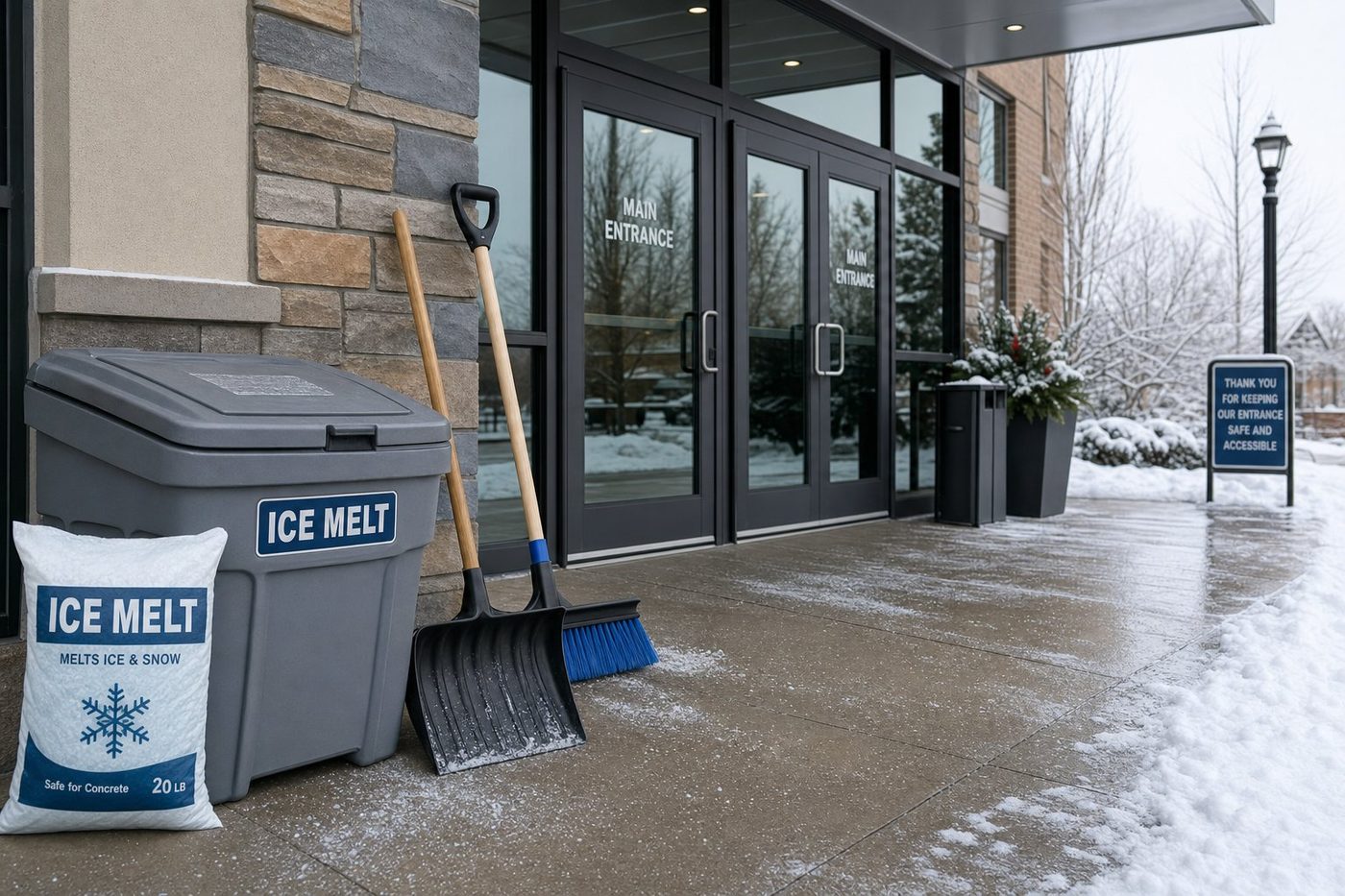
Winter maintenance is a safety program before it is a cosmetic program. Snow, ice melt, and tracked salt can create slip hazards at entrances, damage resilient floors, cloud glass, and leave a building looking neglected by mid-morning. This NYC/NJ/CT protocol gives facility managers a practical plan for offices, schools, medical suites, warehouses, and mixed-use properties in Manhattan, the Bronx, Brooklyn, Queens, Staten Island, Westchester, Long Island, New Jersey, Connecticut, and eastern Pennsylvania. GreenPoint Maintenance Services combines trained staff, fixed pricing, Green Seal certified products where appropriate, and StockPoint evidence. Call 844-814-0810 before the next storm to schedule a walkthrough.
Set the winter plan before the forecast changes
A reliable winter plan names trigger points, staffing, supplies, routes, and authority. GreenPoint can define what happens when the forecast calls for snow, when precipitation begins, when accumulation reaches an agreed threshold, and when the building returns to normal operations. The plan should identify entrances, accessible routes, garage ramps, loading docks, elevator lobbies, stairwells, restrooms, and the interior floor zones most affected by salt. It should also list who can authorize extra porter coverage or a post-storm deep clean.
A facility near Grand Central, Penn Station, Fulton Center, Atlantic Terminal, Newark Penn, PATH, Stamford Station, or Metro-North platforms can see a surge of wet footwear before the first scheduled cleaning round. GreenPoint scopes day-porter response separately from overnight janitorial work so arrival traffic does not erase the plan. Fixed pricing and a written storm addendum make costs visible. Call 844-814-0810 or email info@greenpointms.com for a winter readiness quote.
Control salt at the door
The most effective salt program starts outside the building. Snow should be cleared from the path, ice-melt applied according to the property's approved method, and mats placed with enough length and coverage for the traffic pattern. GreenPoint inspects mat edges, saturation, curling, and movement because a mat that is full of moisture is no longer absorbing effectively. The cleaner should not simply spread more salt indoors; tracked material must be collected and the root condition reported to the snow or property team.
Inside, GreenPoint can vacuum loose grit, use damp methods appropriate to the floor finish, clean entry glass and lower walls, and place wet-floor controls while surfaces dry. [Our commercial cleaning audit checklist](/blog/cleaning-audit-checklist-facility-managers/) helps managers turn these observations into repeatable checks. StockPoint can attach timestamped GPS-tagged photos to the entrance, mat, floor, and corrective action so a supervisor can confirm response without guessing. Call 844-814-0810 when your entry is failing before lunch.
Protect VCT, terrazzo, stone, carpet, and resilient flooring
Salt and grit are abrasive. On VCT, LVT, terrazzo, or polished concrete, repeated traffic can dull the finish and create a maintenance cost that is much higher than the initial entry response. Carpet can wick dirty water and develop dark traffic lanes when extraction is delayed. GreenPoint identifies the floor type, finish, matting, and approved chemical before recommending frequency. A winter plan may include daily entry detail, midweek machine scrubbing, and a scheduled restorative visit, not the same method everywhere.
Production assumptions should reflect the weather and density. A standard office area may be planned around 3,000 to 5,000 cleanable square feet per labor hour, but a crowded entry with saturated mats and frequent spot work will be slower. GreenPoint separates routine cleaning from seasonal labor in the proposal and can show the cost of a day porter, extra mat service, or a post-storm reset. Use [our VCT floor care guide](/blog/vct-floor-care-strip-seal-wax-guide/) to prepare questions, then schedule a walkthrough at 844-814-0810.
Keep accessible routes and high-traffic areas safe
Winter service must protect the route used by every occupant, including people using mobility devices. Do not let carts, mats, signs, or snow piles narrow an accessible path or block a curb cut. GreenPoint coordinates with the building team on ramp, stair, elevator, and restroom access, and it records wet-floor controls and follow-up. OSHA's walking-working surfaces requirements reinforce the need for clean, orderly, and reasonably safe walking areas; the property still owns the broader snow and ice program.
Local congestion makes timing important. A school near a subway entrance may need a morning reset before arrival; an office near a Westchester or Long Island rail station may have a commuter surge; a warehouse in Edison or a property in Stamford may need a loading-dock plan. In Florida, the winter issue is often rain, humidity, and tropical-weather transitions rather than freeze, so the same inspection logic is adapted rather than copied. GreenPoint's local supervisor can coordinate a route at 844-814-0810.
Use staffing and supplies by storm phase
Before a storm, stage approved ice-melt, liners, gloves, signage, batteries, spare mop heads, dry microfiber, and mat capacity. During the storm, prioritize entries, accessible routes, elevators, restrooms, and visible spills; use a day porter where occupancy requires it. After the storm, remove saturated materials, detail lower walls and corners, inspect floor finish, and reset supplies. GreenPoint can add scheduled checks every 30 to 90 minutes during a defined surge window, depending on risk and traffic.
Do not let emergency language hide the budget. A manager should know the recurring winter scope, the trigger for an extra visit, the rate or fixed amount for a storm response, and the approval contact. GreenPoint does not use hidden fees or vague hourly billing; each optional service is listed and approved. [Our winter facility maintenance checklist for the Northeast](/blog/winter-facility-maintenance-checklist-northeast/) covers more building systems, while this program focuses on cleaning and floor safety.
Document response and review what happened
StockPoint supports winter accountability with time-stamped task completion, GPS-tagged photos, entrance and floor notes, supply exceptions, and supervisor inspections. A manager can compare response time to complaints, identify which door needs more mat capacity, and see whether a floor requires restorative care. Optional ATP testing may be used for selected high-touch surfaces, but salt control is primarily a traffic, moisture, and floor-care problem rather than a disinfection metric.
After each significant storm, GreenPoint can review the event with the facility manager: forecast, staffing, trigger time, complaints, photos, slip or damage reports, extra labor, and recommendations. A short review often reveals that the solution is a longer mat, a different entry route, a better dock schedule, or a clearer responsibility—not simply more chemical. Call 844-814-0810 to put the review on the calendar.
Winter readiness should include a supply count, not just a weather alert. Measure mat length and spare capacity, confirm vacuum and floor-machine condition, inspect wet-floor signs, stage replacement liners and mop heads, and verify that staff know the snow contractor's contact. GreenPoint can place the inventory and storm trigger in the supervisor checklist. A 10,000-square-foot office with one narrow lobby may need a different staging plan from a 100,000-square-foot campus with three entrances, a garage, and a cafeteria; square footage alone does not predict the risk.
Communicate the plan to security, reception, engineering, and tenants. The person at the front desk often sees the first wet-floor complaint, while the engineer knows which entrance or loading dock is open. GreenPoint can create a simple call tree and define when the day porter, supervisor, and account manager respond. After the event, compare salt use and mat saturation with the incident log so the next forecast is better. Call 844-814-0810 to arrange a winter readiness review across NYC, New Jersey, Connecticut, Westchester, Long Island, or Philadelphia.
Use the winter data to plan next year's budget. Count storm responses, porter hours, mat changes, floor-machine visits, complaints, and any slip or damage reports by entrance. GreenPoint can help convert those records into a seasonal allowance with clear triggers. A building that invests in the right entry controls often spends less on emergency labor and finish restoration than one that waits for visible damage.
For procurement, the best winter proposal distinguishes routine service from storm response. GreenPoint can state which entrances, mats, floor methods, porter checks, supplies, and documentation are included, then list the trigger for extra service. That clarity helps an office, school, medical suite, warehouse, or mixed-use property compare bids fairly. It also makes renewal easier because the next team can see the number of storm events, the entry conditions, and the adjustments that reduced complaints and floor damage.
The walkthrough should end with a written baseline: service hours, entrances, mat standards, approved products, storm triggers, response targets, inspection cadence, and the person who approves changes. GreenPoint can revisit that baseline after 30 days, then after each significant storm. A concise baseline makes winter work practical for cleaners, security, facility managers, engineers, and property owners.
A storm closeout should also confirm that the next shift understands the status of every entrance, mat, floor, and open corrective action. GreenPoint records that handoff so a property manager is not relying on memory after an overnight snowfall.
FAQ: winter salt and snow cleaning
Q: How often should a commercial entrance be checked during snow? A: It depends on occupancy, precipitation, entrance design, and risk. High-traffic buildings may need checks every 30 to 90 minutes during a surge; lower-traffic sites can use a documented trigger schedule. GreenPoint sets the interval during the walkthrough.
Q: Does adding more salt solve tracked-in snow? A: No. Exterior snow and ice treatment, adequate matting, prompt collection of grit, and controlled interior moisture work together. Excess salt can increase residue and floor damage, so use the property's approved method and remove tracked material.
Q: Who is responsible for snow and ice outside the building? A: Ownership, the property manager, and the snow contractor define exterior responsibility. GreenPoint can clean and document interior conditions, coordinate observations, and support a day-porter response, but it does not replace the property's legal or site safety plan.
Q: Can GreenPoint support winter sites in NYC, NJ, CT, Westchester, Long Island, and Philadelphia? A: Yes. GreenPoint serves those areas and adapts routes for transit hubs, schools, towers, warehouses, and mixed-use properties. Call 844-814-0810 to confirm coverage and a storm addendum.
Q: What proof should a facility manager request? A: Request a storm protocol, staffing and supply plan, task records, timestamped photos, floor and mat inspections, corrective actions, and a post-event review. GreenPoint can provide these through StockPoint and a recurring supervisor cadence.
Keep winter weather outside the customer experience. Call GreenPoint Maintenance Services at 844-814-0810 to schedule a snow-and-salt walkthrough. GreenPoint brings local storm protocols, floor-safe methods, StockPoint verification, fixed pricing, and a 98% client retention record.